

Every number you need before buying: cost per square foot, total project cost, ongoing maintenance, and the real 10-year math for Texas homeowners and property managers.
What Artificial Turf Lawn Cost Looks Like in 2026
Texas homeowners replacing natural grass with artificial turf face costs that range from $3,500 for a small side yard to over $30,000 for a large backyard on clay soil. The wide range is not random. It comes from five variables: lawn size, soil conditions, turf grade, infill type, and whether you hire a professional or go DIY.
The national average cost for artificial turf lawns runs $5 to $20 per square foot installed. Texas sits in the $7 to $12 range for most residential projects. That gap from low to high comes down mostly to base preparation and turf system quality, both of which matter more in Texas than in most states because of clay soil, extreme summer heat, and heavy rain events.
Artificial Turf Lawn Cost per Square Foot by System Grade
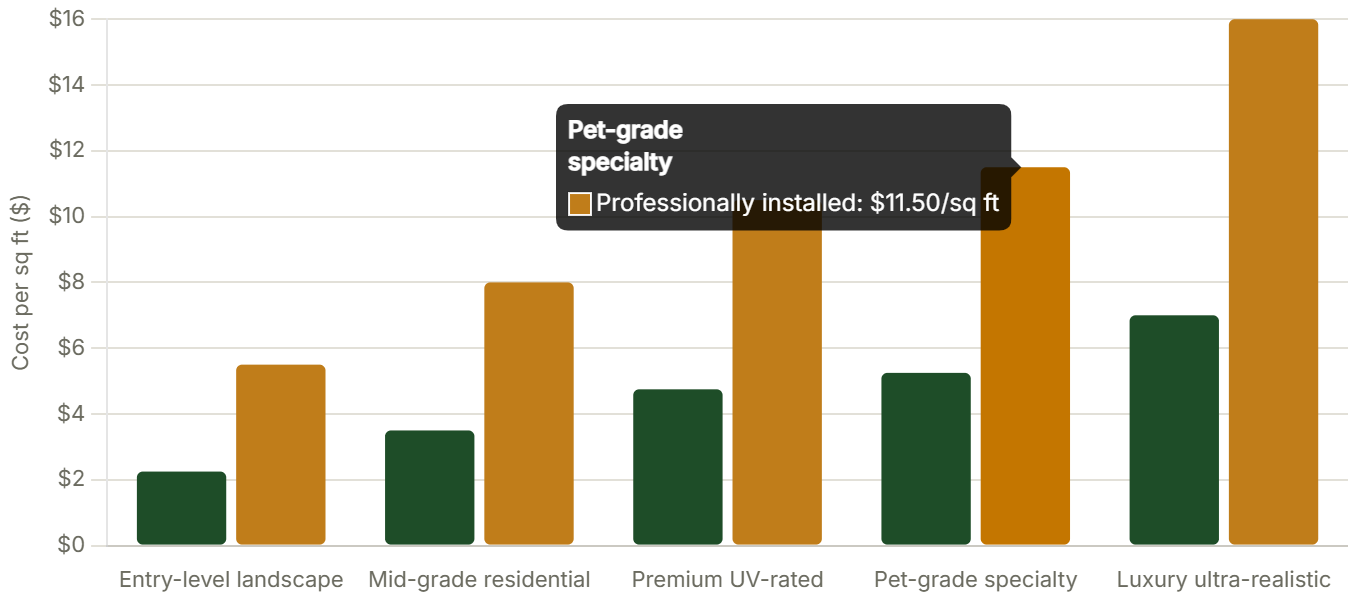
The chart above separates what you pay for turf material versus what you pay total once a contractor finishes the job. The labor and base prep gap is significant because proper sub-base work requires excavation, grading, and compacted aggregate, none of which scales down much regardless of turf quality.
Full Cost Breakdown: Every Line Item
When contractors quote an artificial turf lawn project, the single number they give you covers multiple line items. Understanding each one gives you negotiating leverage and prevents surprise add-ons at the end of the job.
| Line Item | Notes | Cost Range |
|---|---|---|
| Turf carpet (material) | Fiber type, pile height, stitch rate. Landscape grade vs. sports grade. | $2.00 - $5.50 / sq ft |
| Sod removal | Existing grass + root zone removal, haul-away. Required for most lawns. | $1.00 - $2.50 / sq ft |
| Excavation / grading | Level sub-grade to positive drainage slope. Clay soil adds cost. | $0.50 - $1.50 / sq ft |
| Crushed aggregate base | 2-4 inch compacted DG or crushed granite. Essential for drainage. | $0.75 - $1.50 / sq ft |
| Weed barrier membrane | Geotextile fabric placed over base. Prevents root penetration for 15+ years. | $0.15 - $0.40 / sq ft |
| Infill (crumb rubber) | Standard recycled rubber. 2-3 lbs per sq ft residential. | $0.40 - $0.85 / sq ft |
| Infill (silica sand) | Cooler and firmer surface feel. Often blended with rubber. | $0.30 - $0.65 / sq ft |
| Infill (organic / cork) | Coolest surface in Texas heat. Coconut, cork, or zeolite blends. | $1.20 - $2.80 / sq ft |
| Labor (install + seaming) | Unrolling, seaming, stretching, securing edges and perimeter. | $1.00 - $2.00 / sq ft |
| Edging / bender board | Bender board, nails, or concrete mow strip around perimeter. | $3.00 - $8.00 / linear ft |
Total Artificial Turf Lawn Cost by Project Size (Installed)
Factors That Change Your Turf Lawn Cost
Turf Fiber Technology
Not all turf looks or feels the same. Monofilament fibers are individual strands that stand upright and look more like real grass blades. Slit-film fibers are flat ribbons cut from a sheet, cheaper to produce, and more durable for high-traffic areas.
Textured blends combine both for a natural appearance with better performance. Pile height ranges from 1 inch for pet areas to 2.5 inches for lush front lawns. Longer piles at higher stitch rates costs more per square foot but delivers a better visual result at ground level.
Infill Material Choice
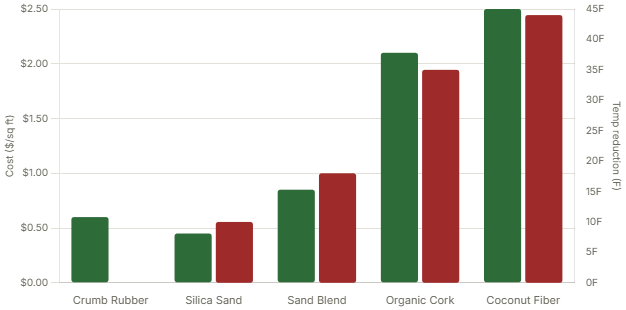
Infill is the material spread between the blades. It keeps fiber standing upright, provides cushion underfoot, and affects surface temperature. In Texas, infill choice matters more than most homeowners realize. Standard crumb rubber can reach 150 to 180 degrees Fahrenheit on a 95-degree summer day. Silica sand is cooler. Organic infills made from cork or coconut fiber reduce surface temperatures by 30 to 50 degrees at a higher upfront cost.
Infill System Cost vs. Surface Temperature Reduction (Texas Summer)
Soil Conditions Across Texas
Texas soil is one of the biggest variables in this cost equation. Sandy loam in the Texas Panhandle requires minimal base prep. Expansive black clay in the DFW Metroplex, San Antonio, and Austin areas absorbs water and heaves, which demands more aggressive base preparation, often lime stabilization at $0.25 to $0.75 per square foot on top of standard base costs. Getting this step wrong leads to drainage failure and turf rippling within a few years.
Drainage Requirements
Quality turf systems drain 30 to 45 inches of water per hour through the backing. But the water still has to go somewhere. On flat sites with clay soil, perforated drain pipe running to a catch basin adds $500 to $2,500 to a residential project. Ignoring this step causes standing water, odor problems in pet areas, and eventually backing degradation.
Lawn Shape and Access
Simple rectangular lawns cost less to install than complex shapes with curves, multiple levels, or obstacles like trees, raised planters, or pool decks. Complex cuts create more waste and take longer to seam. Curved edging requires more bender board. Narrow side yards with tight equipment access add labor cost.
Texas Tuff note: We work in every Texas soil zone. North Texas clay, Central Texas caliche, and Hill Country rock each require a different base approach. A local installer who knows your specific county’s soil profile prevents the most expensive mistakes in any turf project.
DIY Artificial Turf Lawn Cost vs. Hiring a Pro
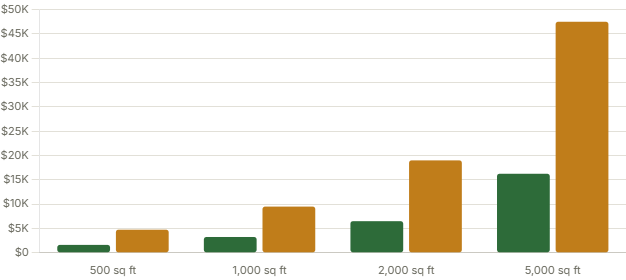
DIY turf installation is genuinely possible on small, simple, flat lawns with sandy soil. On any site that involves clay, slopes, drainage challenges, or complex shapes, professional installation prevents mistakes that are expensive to fix after the fact.
DIY Materials Only vs. Professional Install Cost by Lawn Size
| Factor | DIY Install | Professional Install |
|---|---|---|
| Material cost | Full price (no contractor discount) | 5-20% lower (contractor pricing) |
| Labor cost | $0 (your time) | $1.00 - $2.00 / sq ft |
| Tool rental | $150 - $400 (sod cutter, plate compactor) | Included |
| Base prep quality | Variable (common failure point) | Consistent, tested |
| Seam quality | Visible seams common | Near-invisible seams |
| Warranty | Material warranty only | Installation + material |
| Timeline | 2-4 weekends typical | 1-3 days typical |
When DIY makes sense: Areas under 400 square feet, flat sandy soil, no drainage requirements, pet-run strips, or decorative garden areas. For anything larger or more complex in Texas soil, the base prep savings from professional experience outweigh the labor cost within the first 3 years of ownership.
How Artificial Turf Lawn Installation Works
Most cost surprises happen because homeowners do not understand what goes into the ground before the turf is ever unrolled. Here is every step a proper installation requires.
01. Site Measurement and Soil Assessment
The contractor measures the area, accounts for waste factor (typically 10-15% for cuts and pattern matching), and evaluates soil type and existing drainage. Clay soil triggers a different base spec than sand.
02. Existing Lawn Removal
Sod cutter removes existing grass and the top 2-4 inches of root zone. Sod and soil are hauled away. This step typically runs $1.00 to $2.50 per square foot including disposal, and it is the one DIYers most often underestimate in both time and cost.
03. Sub-Grade Preparation
The exposed soil is graded to a positive cross-slope (1-2% recommended) so water moves away from structures. In Texas clay areas, lime may be tilled into the top 4-6 inches to stabilize the base and prevent heave. A plate compactor firms up the sub-grade before aggregate is added.
04. Drainage Layer and Aggregate Base
2 to 4 inches of crushed decomposed granite or crushed aggregate is spread and compacted in 1-2 inch lifts. In sites with drainage challenges, perforated pipe runs beneath the aggregate. This layer is what makes or breaks a turf installation long term.
05. Weed Barrier Placement
Geotextile weed barrier is laid across the compacted base and overlapped at seams. This prevents roots from pushing up through the turf backing over time, one of the leading causes of premature turf failure.
06. Turf Roll Placement and Seaming
Turf rolls (typically 15 feet wide) are laid out, allowed to relax, cut to shape, and seamed using adhesive and seaming tape or a sewing method. Seam placement is planned to follow turf grain direction and minimize visibility. Invisible seams are the mark of an experienced installer.
07. Perimeter Securing and Edge Trim
Turf is stretched, pulled to remove wrinkles, and nailed to the perimeter board or concrete mow strip at 6-inch intervals. Cut edges are sealed. Bender board is installed around curved edges.
08. Infill Spreading and Power Brooming
Infill is spread with a drop spreader in multiple passes at the rate specified for the turf system (typically 1.5 to 3 lbs per square foot for residential). A power broom then stands the fiber upright and works infill down to the correct depth. A final inspection checks for uniform fiber orientation and infill coverage.
Cost to Replace Lawn with Artificial Turf
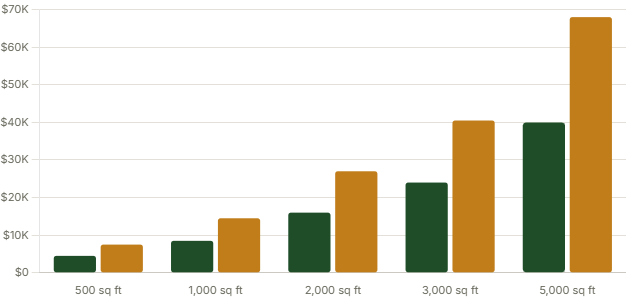
Replacing an existing natural grass lawn is slightly more expensive than starting from bare soil because the sod removal step adds cost. Homeowners planning the switch should budget for removal plus installation rather than installation alone.
Cost to Replace Lawn with Artificial Turf: Full Project by Size
What Adds Cost When Replacing Existing Grass
Sod removal runs $1.00 to $2.50 per square foot when done by a contractor. This covers the equipment, labor, and disposal. If the existing lawn has a thick root zone built up over many years, or if tree roots extend through the area, removal takes longer and costs more. Weed-choked lawns with deep bindweed or Bermuda root systems require extra attention before base work begins.
Texas Bermuda Grass Removal
Bermuda grass is the dominant lawn variety across Texas and one of the hardest to kill. Rhizomes and stolons regenerate from small root fragments left in the soil. A professional installer treating a Bermuda lawn typically applies a pre-emergent after removal and uses a thicker weed barrier to prevent re-growth pushing through the turf backing. This extra step costs $0.10 to $0.25 per square foot but saves far more in future problems.
Water bill savings in Texas: The average Texas household uses 30-40% of outdoor water on lawn irrigation. Replacing a 2,000 square foot Bermuda grass lawn with artificial turf saves an estimated 35,000 to 60,000 gallons per year. At current DFW, San Antonio, and Austin water rates, that translates to $400 to $900 per year in reduced water bills.
Natural Grass vs. Artificial Turf: Total Cost of Ownership
The upfront cost of artificial turf is higher. Over 10 years, most Texas homeowners find it cost-neutral or better when they account for water, lawn care services, fertilizer, and irrigation maintenance.
10-Year Cumulative Cost Comparison: Natural Grass vs. Artificial Turf (2,000 sq ft)
The crossover point where artificial turf becomes the lower cumulative-cost option depends on how aggressively you maintain natural grass and how much water costs in your Texas city. Dallas and San Antonio homeowners with higher water rates typically see crossover in years 5 to 7. Lower water cost areas in rural Texas push that crossover to years 7 to 9.
All Turf Lawn Care Costs After Installation
Artificial turf is low maintenance, not zero maintenance. The systems that last 20 years are the ones with consistent basic care. Knowing every turf lawn care cost item upfront prevents surprises and protects your investment.
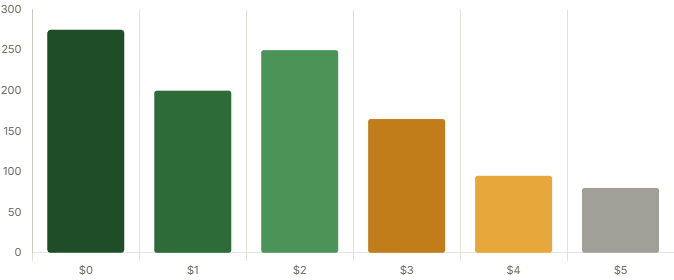
Annual Turf Lawn Care Cost by Task (Residential, 1,500 sq ft)
| Maintenance Task | Frequency | Annual Cost |
|---|---|---|
| Brushing / grooming fiber | Monthly | $150 - $400 |
| Leaf and debris removal | Weekly (fall/spring) | $100 - $300 |
| Pet waste cleanup | As needed | $100 - $400 |
| Enzyme odor treatment (pet areas) | Monthly in summer | $80 - $250 |
| Infill top-up | Every 2-3 years | $100 - $350 per event |
| Perimeter weed control | 2-4x per year | $40 - $150 |
| Seam inspection and repair | Every 3-5 years | $150 - $600 per event |
| Total annual cost (no pet use) | Ongoing | $400 - $900 |
| Total annual cost (with pets) | Ongoing | $700 - $1,600 |
Texas-Specific Maintenance Considerations
Texas pecan and live oak trees drop significant debris year-round. Properties with heavy tree canopy over turf need more frequent blowing and raking to prevent organic material from decomposing in the infill layer. Decomposing organics raise bacteria counts, cause odor, and accelerate fiber degradation. A leaf blower run weekly in fall costs nothing but time and saves the infill layer from early replacement.
Summer heat means infill compaction is more pronounced in Texas than in cooler climates. Power brooming once in spring and once in fall (or quarterly in high-traffic areas) keeps fiber standing correctly and distributes infill evenly.
Frequently Asked Questions
How much does turf lawn cost for a small backyard?
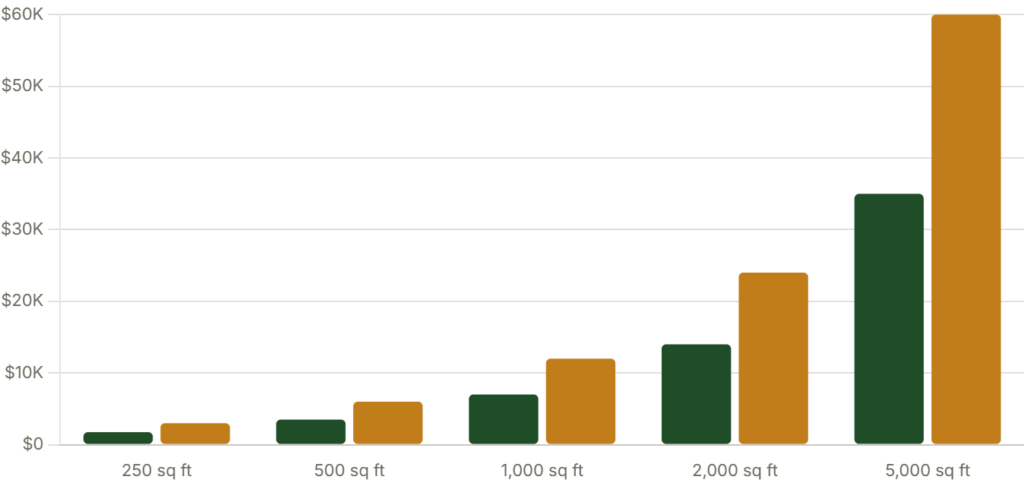
A 500 square foot backyard runs $3,500 to $6,000 professionally installed in Texas. That range reflects soil variability and turf grade. Entry-level turf on sandy soil lands near the low end. Mid-grade turf on clay with sod removal lands at the high end. DIY on simple flat sites with sandy soil can bring this down to $1,500 to $2,500 in material cost alone.
What is the average cost of artificial turf lawn for a 1,000 sq ft area?
At Texas pricing of $7 to $12 per square foot installed, a 1,000 square foot lawn runs $7,000 to $12,000 total. Add $1,000 to $2,500 for sod removal if replacing existing grass. Premium infill or drainage work can push the project toward $14,000 to $16,000 for a complex site with clay soil.
Is artificial turf worth the cost in Dallas?
For most Texas homeowners, yes. Water restriction events have become more common across DFW, San Antonio, Austin, and Houston. Drought stress kills natural lawns regularly in Texas, forcing replanting costs of $1,500 to $5,000. When you add water bills, mowing services, fertilizer, and irrigation repairs over 10 years, the cumulative cost of natural grass approaches or exceeds the cost of turf on most Dallas residential properties.
What is the cost to turf a lawn with a pool area included?
Pool surround installations add complexity because of drainage direction requirements, extreme heat reflected off the water onto the turf, and safety considerations around pool edges. Expect a 15 to 25 percent premium over standard lawn pricing for pool surround turf. Specialized low-pile, heat-resistant turf designed for pool areas costs $3.50 to $6.00 per square foot in material alone.
How long does artificial turf last in Texas heat?
Quality residential turf systems with UV-stabilized fiber last 15 to 25 years in Texas conditions. Lower-grade systems without UV protection degrade faster, with fiber becoming brittle and discolored in 7 to 10 years. The backing deteriorates before the fiber on most system failures. Choosing a product with a perforated or dual-layer backing designed for hot climates extends life significantly.
What are all turf lawn care costs per year?
For a typical 1,000 to 2,000 square foot Texas residential lawn, all turf lawn care costs run $400 to $900 per year with no pets and $700 to $1,600 per year with dogs. This covers grooming, cleaning, infill top-up amortized over the replacement cycle, and perimeter weed control. Compare this to $2,000 to $5,500 per year for comparable natural grass maintenance including mowing, water, and fertilizer.
How to Get Your Real Artificial Turf Lawn Quote
There is no substitute for a real site assessment when it comes to pricing an artificial turf lawn. Online estimates and average cost ranges give you a starting point, but the actual price depends on conditions that can only be evaluated in person.
Here is what to have ready when you reach out for a consultation:
Know the size of your lawn or at least a rough square footage estimate. Have a basic understanding of your soil type (clay, sandy, or mixed) and any drainage issues such as standing water or runoff areas. Take note of any slopes, trees, or obstacles that may affect installation. Think about your timeline, especially if you are planning around landscaping projects or seasonal use. And if you have a budget range, share it upfront so the installer can recommend the right artificial lawn grass turf system for your needs.
Texas Tuff offers free consultations for artificial turf lawn projects across the DFW area. We evaluate your site, walk you through your options, and provide a detailed, accurate quote so you know exactly what to expect before the project begins.
Request a site visit to get exact pricing based on your lawn size, soil, and installation requirements. Texas Tuff provides free on-site estimates across DFW with clear, itemized costs and no hidden fees.