

Full cost data for artificial turf football field installation, from high school to college grade. Site prep, materials, infill, labor, and the 10-year ownership math, all in one place.
What a Turf Football Field Actually Costs in 2026
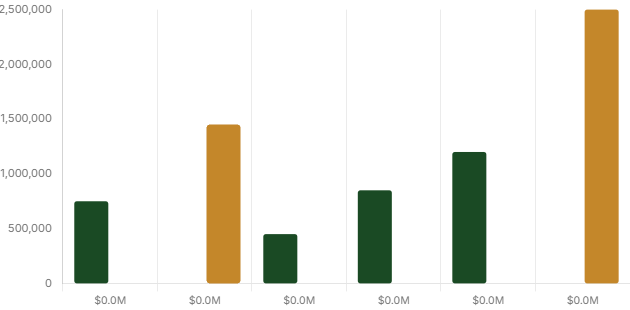
The average cost of an artificial turf football field for a Texas high school runs between $750,000 and $1.2 million for a complete installed system. College and university projects start around $1.2 million and climb to $2.5 million for premium systems with full shock pad and cooling infill. Those are not sticker prices for the carpet alone; they are all-in numbers including site preparation, drainage, base construction, turf material, infill, installation labor, and field markings.
The cost to turf a football field varies this much because five variables move the number independently: field size, base condition, infill type, fiber grade, and contractor market. A school on sandy loam soil with a prepared sub-base starts from a different position than one dealing with North Texas black clay that requires lime stabilization before a single layer of stone goes down.
Texas note: Surface temperature is a real variable in Texas budget decisions. Crumb rubber infill on a 95-degree day in the DFW or Houston area can reach 160 degrees Fahrenheit. Selecting an infill system built for Texas heat affects both upfront cost and how many hours per day the field is usable during August two-a-days. Texas Tuff designs systems specifically for these conditions.
Artificial Turf Football Field Installation Cost by Facility Level
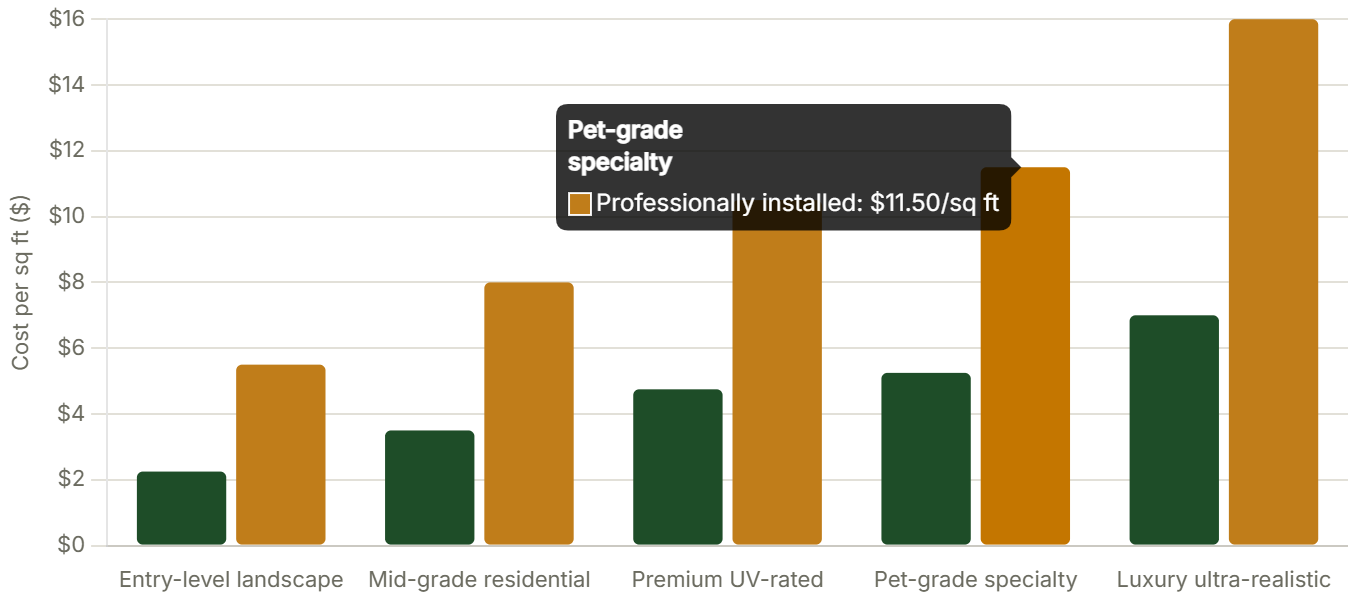
The numbers above represent complete installed cost. They do not include lighting upgrades, stadium seating, or scoreboard replacement, which are frequent companion projects but separate budget line items. Drainage infrastructure is included for fields without existing storm systems.
What Makes the Cost of Turfing a Football Field Go Up or Down
No two football field turf projects land at the same number. The variables below explain most of the spread between a $700,000 high school field and a $1.4 million high school field with identical dimensions.
Turf Fiber Technology
A field on stable, well-draining sandy soil with a reasonably level base can move from demolition to first game in 8-10 weeks. A field sitting on expansive black clay in North Texas or the DFW area may require 4-6 inches of lime stabilization, engineered drainage, and additional compacted stone before any turf work begins. This soil work can add $80,000 – $200,000 to a project that would otherwise be straightforward.
Infill Selection
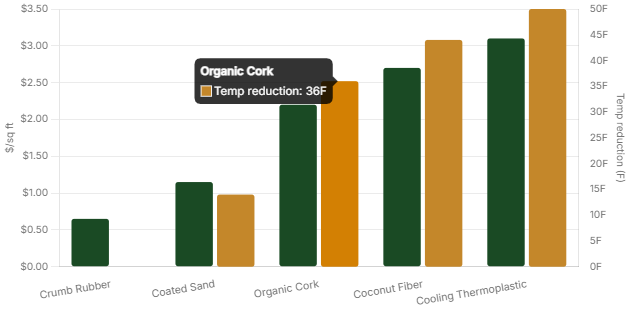
Infill is the material spread between the synthetic fiber blades. It determines surface temperature, G-max performance (impact attenuation), durability, and playing feel. The choice between crumb rubber, coated sand, organic blends, and thermoplastic options is one of the largest single cost decisions in a turf football field budget.
Infill Options: Cost per Square Foot vs. Surface Temperature Reduction
Fiber System and Pile Height
Football fields use pile heights between 2.25 and 2.75 inches. Monofilament fiber, slit-film fiber, and textured two-component blends each have different durability profiles and cost points. Higher stitch rates (more fiber per square meter) cost more upfront but hold their performance characteristics longer under heavy use. A field hosting football, soccer, and band practice year-round justifies a higher stitch rate than a single-sport practice facility.
Shock Pad Systems
An engineered foam shock pad installed beneath the turf carpet improves G-max performance, reduces the infill depth required, and meaningfully extends field life. Shock pads add $0.75 – $1.50 per square foot. For a full football field, that is $43,000 – $87,000 additional cost. Most programs that install shock pads report better G-max test results at year six compared to fields that used infill depth alone for attenuation.
Field Markings and Custom Logos
Standard hash marks, yard lines, and numbers tufted into the turf carpet during manufacturing add $15,000 – $25,000 to a project. Custom end zone logos, mid-field crests, school colors, and specialty graphics are applied as separate colored turf panels. A complex logo with multiple colors can add $30,000 – $60,000 on top of standard markings.
Contractor Availability in Texas
Texas has seen significant growth in turf field installations over the past decade. During peak season (March through July for fall sport readiness), leading installers carry full project schedules. Projects bid during peak demand often run 8-15% above off-season pricing. Planning your project 12-18 months out and targeting a fall or winter bid window provides real leverage on final cost.
Infill System Cost vs. Surface Temperature Reduction (Texas Summer)
Source: STMA Field Budget Estimates Report 2023
How Much Does a High School Turf Football Field Cost?
The most common question Texas athletic directors and school boards face when a turf project comes up is exactly this one. For a UIL-compliant high school football field, the honest answer in 2026 is $750,000 to $1.2 million for most Texas installations. Fields with significant site challenges, premium infill, or elaborate custom graphics push toward the upper end and beyond.
That range assumes a full-size regulation field including both end zones (approximately 57,600 square feet of playing surface), standard drainage infrastructure, crumb rubber or coated sand infill, tufted-in markings, and goal posts if not already in place.
| Field Configuration | Square Footage | Estimated Cost |
|---|---|---|
| High school game field (regulation) | ~57,600 sq ft | $750,000 - $1,200,000 |
| High school with premium infill and shock pad | ~57,600 sq ft | $1,000,000 - $1,500,000 |
| Practice field (no end zones, no markings) | ~36,000 sq ft | $450,000 - $750,000 |
| Multi-sport field (football + soccer) | ~65,000 sq ft | $850,000 - $1,400,000 |
| Indoor practice facility (partial field) | 10,000 - 25,000 sq ft | $175,000 - $450,000 |
UIL and G-max compliance: Texas UIL regulations require athletic surfaces to meet ASTM F1936 impact attenuation standards. G-max readings must fall below 200. Annual testing by a certified third-party lab costs $800 – $2,000 per test and is required throughout the field’s life. Factor this into your long-term budget from day one.
How Much Is a Turf Football Field: Cost by Configuration and Grade
Cost to Install Artificial Turf Football Field: What You Pay For
Understanding the installation sequence explains why the cost to install artificial turf on a football field is not simply the cost of carpet times square footage. Every phase of the project contributes to the final bill, and skipping or under-specifying any phase creates expensive long-term problems.
01. Site Assessment and Geotechnical Testing
Soil bearing capacity, existing drainage, utility locations, and grade are evaluated. Texas-specific concerns include shrink-swell clay soils in the Blackland Prairie region and caliche hardpan in West Texas, both of which require modified base strategies.
02. Demolition and Soil Stabilization
Existing vegetation and 6-10 inches of topsoil are removed. Expansive clay soils require hydrated lime mixing and compaction before any aggregate is placed. This step adds $0.50 – $1.50 per square foot when soil treatment is required.
03. Drainage System Installation
Perforated pipe in a herringbone or grid pattern is installed at the sub-grade level, connected to catch basins and tied into the site’s storm system. Texas receives significant rainfall events that overwhelm inadequate drainage, making this step non-negotiable for a field that performs after August storms.
04. Aggregate Base Construction
4-6 inches of crushed stone is placed in lifts and compacted to 95% Modified Proctor density. The surface is graded to a 1% cross-slope to ensure positive drainage across the entire field. Poorly compacted bases are the leading cause of early field failures and uneven playing surfaces.
05. Shock Pad Placement (if specified)
Engineered foam pad rolls are laid on the compacted base and seamed. The shock pad must be compatible with the turf system above it and secured at edges and perimeter to prevent migration under heavy use.
06. Turf Carpet Laying and Seaming
Turf rolls are unrolled, positioned, and seamed using adhesive bonding on a geotextile carrier. Seam placement is planned around the field layout to minimize seam visibility and avoid high-traffic zones like the line of scrimmage area. Poorly executed seams create trip hazards and fail G-max testing.
07. Infill Spreading and Power Grooming
Infill is applied in multiple passes using calibrated spreaders, brushed upright, and tested for depth uniformity. Infill depth directly affects G-max performance; under-filled fields fail impact attenuation tests and require immediate correction before the field opens.
08. G-Max Testing and Field Certification
An independent ASTM F1936 G-max test is conducted before the field is accepted. A passing G-max reading below 200 is required. Most contractors provide at least one full-field test as part of the installation contract. The test report becomes part of the field’s permanent maintenance record.
Artificial Turf Football Field Installation Cost: Every Line Item
The table below breaks down the cost of artificial grass football field installation at the component level. These are 2026 ranges from Texas and Gulf Coast region installations. Projects in major Texas metro areas trend toward the mid-to-upper end of each range due to contractor labor market conditions.
| Component | Unit | Cost Range |
|---|---|---|
| Turf carpet (monofilament, standard) | per sq ft | $2.50 - $4.00 |
| Turf carpet (premium slit-film or textured blend) | per sq ft | $4.00 - $6.50 |
| Lime soil stabilization (where required) | per sq ft | $0.50 - $1.50 |
| Aggregate base (4-6 in. crushed stone) | per sq ft | $0.90 - $2.00 |
| Drainage system (pipe, basins, outlets) | per sq ft | $0.75 - $2.00 |
| Infill, crumb rubber (recycled) | per sq ft | $0.45 - $0.90 |
| Infill, coated sand or organic blend | per sq ft | $1.20 - $2.50 |
| Infill, cooling thermoplastic (e.g., DoublePlay) | per sq ft | $2.50 - $4.00 |
| Shock pad (engineered foam) | per sq ft | $0.75 - $1.50 |
| Installation labor (seaming, infill, edging) | per sq ft | $0.65 - $1.40 |
| Standard field markings (tufted in) | flat | $15,000 - $28,000 |
| Custom logo or end zone graphics | per logo | $8,000 - $30,000 |
| Goal posts (aluminum, code-compliant) | per pair | $3,500 - $8,000 |
| G-max testing (independent lab) | per test | $800 - $2,000 |
Hidden cost alert: Haul-off and disposal. Removing existing natural grass sod plus sub-grade material from a full football field generates 800-1,400 tons of material. Disposal costs vary widely by Texas county and landfill access, but budget $15,000 – $45,000 for demolition and haul-off on a full-field project unless your installer explicitly includes it in their base bid.
Artificial Turf vs. Natural Grass: The Real Cost Comparison
The cost of artificial grass football field installation looks large compared to resodding a natural grass field. The comparison stops looking that way when you run 10-year numbers. Artificial turf has higher upfront cost and a scheduled replacement cost, but the annual operating cost difference is substantial enough that most high-use Texas programs reach cost parity within 6-8 years.
10-Year Cumulative Cost: Natural Grass vs. Artificial Turf Football Field
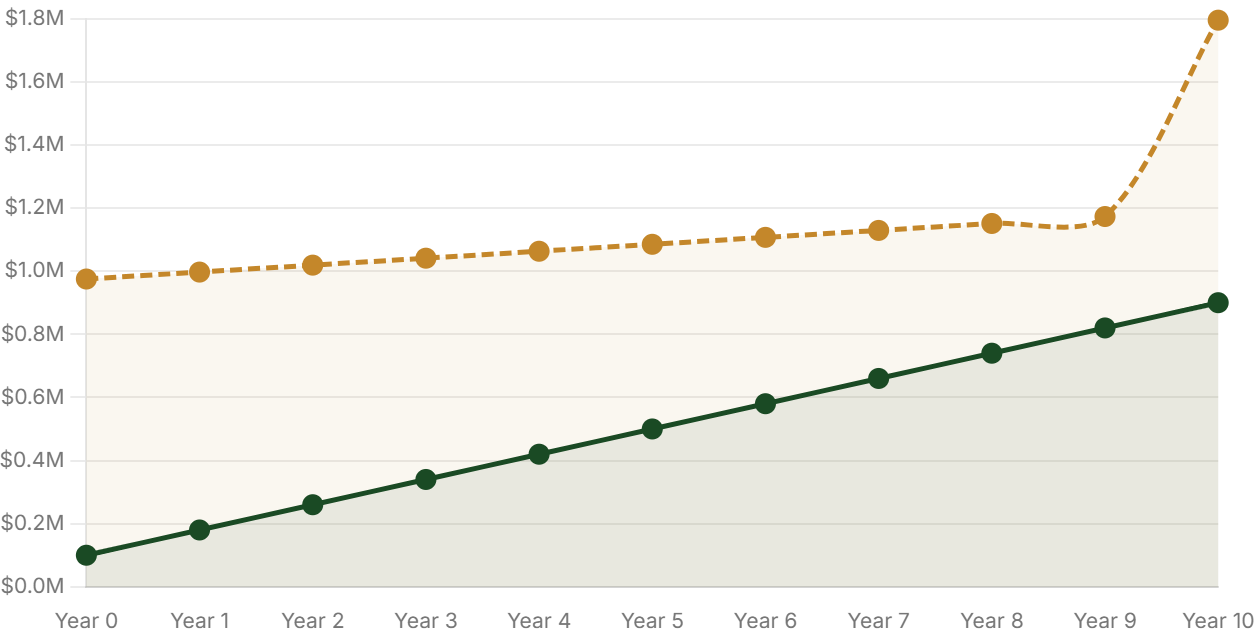
The crossover point where artificial turf becomes the lower total-cost option comes earlier for fields used more intensively. A Texas high school field used for football, soccer, lacrosse, band practice, and PE classes year-round extracts more value from the installation cost than a single-sport varsity field. High-frequency use programs typically reach cost parity at year 6-7.
Annual Maintenance Costs After Installation
Artificial turf fields are low maintenance, not zero maintenance. Proper ongoing care extends field life, keeps G-max performance within compliance range, and protects a seven-figure investment. These are the recurring costs that belong in every athletic department’s annual budget once a turf field goes into service.
| Maintenance Task | Frequency | Annual Cost (Full Field) |
|---|---|---|
| Mechanical grooming (power brush) | Monthly | $3,000 - $8,000 |
| Infill redistribution and top-up | Every 1-2 years | $2,000 - $5,000 / event |
| G-max compliance testing (independent) | Annual | $800 - $2,000 |
| Seam and edge inspection and repair | Annual | $1,000 - $3,500 |
| Deep cleaning (sanitizing treatment) | 1-2x per year | $1,500 - $4,000 |
| Perimeter weed and pest control | 3-4x per year | $400 - $1,200 |
| Total annual maintenance | Ongoing | $15,000 - $30,000 |
Compared to natural grass maintenance costs of $60,000 – $100,000 per year for a full high school football field (mowing, aeration, seeding, fertilizing, irrigating, pest control, and game prep), the savings on an artificial turf field are $35,000 – $70,000 per year. Over an 8-year field life, that maintenance delta alone covers a significant portion of the original installation cost.
To understand how these factors impact pricing and planning in real projects, see our guide on artificial turf cost in Dallas.
How Texas Schools and Districts Fund Turf Football Fields
Very few Texas school districts fund a turf football field project from operating budget alone. Here is how most projects actually get financed.
Bond Package Inclusion
Athletic facility improvements including turf fields are routinely included in Texas school bond elections. UIL-classified 5A and 6A districts have successfully passed bonds that include turf, lighting, scoreboard, and seating packages as single ballot items. Bond financing spreads the capital cost over 20-30 years at tax-exempt interest rates, which transforms a $1 million project into a manageable per-student annual cost when spread across district enrollment.
Booster Club and Naming Rights Revenue
Texas booster club fundraising is a significant capital source. End zone naming rights, mid-field logo sponsorships, and fundraising campaigns have helped many districts close the gap between bond allocation and actual project cost. Several major DFW and Houston-area high school programs have generated $150,000 – $400,000 through naming rights and campaign contributions toward turf projects.
Lease-to-Own Programs
National turf manufacturers and specialty lenders offer lease-to-own structures specifically for school athletic facilities. A $1 million field converts to monthly payments spread over 7-10 years at fixed rates, with buyout options. This structure eliminates the large upfront capital requirement and fits within operating budget frameworks for many districts that cannot or prefer not to pursue a bond election.
TPWD Local Park Grants
Texas Parks and Wildlife Department Local Park Grants are available to municipalities and counties for public recreational facility improvements. Grant cycles have funded artificial turf projects at public parks and school athletic facilities open to community use. Awards of $100,000 – $500,000 have been made to Texas entities for synthetic turf athletic fields.
Frequently Asked Questions
How much does artificial turf cost for a football field compared to 5 years ago?
Material costs for synthetic turf systems have increased 15-25% since 2019 due to raw material price increases in polyethylene and polypropylene resins, plus shipping and logistics inflation. Labor costs in Texas have risen similarly. A field that cost $850,000 in 2019 would be priced at $1.0 – $1.1 million for an equivalent system in 2024. This has not materially changed the economics because natural grass maintenance costs have increased at comparable rates.
What is the cost to turf a football field if we already have a prepared base?
If your site already has a properly compacted aggregate base and functional drainage in good condition, the cost to turf a football field drops significantly. You are essentially paying for turf material, infill, installation labor, and markings only. That reduces a typical $1 million project to roughly $450,000 – $700,000 depending on turf grade and infill selection. Having the base independently evaluated before pricing the project is important because base conditions that look acceptable visually may not meet compaction or drainage specifications.
How much does it cost to replace turf after it wears out?
Replacement cost runs 55-70% of original installation cost because the base, drainage infrastructure, and goal post foundations are already in place. A field that cost $1.0 million originally will typically cost $550,000 – $750,000 to replace the carpet, infill, and markings. Proactive planning for replacement from the first day of field ownership prevents a budget crisis at year 10-12. Some districts establish a dedicated turf replacement reserve fund from the time the field is first installed.
Is a shock pad worth the additional cost?
For high-use fields, yes. A shock pad adds $43,000 – $87,000 to a full field project. It improves G-max performance from day one and maintains compliance longer as infill compacts over years of use. Programs that skip shock pads often find themselves spending on infill top-ups and G-max remediation work after year 5-6. The shock pad also allows slightly less infill, which partially offsets its own cost. For practice facilities with lighter loads, the return on investment is less clear.
How do I get an accurate cost estimate for a turf football field in Texas?
The only way to get an accurate number for your specific site is a site visit and soil assessment. National average ranges serve as planning benchmarks, but your actual cost depends on soil conditions, existing drainage, access, and current contractor schedules in your area. Texas Tuff provides free site assessments and detailed project estimates for Texas facilities, with pricing built for local conditions rather than national averages.
How to Get a Real Artificial Turf Football Field Quote in Dallas Fort Worth
Online price ranges are helpful, but they cannot replace a real site visit. In Dallas Fort Worth, soil conditions, drainage, and existing field structure can significantly change the final cost of a turf football field.
To get an accurate quote, come prepared with a few basics. Know your field size and how it will be used such as a game field, practice field, or multi sport use. Take note of current conditions like drainage issues, uneven ground, or worn out grass. Check if any base or drainage system already exists since that can reduce costs. Also think about your preferred features such as infill type, shock pad, and custom logos.
Having a rough budget and timeline helps contractors recommend the right system faster and more accurately.
Texas Tuff offers free on site evaluations across the Dallas Fort Worth area, giving you a clear and detailed quote based on your actual field conditions, not just averages.
Get a detailed, site-specific quote for your artificial turf football field. No guesswork, just real numbers based on your property.