
How Much Does a Backyard Putting Green Cost?
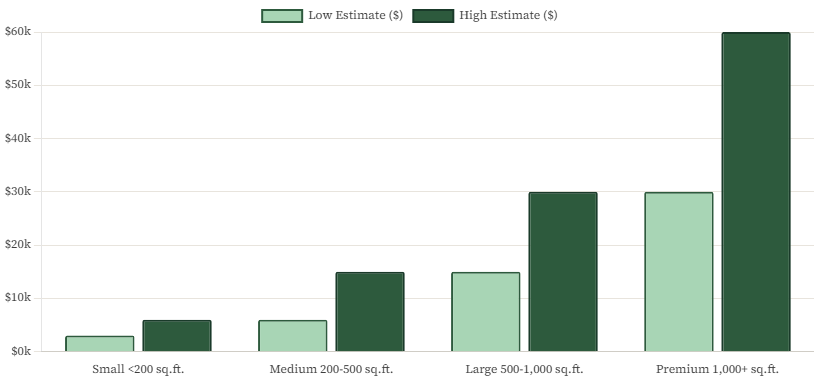
A backyard putting green costs $15 to $40 per square foot for professional synthetic installation. Most homeowners spend between $6,000 and $20,000 total, depending on size, turf grade, base prep, and added features. Large custom builds with undulations and tee boxes can reach $40,000 or more.
If you have ever stood in your backyard and thought about turning an empty corner into a small golf practice area, you are not alone. In the Dallas–Fort Worth area, more people have been installing home putting greens over the past five years. Even small yards can fit a synthetic putting green as small as 150 square feet, and it can be used all year for practice.
At Texas Tuff, we have built custom putting greens in Dallas, Frisco, Plano, Fort Worth, McKinney, Garland, Irving, Denton, and nearby areas. We install everything from small one-hole practice greens to larger setups with tee areas, grass edges, and lighting. The cost information in this guide comes from real projects in the DFW area, not national estimates.
This guide explains all the main factors that affect the price of your project. You can read the full breakdown, compare your options, and contact Texas Tuff for a free on-site estimate with no obligation.
Backyard Putting Green Installation Cost in 2026
Installing a backyard putting green in 2026 usually costs between $15 and $40 per square foot depending on the quality of materials and design. DIY kits are the cheapest, while professional installations with custom features like shaping and fringe areas cost more. Most homeowners also choose mid-range options that balance cost and performance.
Before diving into the details, here is a quick overview of what most homeowners spend:
Backyard Putting Green Cost by Size
Cost Per Square Foot: Installation Type Comparison
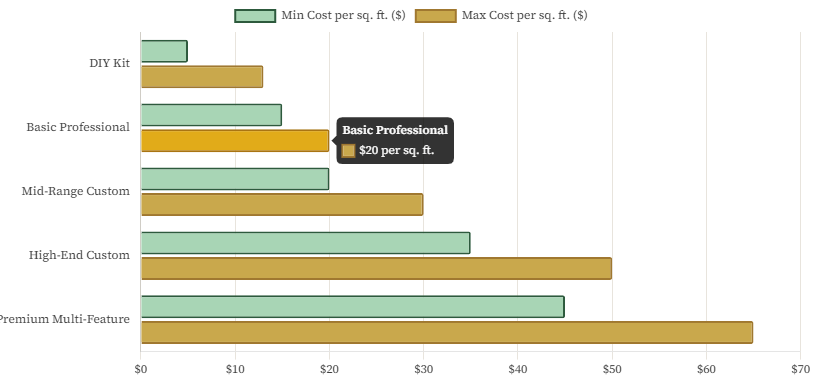
These are national and regional averages. In the DFW market, pricing tends to land in the mid-to-upper range because of local demand, premium turf options, and the expectation for quality workmanship. Keep reading to understand exactly what drives these numbers.
What Factors Affect Synthetic Putting Green Cost?
No two putting green projects are exactly the same. A small 200-square-foot flat green on level ground with good drainage is very different from a 600-square-foot design with multiple sections built on clay-heavy soil in the Dallas–Fort Worth area that needs major grading work.
The difference between the lowest and highest price quotes is not random. It depends on real factors like project size, design details, material quality, and the amount of labor required. Understanding these factors helps you make better decisions before hiring a contractor.
Size, materials, site conditions, and design choices all move the final number. Most projects are shaped by four or five of these at once.
Here is a complete breakdown of every major driver:
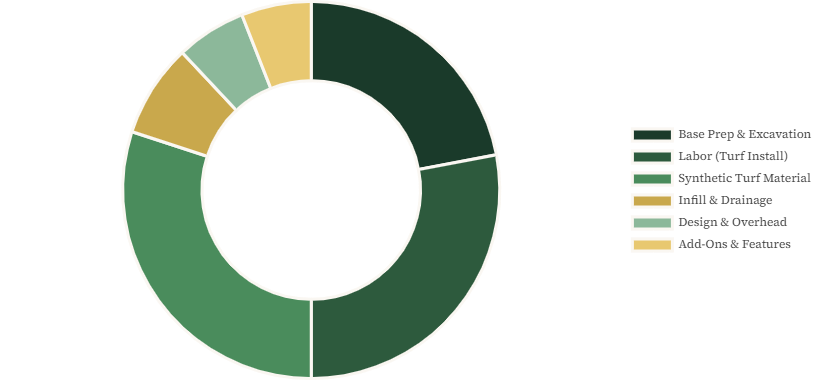
Typical Cost Breakdown: Where the Money Goes on a Mid-Range Install
1. Size of the Green
Size is the most direct driver of total cost. Larger greens require more turf, more base material, and more labor hours. Cost per square foot does tend to decrease slightly at larger scales because fixed costs like equipment mobilization get spread over more area.
For most Texas homeowners who want a functional green without overbuilding, a 300 to 500 square foot installation is the practical sweet spot.
2. Artificial Turf vs. Natural Grass
The surface material you choose has a massive impact on both upfront cost and long-term expenses.
Artificial turf putting green cost is the most popular choice for residential turf installations in Dallas Fort-Worth. Here is why:
| Factor | Artificial Turf | Natural Grass (Bentgrass) |
|---|---|---|
| Upfront Install Cost | $15 to $40 per sq. ft. | $8 to $20 per sq. ft. |
| Annual Maintenance Cost | Under $200 | $1,500 to $4,000+ |
| Water Requirement | None | 30 to 40 gal/sq.ft./year |
| Texas Summer Survival | Handles 100+ F heat | Requires intensive care |
| Lifespan | 10 to 15+ years | Indefinite, but high maintenance |
| Ball Roll Consistency | Year-round consistency | Seasonal variation |
| 10-Year Total Cost (500 sq. ft.) | $12,500 to $20,000 | $19,000 to $44,000 |
Natural bent grass requires daily mowing, twice-weekly irrigation, aeration, fungicide treatments, and overseeding just to stay playable.
In a DFW summer, a week without irrigation is enough to cause serious damage. Synthetic turf eliminates all of that. Maintenance costs on a Texas Tuff putting green run under $200 per year, compared to $1,500 to $4,000 annually for well-maintained natural grass. Over 10 years on a 500-square-foot green, that gap compounds to $12,000 to $20,000 in operating cost savings. For a full breakdown of these advantages, see our guide on backyard putting green benefits.
10-Year Total Cost: Synthetic vs. Natural Grass Putting Green (500 sq. ft.)
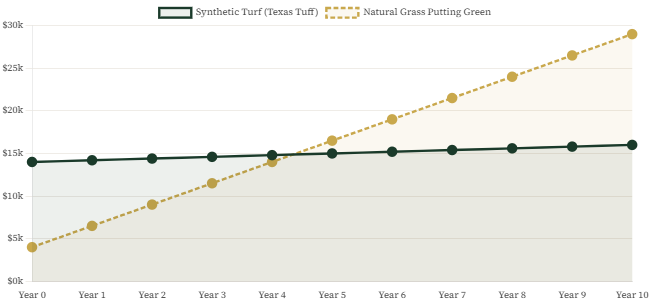
The crossover point where synthetic total cost exceeds what natural grass would have cost sits around Year 2 for most DFW projects. By Year 10 the difference in total spending is typically $10,000 to $18,000 in favor of synthetic.
3. Turf Quality and Pile Height
Putting green turf uses short pile heights of 3/8 to 5/8 inch for clean ball roll. Lower-grade products flatten under foot traffic and Texas heat. Commercial-grade turf uses denser, UV-stabilized fibers that hold their structure through heavy use and 100-degree summers.
Pile height also controls ball speed: shorter pile plays faster and demands more precision, longer pile is more forgiving. Texas Tuff only installs commercial-grade, heat-rated products selected for Texas climate performance.
4. Base Construction and Drainage
The base is invisible once the turf is down and is where most cheap installs cut corners. A proper base starts with 4 to 6 inches of excavation, followed by compacted crushed limestone or decomposed granite installed in layers. This provides stability, free drainage, and the shaped surface that undulations are built into.
DFW clay soils swell and shrink seasonally. Without a proper aggregate buffer, a green built on compacted clay will heave and develop low spots within a few seasons. For low-lying lots or hardpan clay, perforated drain lines add $500 to $2,000 but prevent expensive failures down the road.
5. Design Complexity and Undulations
Flat greens cost the least to build and are the least useful for practice. Undulations are shaped into the aggregate base before turf goes down and add $3 to $8 per square foot to base cost.
Multi-cut designs use different turf pile heights across zones: a tight putting surface, a taller fringe, and a fairway chipping area. This setup allows you to practice the full range of short game shots in one footprint. Single-cut greens are fully functional and more budget-friendly for homeowners focused primarily on putting.
6. Add-On Features
Lighting is one of the most underrated upgrades in DFW, where spring and fall evenings are ideal for practice and extend your usable hours well past sunset. Tee boxes protect the putting surface from spike damage while adding chipping practice value. Every add-on below can be included in the original project scope for less than adding it after installation.
| Add-On Feature | Description | Estimated Cost |
|---|---|---|
| Tee Box | Hitting mat area with premium turf, per unit | $200 to $800 |
| Flagsticks and Cups | Per hole, stainless or powder-coated | $50 to $200 |
| Undulations and Contouring | Shaped base for slopes and breaks | +$3 to $8 per sq. ft. |
| Fringe Turf Section | Different pile height around perimeter | +$2 to $5 per sq. ft. |
| Evening Lighting | Low-voltage LED border or path lighting | $500 to $3,000 |
| Sand Bunker | Integrated sand trap with liner | $800 to $2,500 |
| Retaining Wall or Border | Timber, stone, or concrete edging | $1,000 to $5,000 |
| Perforated Drain Lines | For clay-heavy or low-spot DFW lots | $500 to $2,000 |
| Typical Add-On Budget Range (Mid-Size Project) | $2,000 to $12,000 | |
Talk through your priorities with a Texas Tuff consultant before finalizing your feature list. Adding items after installation is always more expensive than including them in the original scope.
How a Putting Green Gets Built: Installation Process
Understanding the installation process helps you see where costs come from at each stage and why base preparation is just as important as the turf itself. It also helps you evaluate contractor bids. A quote that skips or shortcuts any of these steps is almost always a quote that will cost you more in repairs or replacement down the road.
Backyard Putting Green: Installation Process Flowchart
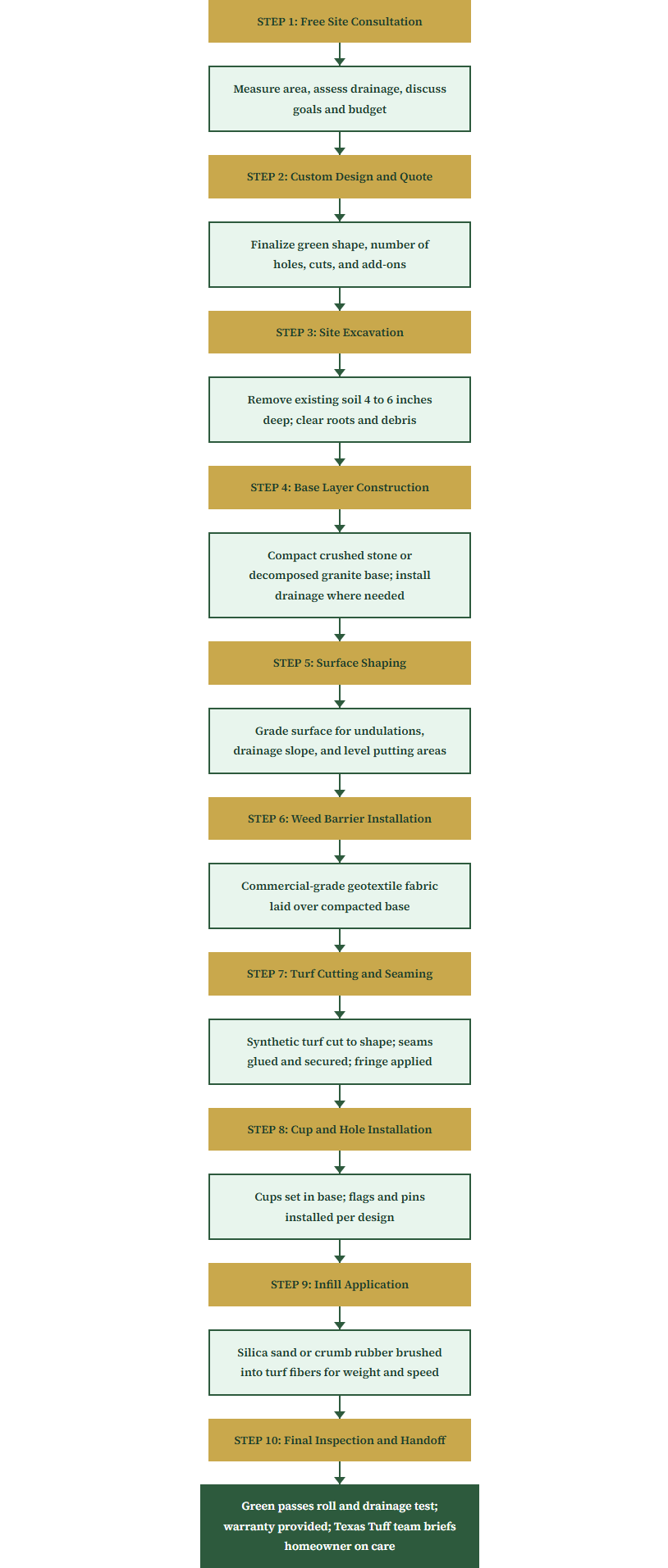
At Texas Tuff, every residential putting green installation follows this sequence. The timeline from consultation to completed installation typically runs two to four weeks, depending on project size and schedule. Site preparation and base construction take the most time. Turf installation on a well-prepared base moves quickly and precisely.
Synthetic Putting Green Cost vs ROI
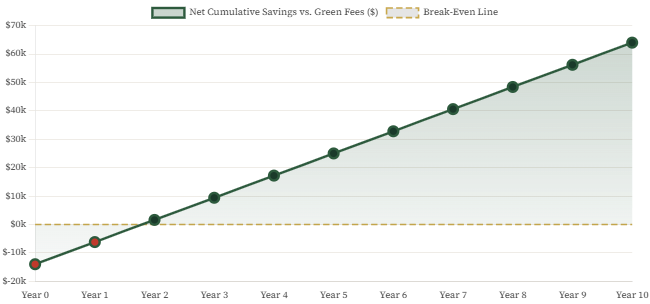
The upfront putting green cost is real, but so is what you get back over time. In Texas, synthetic greens are usable 10 to 12 months per year. For golfers who regularly pay green fees or club dues, the math works in favor of home installation within a few years.
Backyard Putting Green ROI Over 10 Years
Year-round practice access:
In Texas, you can use an outdoor synthetic putting green 10 to 12 months of the year. That is a substantial improvement over a couple of weekend range sessions per month.
No ongoing water costs
A synthetic putting green requires no irrigation. In a state where summer water bills can spike significantly, that matters.
Home value
A professionally installed putting green adds visual appeal and a desirable outdoor living feature that can strengthen your home’s resale value, particularly in golf-enthusiastic DFW communities.
Entertainment value
Putting greens are genuinely enjoyed by the whole family. Casual putting games are entertaining for guests of all ages and skill levels.
Elimination of club membership fees
Regular golfers paying $150 to $300 per month in green fees or membership costs can recoup the cost of a quality backyard green within a few years.
DIY Putting Green Kits vs. Professional Installation
DIY putting green kits are available online ranging from $5 to $13 per square foot. These kits include modular base panels and a roll of synthetic turf designed for flat, stable surfaces without excavation.
Here is what the comparison actually looks like:
| Factor | DIY Kit | Professional Install (Texas Tuff) |
|---|---|---|
| Cost Per Sq. Ft. | $5 to $13 | $15 to $40 |
| Base Preparation | None included | Full excavation and compaction |
| Drainage | Not engineered | Built to site conditions |
| Undulations | Not possible | Custom shaped |
| Ball Roll Quality | Functional, flat only | PGA-comparable performance |
| Texas Heat Resistance | Moderate | UV-stabilized, rated for 100+ F |
| Warranty | Product only, limited | Full installation warranty |
| Lifespan | 5 to 8 years | 10 to 15+ years |
Frequently Asked Questions
How much does a backyard putting green cost on average?
Most DFW homeowners spend $6,000 to $20,000. Smaller greens under 200 sq. ft. start around $3,000. Large custom builds exceed $40,000. The average mid-size DFW residential project lands between $10,000 and $16,000.
What is the artificial turf putting green cost per square foot?
Turf material alone runs $10 to $25 per square foot. Total installed cost including base prep, labor, drainage, and cups ranges from $15 to $40 per square foot in the DFW market.
Is artificial turf better than natural grass for a putting green in Texas?
Yes, for most Texas homeowners. Synthetic turf handles DFW summer heat without irrigation and costs under $200 per year to maintain. Natural bent grass requires daily mowing, twice-weekly irrigation, aeration, and fungicide treatments. Without those inputs it deteriorates fast in July and August. The 10-year total cost of natural grass typically exceeds the full cost of a synthetic installation.
How long does a synthetic putting green last?
10 to 15 years or longer with commercial-grade turf and basic maintenance. UV stabilizers and heat resistance prevent fiber breakdown. DIY-grade products typically last 5 to 8 years.
Can a putting green be installed over existing concrete?
Yes, in many cases. This eliminates excavation and base construction, reducing total cost by $3 to $8 per square foot. The concrete must be structurally sound with adequate drainage slope. A Texas Tuff consultant will assess your surface during a free site visit.
What size putting green should I build?
A 300 to 500-square-foot green is the practical sweet spot for most DFW homeowners. It fits three to five holes, allows for slopes and a fringe cut, and delivers genuine short game practice value without overbuilding the budget.
How to Get an Accurate Artificial Turf Putting Green Quote
You really can’t get a true price for a backyard putting green without seeing the space in person. Online estimates and average price ranges are useful, but they only give a basic idea. The real cost depends on details that can’t be understood from a photo or description, like the shape of your yard, drainage, slope, and how easy it is to bring in equipment.
At Texas Tuff, we always start with an on-site visit before giving a final price. This helps us understand your yard properly and design something that fits your space and goals. After that, you get a clear and accurate quote based on your actual project, so there are no surprises later.
Texas Tuff installs custom putting greens across Dallas, Fort Worth, Frisco, Plano, McKinney, and the entire DFW metro. Real pricing, no pressure, no hidden fees.