
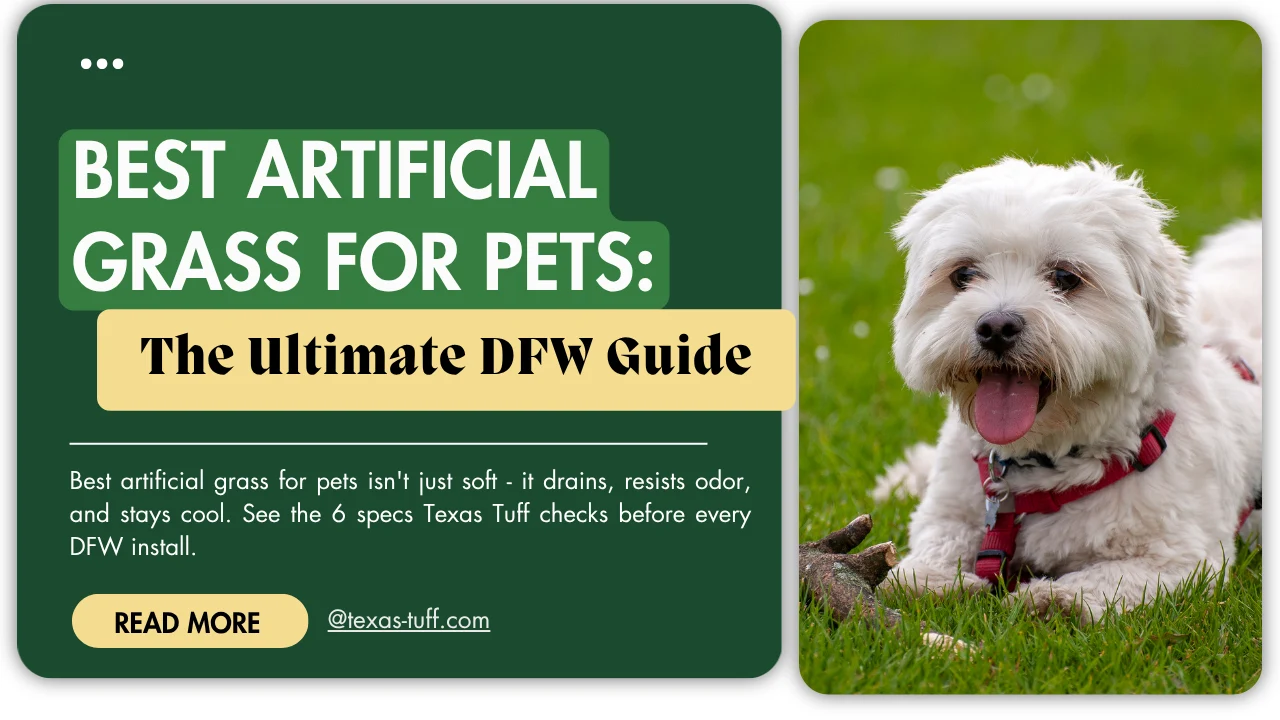
If you’re searching for the best artificial grass for pets, you’ve likely noticed that most turf marketed as “pet friendly” is just standard landscaping turf with a different label. The difference matters. A yard that looks great on installation day can turn into an odor problem, a heat hazard, or a matted mess within a season if the drainage rate, infill, and fiber weren’t actually built for daily use by dogs or cats.
This guide covers the six specifications that determine real pet turf performance, how fiber material affects comfort and heat retention, how drainage systems work beneath the surface, and what a realistic maintenance schedule looks like by pet type.
What Is Pet Friendly Artificial Grass
Pet friendly artificial grass is a specific category of synthetic turf engineered to handle the conditions that come with dogs and cats using a yard daily. That means a drainage system capable of moving urine through the backing within seconds, a fiber pile that resists flattening under paw traffic, a surface temperature that stays manageable in summer heat, and a backing or infill material free of compounds that can cause skin or respiratory irritation in animals.
Regular artificial grass, including the kind sold at home improvement stores for general landscaping, is not built to these standards. Its backing often has fewer drainage perforations per square foot, its infill is typically crumb rubber (which retains heat and carries known toxicology concerns), and the fiber itself is designed for foot traffic, not claw-to-surface contact repeated thousands of times per month.
The term pet safe fake grass appears frequently in search queries, and it is a useful way to frame the core question: is this product actually safe and functional for the animal, or is it just marketed with that label? At Texas Tuff, we install across the Dallas-Fort Worth area, and we see the results of both choices in the yards we are called to replace or repair.
Why Standard Turf Falls Short for Pets
Standard artificial grass is designed to look like a lawn from a distance. Pet turf is designed to function like a yard under daily animal use. The difference shows up across four common failure points that homeowners regularly report.
Standard artificial grass is designed to look like a natural lawn and handle human foot traffic. Pet turf is a subcategory engineered specifically for animal use, with higher drainage rates, heavier face weight, non-toxic infill, and blade profiles chosen for durability under paw traffic. For homeowners comparing grass alternatives you can walk on, pet turf can also provide a practical option where regular lawn maintenance is difficult. The difference in cost at installation is typically two to five dollars per square foot, but pet turf lasts significantly longer and avoids the odor, heat, and matting issues that cause homeowners to replace standard turf early.
Odor buildup
Urine pools in low-drainage backing and penetrates the infill. In summer heat, ammonia off-gassing can become severe within two to three weeks of installation on non-pet-grade turf.
Fiber matting
Dogs run the same routes repeatedly. Standard turf fiber flattens in high-traffic corridors within six to twelve months. Pet-grade turf uses stiffer, heavier monofilament or C-shaped blade profiles that spring back.
Surface heat
Black or dark-backed turf can reach 145 to 160 degrees Fahrenheit on a 95-degree afternoon. Dogs walking on those surfaces can suffer pad burns. Lighter backing and cooling infill materials can keep surface temperatures 20 to 40 degrees lower.
Infill toxicity concerns
Crumb rubber infill, common in standard and sports turf, contains polycyclic aromatic hydrocarbons (PAHs). Dogs that mouth, chew, or dig at infill ingest more of these compounds than humans walking on the same surface.
Research note: A 2022 study by the Environmental Research Foundation found crumb rubber infill samples from synthetic sports fields contained detectable levels of benzene, xylene, and naphthalene. While the study focused on children, dogs spend more direct contact time at ground level than most humans, and smaller body weight means higher relative exposure per pound.
Source: Environmental Research Foundation, Synthetic Turf Infill Review, 2022.
The 6 Specs That Decide the Best Artificial Grass for Pets
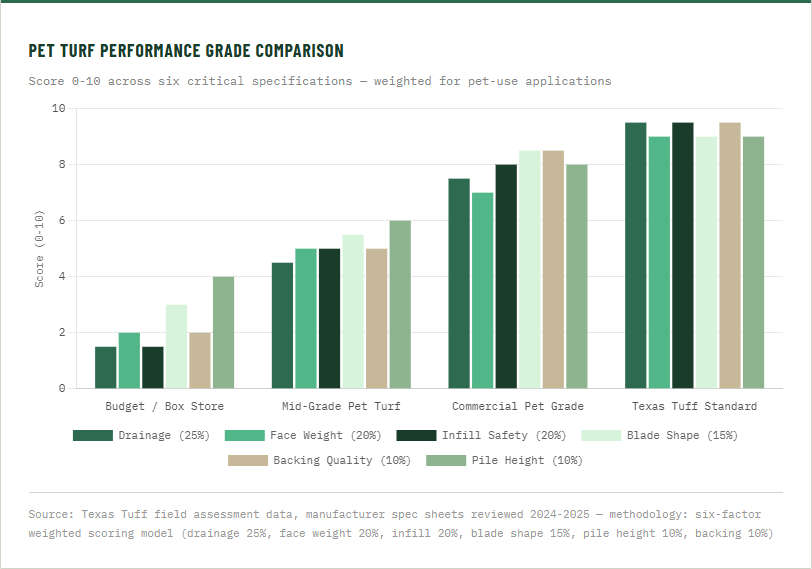
When evaluating any product labeled as the best pet artificial grass, check these six specifications. A supplier or installer who cannot answer each of these questions precisely is not a reliable source.
1. Drainage Rate (Inches Per Hour)
Drainage rate measures how fast water or liquid can pass through the turf backing and into the sub-base below. For pet turf, the minimum acceptable rate is 30 inches per hour. Quality pet-grade products achieve 50 to 120 inches per hour through perforated backings with hole spacing no greater than 4 inches on center. A turf with 10 to 15 holes per square foot drains meaningfully faster than one with 4 to 6 holes per square foot.
2. Pile Height (Millimeters)
Pile height is the length of the synthetic blade from the backing to the tip. For pet turf, the target range is 1.5 inches (38mm) to 1.75 inches (44mm). Shorter pile, under 1.25 inches, reduces the cushioning that protects joints in active dogs. Taller pile, above 2 inches, traps waste between blades and makes cleaning more difficult. The sweet spot for most pet applications sits at 1.5 inches.
3. Blade Shape
Blade shape affects both durability and the degree to which the turf retains heat and traps particulate. Flat blades look realistic but mat quickly under paw pressure. W-shaped and C-shaped blade profiles have structural memory baked into the fiber cross-section, meaning they return to upright position after compression. Most commercial-grade pet turf products use one of these profiles.
4. Face Weight (Ounces Per Square Yard)
Face weight is the weight of the fiber in a square yard of turf, excluding the backing. Higher face weight indicates more fiber density and generally longer product life. For high-traffic pet applications with one or more large dogs, 60 to 80 ounces per square yard is the appropriate range. Products below 50 ounces per square yard show visible wear paths within 18 to 24 months under active dog use.
5. Infill Material
Infill is the granular material spread between the blades to support fiber upright position, add weight, and cushion impact. For pet turf, the three main options are silica sand (clean, affordable, heat-neutral but does not resist odor), zeolite (a volcanic mineral that absorbs ammonia and is an upgrade for heavy dog use), and crumb rubber (lowest cost, highest heat retention, and under increasing scrutiny for toxicology). The correct choice for most pet installations is a blend of silica sand and zeolite.
6. Backing Material and Construction
The backing anchors the blades and controls drainage. Look for a dual-layer polyurethane backing rather than single-layer latex. Polyurethane holds up longer under UV exposure and temperature cycling, does not crack in colder conditions, and maintains its drainage hole integrity for the life of the turf. Some products use a polypropylene primary backing with a urethane coating applied after tufting, which is an acceptable alternative.
Pet Turf Spec Comparison Table
| Specification | Budget / Box Store | Mid-Grade Pet Turf | Commercial Pet Grade |
| Drainage Rate | 8–15 in/hr | 20–35 in/hr | 40–80 in/hr |
| Pile Height | 1.0–1.25 in | 1.25–1.5 in | 1.5–1.75 in |
| Blade Shape | Flat | Flat / W-shape | W or C-shape |
| Face Weight | 30–45 oz/sq yd | 50–60 oz/sq yd | 60–75 oz/sq yd |
| Infill Type | Crumb rubber | Silica sand | Silica + zeolite |
| Backing | Single latex | Dual polyprop | Dual polyurethane |
| Warranty (Typical) | 1–3 years | 5–8 years | 10–15 years |
| Approx Cost Installed | $6–9 / sq ft | $9–13 / sq ft | $13–18 / sq ft |
| Pet Grade Score | 3 / 10 | 6 / 10 | 8 / 10 |
Turf Fiber Materials Compared
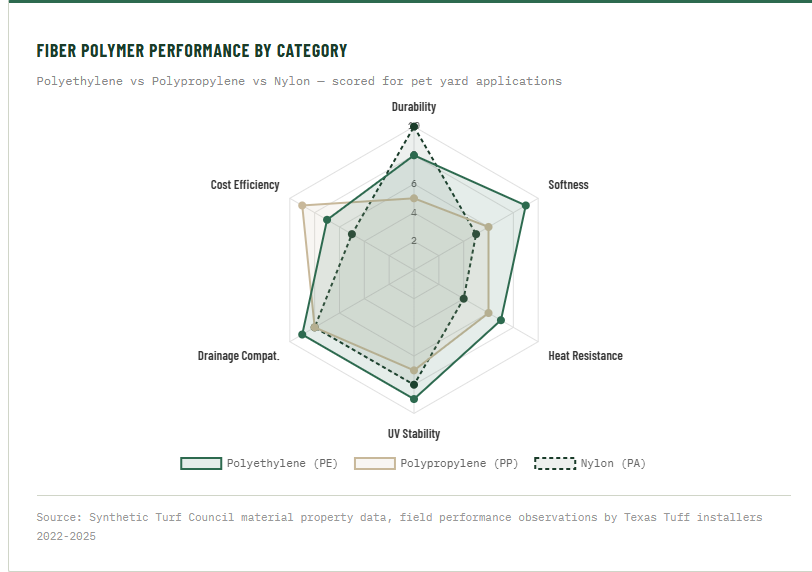
Artificial grass fiber is made from one of three primary polymers. Each has distinct tradeoffs for pet applications in terms of durability, softness, heat behavior, and cost.
Polyethylene (PE)
Polyethylene is the most common fiber in premium pet turf. It is soft to the touch, holds color well under UV exposure, and performs reliably in high-temperature conditions. PE blades drain efficiently and do not retain as much heat as nylon. Most pet owners find PE the most comfortable underfoot for both children and animals. It is the correct default choice for pet safe fake grass in residential applications.
Polypropylene (PP)
Polypropylene is the lowest-cost option and common in entry-level products. PP fiber is stiffer than PE, which makes it less comfortable for dogs and cats at rest. It loses its upright posture under paw pressure more quickly than PE. For high-traffic pet use, polypropylene products typically require replacement within 4 to 7 years versus 10 to 15 years for comparable PE products.
Nylon (PA)
Nylon is the most durable fiber and the standard in commercial and sports applications. It maintains its blade shape under heavy, repeated compression and is resistant to digging damage from dogs. Its main drawback in pet applications is heat retention. Nylon fiber absorbs and holds heat significantly more than PE, which means surface temperatures in summer conditions can exceed safe paw contact limits even with cooling infill. Some pet turf products use nylon as a thatch layer at the base of a PE pile, combining durability and surface comfort.
How a Pet Turf Drainage System Works
Understanding drainage starts with understanding the full system from the surface down to the soil. Turf drainage is not handled by the grass product alone. The sub-base preparation accounts for roughly 40 percent of the system’s total drainage performance.
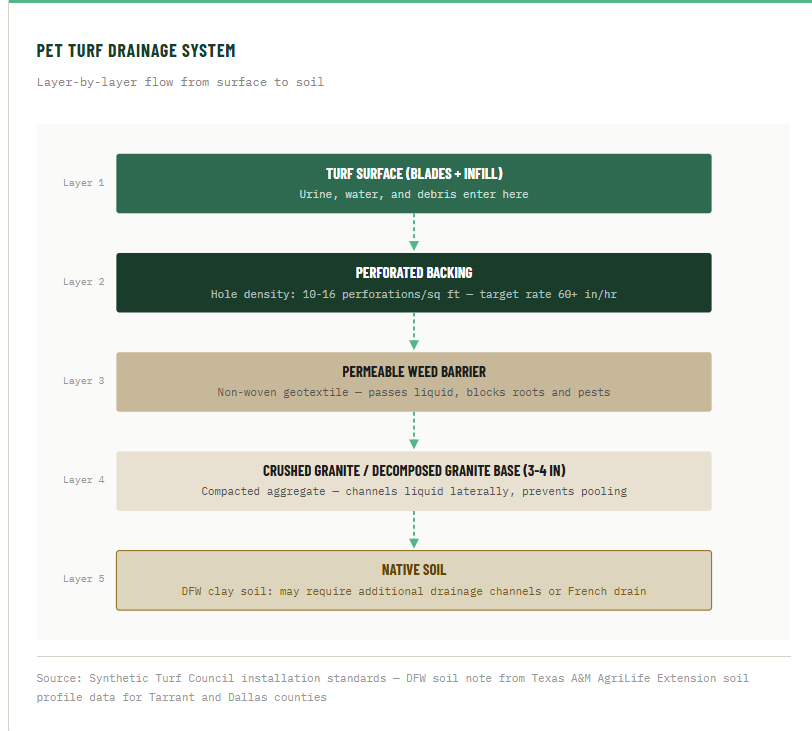
DFW-Specific Note: Dallas-Fort Worth sits on highly expansive black clay soil (Vertisol type). This soil shrinks and cracks in drought conditions and swells when saturated. Standard aggregate bases compact well on this soil but may need additional French drain channels or perforated pipe along low points of the yard. Texas Tuff evaluates every installation site for soil drainage before finalizing the base spec.
Surface Temperature Data by Turf Type
Heat is one of the most under-discussed issues in pet turf conversations. A dog that walks on a surface at 130 degrees Fahrenheit for more than 30 seconds can sustain pad burns. The table below shows measured surface temperatures across turf categories on a 95-degree Fahrenheit summer afternoon with direct sun exposure.
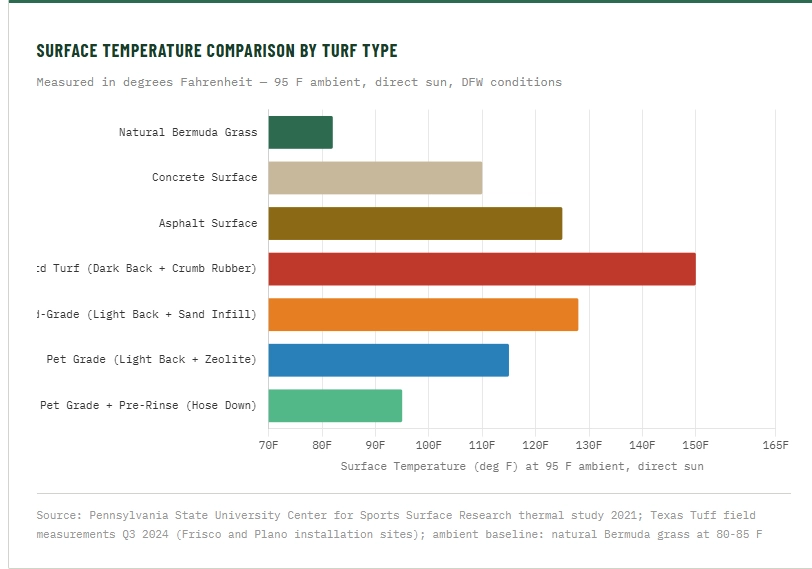
The data above shows why infill choice and backing color matter in hot climates. A standard black-backed turf with crumb rubber infill can reach temperatures that are dangerous for pets to walk on without shade or moisture relief. Cooling infill materials and lighter backing reduce peak surface temperatures by a meaningful margin.
Installation Decision Flowchart
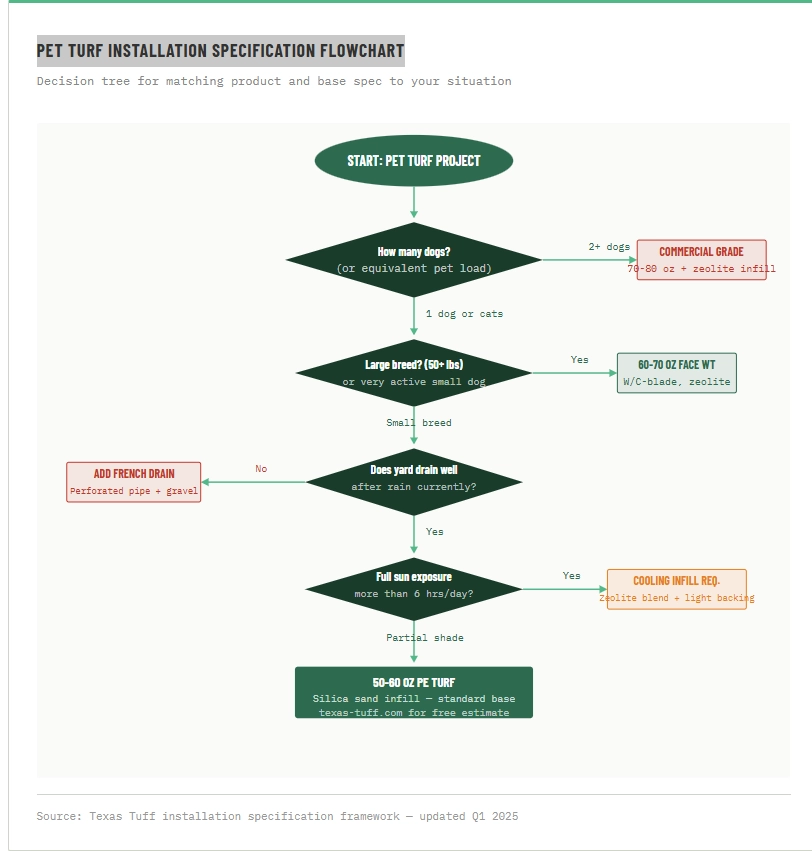
The correct installation specification depends on the number and size of pets, the yard layout, the existing drainage condition, and the budget. This flowchart walks through the key decision points Texas Tuff uses on every pet turf estimate.
Maintenance Schedule by Pet Type
Pet turf is low maintenance, not zero maintenance. The maintenance work you do determines whether the turf smells clean, whether the fiber stays upright, and how long the product lasts before needing replacement. This section gives a concrete schedule by pet type rather than a vague list of suggestions.
Single Dog (Under 30 lbs)
Solid waste removal should happen daily. Rinsing the primary use area with a garden hose should happen two to three times per week. An enzyme-based deodorizer can be applied every two weeks. Grooming the blades with a stiff-bristle brush or power broom occurs monthly. Annual professional inspection and infill top-up is recommended.
Single Dog (30 to 70 lbs)
Daily solid waste removal and rinsing four to five times per week are the baseline. Enzyme deodorizer should be applied weekly during peak summer months, when heat accelerates ammonia off-gassing. Monthly blade grooming and semi-annual infill inspection are recommended. Zeolite infill should be partially replenished every 18 to 24 months.
Multiple Dogs or Large Breed (70+ lbs)
Multiple-dog households treating pet turf well rinse daily, remove solid waste twice daily, and apply enzyme deodorizer twice per week in summer. Professional cleaning with a rotary brush machine is recommended at least twice per year. This scenario benefits most clearly from commercial-grade turf with 70 to 80 ounce face weight and a zeolite-silica infill blend.
Cats
Cats that use an outdoor turf area present lower drainage load than dogs but are more sensitive to surface texture. Cats may reject a turf surface if it retains strong odor or if the pile is too stiff for their preferences. A softer PE fiber in the 1.25 to 1.5 inch pile height range is appropriate. Maintenance load is lighter than dogs: rinsing once or twice per week and solid waste removal daily.
Why Texas Tuff Installs Pet Turf Differently in DFW
Most artificial turf installers in the Dallas-Fort Worth area use a one-size-fits-all base spec. Texas Tuff does not. Every pet turf job we take goes through a site assessment that checks soil drainage, slope, shade coverage, and pet load before we specify a product or a base depth.
We work exclusively in DFW, which means our crews know the soil conditions in Frisco, McKinney, Allen, Plano, Arlington, Southlake, Keller, and every other market in the metroplex. Black clay soil in many of these areas requires deeper aggregate bases and sometimes French drain channels that out-of-state franchises do not account for. We have replaced turf installed by companies that skipped this step.
The products we install for pet applications carry face weights from 65 to 80 ounces per square yard. Our infill spec for dog yards is a silica sand and zeolite blend sized and applied to manufacturer recommendations for the specific product. We use dual polyurethane backing exclusively for pet installations, not latex.
Our warranty on pet turf installations covers both labor and material, which means we stand behind the full system, not just the product. If you are getting quotes in DFW, ask every contractor what grade of backing they use, what their drainage rate is in inches per hour, and whether they assess the sub-base drainage before quoting. Those three questions will tell you everything you need to know about whether the installer takes pet turf seriously.
Frequently Asked Questions
What is pet friendly artificial grass?
Pet friendly artificial grass is synthetic turf built with perforated drainage backing that passes liquid quickly, a fiber pile in the 1.5 inch range that resists paw-traffic matting, infill materials that neutralize ammonia odor, and no crumb rubber or latex compounds that carry health concerns for animals. The term is also used loosely in marketing for products that do not meet those criteria, which is why checking the actual spec sheet matters.
Is artificial turf safe for dogs?
Pet-grade artificial turf installed with the correct infill and on an adequate sub-base is safe for dogs. The primary concerns are crumb rubber infill (which can be ingested and carries polycyclic aromatic hydrocarbons), extreme surface heat from dark backings in direct sun, and sharp seam edges if the installation is done poorly. A properly specified and installed pet turf system with polyethylene fiber, zeolite-silica infill, and a perforated polyurethane backing presents no significant hazard to dogs under normal use.
How do I clean artificial grass used by dogs?
Solid waste should be removed daily and the area rinsed with a hose immediately after. Liquid waste drains through the backing naturally if the drainage rate is adequate. An enzyme-based cleaner applied weekly or twice weekly in hot months breaks down ammonia compounds before odor builds up. Monthly grooming with a stiff brush keeps blades upright. Annual professional cleaning with a rotary brush machine is recommended for multi-dog yards.
What pile height is best for pet turf?
The best pile height for most pet applications is 1.5 inches, which is 38 millimeters. This height provides enough cushioning for joint comfort during active play, resists waste trapping between blades, and allows effective drainage. Pile heights below 1.25 inches reduce cushioning noticeably. Pile heights above 1.75 inches trap waste and are harder to rinse clean.
How long does pet turf last?
Commercial-grade pet turf installed on a proper sub-base with quality infill and maintained consistently lasts 12 to 18 years in most residential applications. Products in the 60 to 80 ounce per square yard face weight range hold up significantly longer than lighter products under regular dog traffic. Texas Tuff’s pet installations carry a 15-year warranty covering both the turf product and the labor.
What is the difference between artificial grass and pet turf?
Standard artificial grass is designed to look like a natural lawn and handle human foot traffic. Pet turf is a subcategory engineered specifically for animal use, with higher drainage rates, heavier face weight, non-toxic infill, and blade profiles chosen for durability under paw traffic. The difference in cost at installation is typically two to five dollars per square foot, but pet turf lasts significantly longer and avoids the odor, heat, and matting issues that cause homeowners to replace standard turf early.