

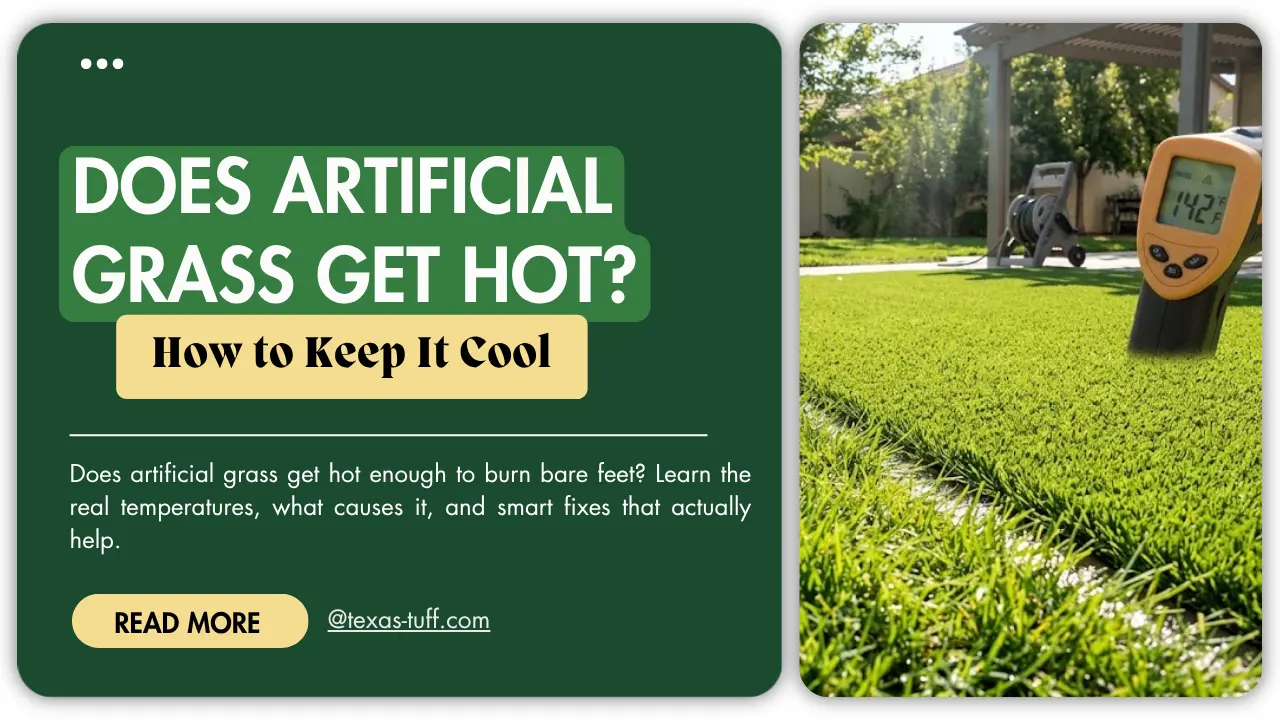
Yes. Artificial grass gets hot.
Anyone who has stepped onto a synthetic lawn on a summer afternoon has felt it. The air might read 90, but the surface is running much higher, and you notice it fast. So the real question isn’t ‘does artificial grass get hot,’ but how hot, why, and what keeps it in check.
The why is simple; turf is plastic. Plastic takes in sunlight and holds the heat, with no water inside to carry it off. A real lawn cools itself by pulling moisture up and letting it evaporate through the blades. Turf can’t. Nothing to evaporate, nothing to cool it, so the heat just builds.
How high it climbs depends on the product, the color, and the way it was installed. The name changes nothing, so does artificial turf get hot too? It does. What moves the needle is the build, not the label, and that is what the rest of this guide covers.
Does Turf Get Hot in the Sun?
Sunlight does all of it. Turf is plastic at heart, polyethylene, polypropylene, sometimes nylon, packed with infill down between the fibers. Plastic soaks up heat and keeps it.
A living lawn has one thing turf never will: water. Roots pull it up, the blades let it evaporate, and that evaporation cools the whole surface, the same way sweat cools your skin. Turf cannot do any of that.
That is the whole reason ‘does artificial turf get hot in the sun’ has such a plain answer. It is plastic, sitting in the sun, and it bakes. Whatever you call it, does synthetic grass get hot the same way? Every bit.
How Hot Does Turf Get?
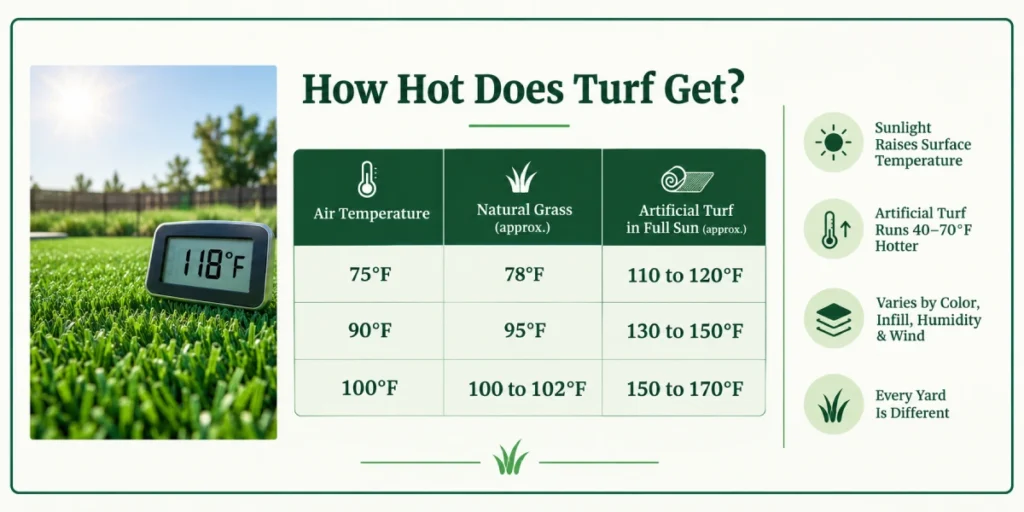
This is the part that surprises people. On a mild, sunny day, the blades can sit 40 to 70 degrees above the surrounding air. Brigham Young University measured it: synthetic fields near 117°F while the natural grass beside them held around 78°F. So the artificial turf temperature you stand on in summer has little to do with what your phone shows outside.
Ask it however you want. How hot does artificial grass get, or how hot does synthetic grass get? The number lands in the same range.
So if you have wondered ‘how hot does artificial turf get’ once the sun is fully on it, the table below is where most yards sit.
| Air temperature | Natural grass (approx.) | Artificial turf in full sun (approx.) |
|---|---|---|
| 75°F | 78°F | 110 to 120°F |
| 90°F | 95°F | 130 to 150°F |
| 100°F | 100 to 102°F | 150 to 170°F |
(Do not hold these to the exact degree. They shift with color, infill, humidity, and how long the sun has been on the surface. A light, coated turf on a breezy day sits well below a dark one that has baked all afternoon with no wind. Every yard is different, so read yours.)
Is Turf Hotter Than Grass?
Yes, and the gap is wider than most people expect. Stand on a real lawn in July, and it feels cool underfoot. Step onto turf nearby, and it can feel like a skillet.
Research from the University of Missouri, compiled by the Sports Field Management Association, recorded synthetic surfaces running 50 to 70 degrees hotter than natural grass on ordinary summer days, and past 160°F under clear skies near 98°F while the grass beside it held near 100°F.
Pin a number on ‘how much hotter does turf get,’ and it lands at a solid 40 to 70 degrees. What you feel barefoot is ‘how much hotter does turf make it feel’ at ankle height, where that heat radiates back up to kids and pets.
As for ‘how much hotter is it on turf’ compared with your patio, the gap is smaller than you might think, since asphalt and pavers can climb past 140°F. Turf runs hot, but it is not the hottest surface in the yard.
What Makes Some Turf Run Hotter
Not all turf heats up equally, and a few choices at install time make a big difference later. The real answer to ‘does artificial grass get hot’ depends heavily on what you pick. Color and material do most of the work, and the infill fills in the rest.
Older nylon products get the hottest, which is why the classic does astroturf get hot complaint is so common. Here is what pushes the temperature up or down:
- Color. Darker blades and dark crumb-rubber infill soak up more sun. Lighter tones and coated infill reflect it.
- Material. Nylon runs hottest, polyethylene sits in the middle, and quality yarns with heat-reflective pigment stay coolest.
- Sun exposure. A south-facing yard with no shade will always read higher than one that catches afternoon shadow.
- Infill choice. Coated silica and moisture-holding infills shed heat far better than plain black rubber.
Is Artificial Grass Too Hot for Dogs and Bare Feet?
It can be, on the worst afternoons. A surface over about 125°F can burn skin and paw pads with enough contact time, and midday turf clears that easily.
The American Kennel Club suggests a simple check: lay the back of your hand flat on the surface and hold it for seven seconds. If you cannot keep it there, it is too hot for paws as well. After that, the fixes are simple. Rinse the area, add shade over the play space, and keep playtime to mornings and evenings.
How to Keep Artificial Grass Cool
You will not beat physics, but you can take the edge off. It comes down to shade, water, and the materials you chose at install. Use all three, and even a hot yard stays usable.
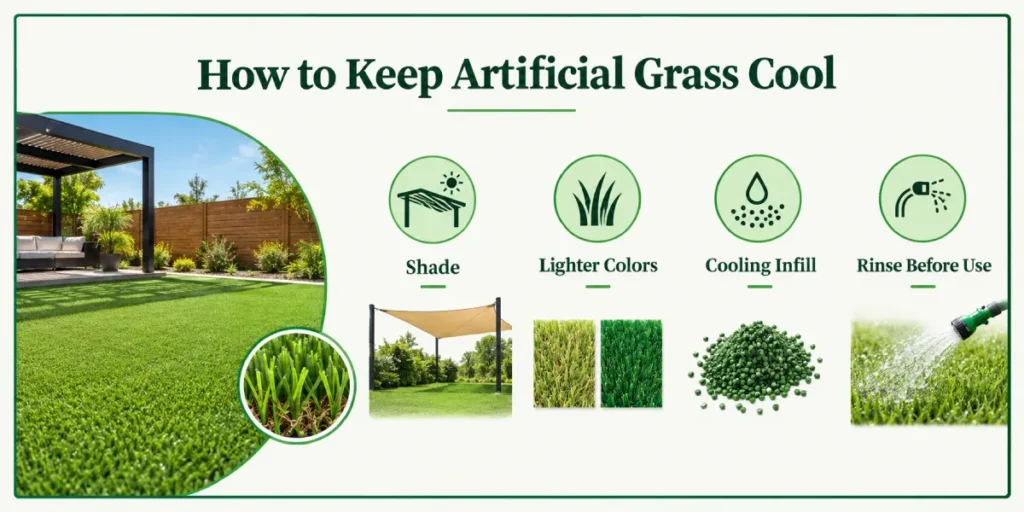
A quick rinse drops the surface fast, though the relief is short. Penn State researchers found that watering cooled synthetic turf for only about 20 minutes before it climbed back up. For turf that stays cool longer, lean on the fixes that do not evaporate:
- Shade. Sails, pergolas, and trees can cut surface temperature by roughly a third.
- Lighter colors. A tan or lighter-green blade with coated infill reads noticeably cooler underfoot.
- Cooling infill. Moisture-holding products can pull the surface down by 30 to 50 degrees on peak days.
- Rinse before use. A hose-down right before the kids go out buys you a cooler window to play in.
Pick the right materials up front, and you end up with artificial turf that stays cool enough to enjoy all summer.
Heat Resistant Turf: Does Cooler Turf Actually Exist?
Yes, within reason. No synthetic lawn will ever feel like grass under a shade tree. But heat-resistant turf today runs a fair bit cooler than the products sold ten years ago.
The difference is in the build. Manufacturers now weave heat-reflective pigment into the yarn and back it with lighter, coated infill, so a solid heat-resistant artificial grass can take real degrees off the peak.
If you are shopping for the best artificial grass for hot climates, look past the label and ask three things: how dark the blade is, what infill it takes, and whether the yarn has a cooling or reflective treatment.
The same well-made products tend to last the longest, which means long-lasting turf and cooler turf usually turn out to be the same roll. That combination is what makes an artificial grass heat-resistant enough to trust in a yard that bakes all summer.
Final Thoughts
So, does artificial grass get hot? It does, hotter than the lawn it replaced, and hot enough to plan around on the worst days.
It is still manageable. Choose a lighter, well-made blade, put a smart infill under it, add shade wherever the yard allows, and keep a hose close for the hottest afternoons. If you would like help choosing a build that holds up in real summer heat, the team at Texas Tuff can point you toward the options that stay coolest.
FAQs
Does turf get hot in the summer even in mild weather?
Yes. The sun drives the temperature, not the air. A mild 75-degree afternoon can still push the blades past 100°F once they have sat in direct light for a couple of hours. Mild air does not always mean a cool surface.
Does fake grass get hot enough to burn you?
On a hot, sunny afternoon, it can. Skin starts to burn above roughly 125°F with steady contact, and midday turf clears that line easily. The quickest way to check before anyone goes barefoot is the back-of-hand test: seven seconds on the surface.
Is there turf that doesn’t get hot at all?
Not really, but there is a wide gap between the coolest and hottest products. A light-colored, heat-reflective blade with coated infill in a shaded yard is about as cool as synthetic grass gets.
Does hot weather make the pee smell worse?
Yes. Heat speeds up the bacteria breaking down urea and reactivates the uric acid crystals sitting in the infill, which is why the smell peaks in summer. Picking artificial grass that doesn’t get hot at install time can soften both the heat and odor issues at once.