

Leave a playset in the yard for a year, and the lawn shows where kids climb and land. The grass by the ladder goes first. Then the strip at the bottom of the slide turns to dirt, and after a few dry weeks that dirt is about as forgiving as a driveway.
That’s usually when parents start pricing turf. Looks and softness in a sample, though, say very little about how a surface handles a fall. So when you compare the best artificial grass for playground use, look under the turf first. Ask what pad is going down and whether it has a test report behind it.
Is Artificial Grass for Playgrounds Safe on Its Own?
On their own, the blades on top do very little to soften a landing. The shock pad installed underneath does most of the cushioning. That’s why safety gets judged on the whole system, turf and pad together, and why that system should come with an independent fall height rating.
Why Fall Protection Comes First
Backyards are the weak spot. When the CPSC looked at home play areas in a special study, it found protective surfacing under the equipment in only about 9 percent of them. Most kids were playing over plain dirt or grass.
A cushioned surface deals directly with the most common way children get hurt on a playground.
How ASTM F1292 Rates Playground Artificial Turf
In the U.S., impact absorption on playground surfaces is measured under a standard called ASTM F1292. A lab drops a metal headform fitted with sensors onto the surface and records two numbers. G-max is the peak shock. The second number, HIC (short for Head Injury Criterion), looks at both how hard the headform hit and how long the impact lasted.
A surface passes at a given height if g-max stays below 200 and HIC stays below 1,000. The highest drop that still passes becomes the surface’s critical fall height.
Before buying, get that rating on paper. A product page calling the turf “soft” or “kid-safe” is using marketing language, and it tells you nothing about how the surface tested.
Critical Fall Height and Shock Pad Thickness Explained
Turf systems have a fall height limit. So does every play structure. The surface rating has to meet or beat the tallest fall a child could take from the equipment in your yard, and working that out takes two steps, both simple enough to do with a tape measure.
How to Measure Your Equipment’s Fall Height
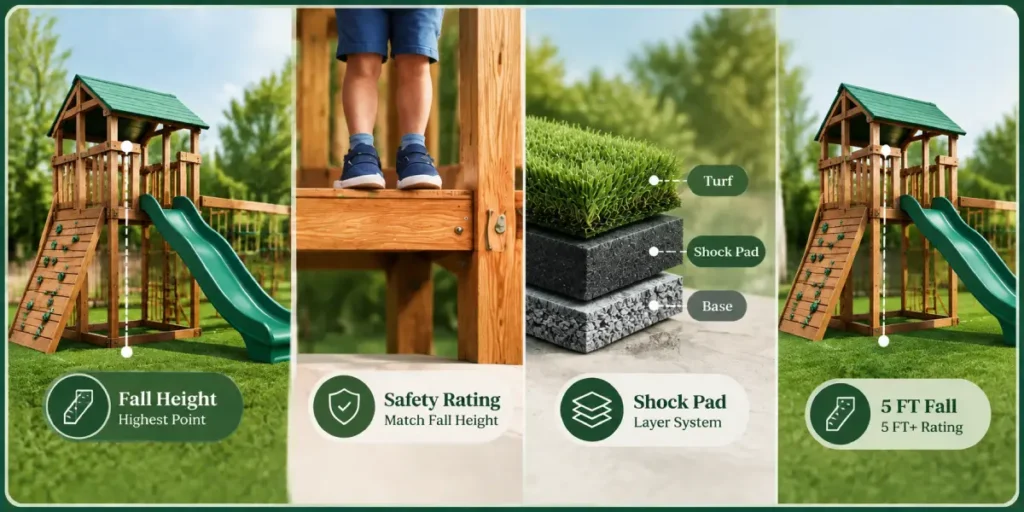
Measure from the highest spot where a child can stand. On a playset with a covered fort, that’s the fort deck. The roof peak doesn’t count, since nobody stands on it. For a climbing dome, use the highest foothold.
Do this for each piece of equipment. The tallest number sets the minimum rating for the whole play area.
How to Match Artificial Playground Turf to Equipment Height
Shock pads come in different thicknesses and foam densities, and each turf-and-pad combination gets tested as one unit. Thicker pads usually support higher ratings, although two pads of the same thickness from different makers can test quite differently.
So work from your own measurement. A playset deck 5 feet off the ground needs a system with a documented critical fall height of at least 5 feet. Going a little above that number gives the pad some room to compress over the years.
How to Choose the Best Artificial Turf for Playground Surfaces
Once the pad takes care of impact, the turf has to take care of wear. Play areas get a lot of it, concentrated in a few spots like the slide exit, the swing path, and the base of the ladder. Fiber, pile height, face weight, and infill all decide how well the surface holds up.
Which Turf Fiber Suits a Play Area?
Turf fibers come in three main types: polyethylene, nylon, and polypropylene. Each one balances softness, toughness, and price in its own way, and the differences show up fast under a slide. Here’s how the three compare on a play surface.
| Fiber | Feel on Skin | Durability | Suitability for Play Areas |
|---|---|---|---|
| Polyethylene | Soft and close to natural grass | Recovers well with proper infill | Strong choice for most play surfaces |
| Nylon | Stiffer and coarser | Highest wear resistance | Better suited to putting greens; can cause turf burn on knees and elbows |
| Polypropylene | Soft when new | Flattens under heavy traffic | Budget option; weaker in high-use zones |
Two products made from the same fiber can still perform quite differently, so compare the spec sheet of the exact turf you’re considering.
For most homes, polyethylene is the best artificial grass for playground areas. It’s gentle on bare knees and still springs back after a full day of play.
What Pile Height and Face Weight Work Best?
Short and dense works better than tall and plush under play equipment. A pile of about 1 to 1.25 inches stays upright when kids run across it and doesn’t mat down as fast. Taller blades look great in a front yard. Under a swing, they fold over and leave worn-looking lanes.
Face weight is the amount of fiber in each square yard, and more fiber means turf that wears more slowly. Texas Tuff’s Palo Duro, for example, uses a 1 1/8-inch polyethylene pile built for playgrounds and other high-traffic spaces.
Which Infill Works Best in Synthetic Turf for Playground Areas?
Infill is the sand-like material brushed down between the blades. It holds the turf in place and keeps the fibers standing up. It also changes how hot the surface gets, which counts for a lot when toddlers are sitting on it. The usual choices are listed below.
- Coated silica sand, smoother on skin than plain sand
- Zeolite, a porous mineral that holds moisture and helps with odor
- Cooling infill, which stores water and lowers surface heat as it evaporates
- Crumb rubber, bouncy but hot
Parents also ask about recycled tire rubber, and it’s a fair question. The EPA’s federal research on tire crumb found metals and other chemical compounds in the material, though human exposure in the fields studied looked limited. CPSC is running its own research on playgrounds. Plenty of families simply pick a mineral or coated infill and leave rubber out of it.
How Does Synthetic Grass for Playground Areas Handle Summer Heat?
Heat is the weak point of any turf in a warm climate. According to Penn State’s Center for Sports Surface Research, synthetic turf generally runs 35 to 55°F hotter than natural grass on hot days. Where summers are long and hot, that gap shapes when a play area is comfortable to use.
The fibers themselves soak up sunlight, so no turf stays cool at 3 p.m. in August. What you can do is bring the temperature down and stretch the hours when the play area is comfortable to use:
- Put play structures where afternoon shade falls, or add a shade sail
- Choose olive or field green over very dark green
- Skip black rubber infill in favor of a cooling or mineral one
- Schedule outdoor play for mornings and evenings during the hottest months
A quick spray with the hose cools the surface fast. In full sun, though, the effect only lasts about 20 minutes, so it works best right before the kids head outside.
Playground Turf for Backyard Play Sets vs. Commercial Sites
The same kind of system works at home and at a school. The rules around it are different. A backyard play set serves one family, while a daycare or public playground serves dozens of children a day, carries more liability, and usually has to follow safety guidelines and keep inspection records.
Home Swing Sets and Climbers
A home project can be smaller, but the shock pad is the wrong place to trim the budget. Measure the play set deck and pick a system rated above it.
Then cover the whole use zone around the set. Turf cut only to the play set’s footprint leaves the slide exit and swing path on hard ground. That’s where a lot of falls end.
Artificial Turf for Playgrounds at Schools, Daycares, and Parks
Commercial sites should ask for a documented ASTM F1292 rating on the installed system. Many will also need an accessibility check under ASTM F1951, which measures how easily a wheelchair moves across the surface.
CPSC points out that some states, local jurisdictions, and insurers require compliance with its handbook and the related ASTM standards. Find out what applies before ordering anything. Once the playground opens, keep written inspection records.
How to Install Artificial Turf for Playground Areas Correctly
A well-rated product can still let you down on a poor base. Uneven compaction leaves soft spots. Weak drainage leaves puddles. Loose seams trip kids up. How the surface is installed decides whether it performs the way its test report says it will, year after year.
Use Zones and Surfacing Coverage
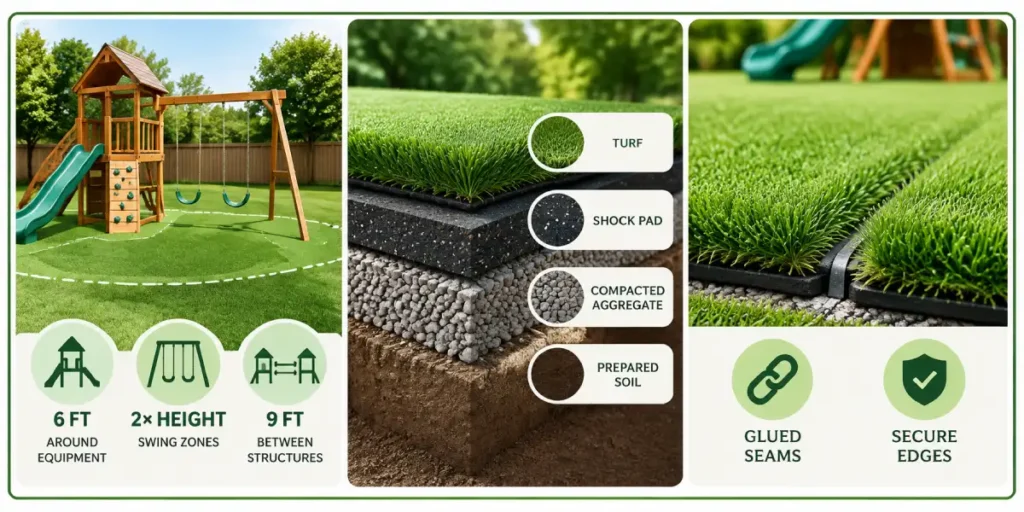
CPSC guidance calls for protective surfacing at least 6 feet out in every direction from play equipment. Swings need more room, reaching twice the height of the top bar both in front and behind. Structures taller than 30 inches should sit at least 9 feet apart.
Mark these zones out in the yard first. Order turf only once the layout is set.
Base, Drainage, and Seams
Clay soil drains slowly once it’s wet, and plenty of yards sit on it, so the base under a playground deserves extra care. A standard install digs out 3 to 4 inches of soil, grades a slight slope for runoff, and fills back in with compacted crushed aggregate.
The shock pad goes on top of that, then the turf. Seams should be glued and secured so no edge can lift. Where the layout allows, keep them away from landing spots like slide exits.
How Does Artificial Grass for Play Area Surfacing Compare With Mulch and Rubber?
Turf isn’t the only accepted playground surface. Wood mulch, rubber mulch, and poured-in-place rubber all show up on playgrounds across the country, each with its own strengths. They differ in fall protection, upkeep, access, and heat, as the table below shows for home and light commercial use.
| Surface | Fall Protection | Maintenance | Accessibility | Heat in Sun |
|---|---|---|---|---|
| Turf with shock pad | Based on the system’s test rating | Brushing, rinsing, and infill top-ups | Firm, level surface | Hot |
| Wood mulch | Depends on depth; the CPSC checklist calls for at least 12 inches | Frequent raking and refilling | Difficult for wheelchairs | Stays cooler |
| Rubber mulch | Depends on depth | Raking; scatters easily | Difficult for wheelchairs | Hot |
| Poured-in-place rubber | Based on thickness and test rating | Low day-to-day; repairs are costly | Excellent | Hot |
Results depend on the product, the depth, and the quality of installation. Ask each supplier for test data on the exact system before you decide.
Final Thoughts
For most families, the best artificial grass for playground use is a soft polyethylene turf laid over a shock pad tested above the height of the tallest deck or climber. That pad is where the budget should go first. After that, good infill and drainage keep the surface clean and level, and a little shade planning makes it usable on hot afternoons. With those pieces in place, a play area can stay green for years without much work.
For a second opinion on your yard, Texas Tuff installs playground turf over a cushioned pad for homes, schools, and daycares. Its turf products come with a 15-year warranty, and a site visit covers fall heights, use zones, and base prep before anything gets ordered.
FAQs
How Thick Should a Shock Pad Be Under Playground Turf?
It depends on the product, which is rarely the answer people want to hear. Pads are rated as part of a system, meaning one specific pad tested under one specific turf. Swap either one, and the rating may no longer apply. The practical route is to measure the tallest fall height in your yard and ask the installer for a test report showing their system covers it.
Can You Install Turf for Play Area Use Directly Over Dirt?
Not if you want it to stay flat. Dirt shifts as it gets wet and dries out, and clay can hold water for days after a storm. Within a season, you would likely see dips, soft spots, and puddles. A few inches of excavation and a layer of compacted gravel give the pad and turf something stable to sit on.
How Long Does Playground Turf Last?
Ten to twenty years is a fair range for good turf with UV protection and a solid base. Where it lands in that range has a lot to do with traffic. A backyard used by two kids after school will outlast a daycare yard used by forty kids all day. Brushing, topping up infill now and then, and checking the pad for compression help push it toward the longer end.