

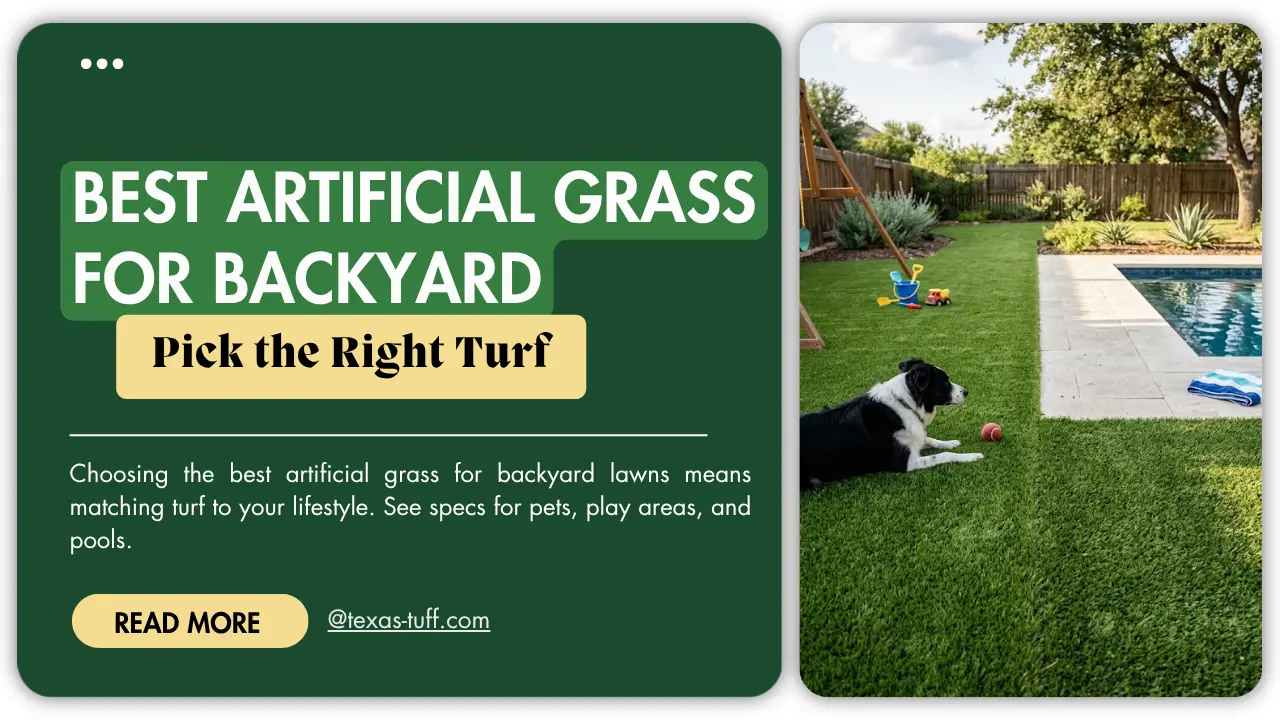
A few weeks of hot weather can undo months of your hardworking lawn care. Brown patches show up even with the sprinklers running on their allowed days. And if there’s a dog, there’s probably a bare track along the fence by now. That is usually when you start pricing turf.
Picking the best artificial grass for backyard use comes down to reading a spec sheet correctly. Pile height. Face weight. Backing type. Choose poorly, and the turf may be matted by year two. Choose well, and eight years later it can still look close to new.
What Is the Best Artificial Grass for Backyard Use Where Summers Run Long?
It depends on the yard, and anyone recommending a product before asking about yours is guessing. Two things count most here: who’s out there using the space, and how many hours of direct sun it gets. Both are worth sorting out before you compare a single sample.
How Will the Yard Be Used?
Picture a regular Tuesday, not the big summer cookout. If the yard mostly gets used for sitting out after dinner, a taller and softer turf is fine.
Kids and big dogs change that. Running, turning, and digging flatten tall blades quickly, so a busy yard needs shorter turf with more fiber packed into it. Appearance still counts, but it comes second to traffic.
How Do Sun and Heat Affect Turf?
Heat is where synthetic grass struggles. Researchers at Penn State’s Center for Sports Surface Research found that synthetic turf usually runs 35 to 55°F hotter than natural grass when it’s hot out. That’s a big difference, and in places where summer drags on for months, you’ll feel it most afternoons.
So color and infill deserve as much thought as softness does. Olive and field green shades absorb less heat than very dark greens, and some fibers are made to reflect sunlight. A cooling infill helps too, at least for a few hours after watering.
Polyethylene, Nylon, or Polypropylene?
Turf blades come in three plastics, and a lot of products blend two of them together. Which one you get changes how the lawn feels when you walk on it and how quickly it stands back up after being flattened. It also changes the price. Seeing the three side by side makes the choice easier.
| Fiber | Softness | Durability | Relative Cost | Best Use |
|---|---|---|---|---|
| Polyethylene | Soft, natural feel | Good | Moderate | Most backyard lawns, play areas, and pet areas |
| Nylon | Stiff | Highest | Highest | Putting greens and very heavy traffic |
| Polypropylene | Soft when new; flattens with wear | Lowest | Lowest | Light-use decorative areas and thatch layers |
Keep in mind that turf made from the same fiber can vary quite a bit from one brand to the next. The spec sheet for the exact product tells you more than the fiber name does.
Polyethylene
Most home lawns are polyethylene. It feels soft underfoot and looks a lot like grass, and for a normal family yard it bounces back well enough. One thing to check is UV protection. If the fibers don’t have UV stabilizers, strong sun will fade them and make them brittle, sometimes within a few seasons.
Nylon
Of the three, nylon holds up best, and it’s usually the priciest. You’ll find it on a lot of putting greens, where it has to keep its shape under steady foot traffic. Across a whole lawn, though, it can feel stiff, even a bit scratchy, so most homeowners go with something softer for the main yard.
Polypropylene
Polypropylene is the cheapest option. New, it feels okay. After a season or two of regular traffic, it tends to lie flat, and it doesn’t hold up to heat as well as the others. Where it does work is in low-traffic decorative spots, or as the curly thatch layer tucked inside better turf.
Pile Height, Face Weight, and Density
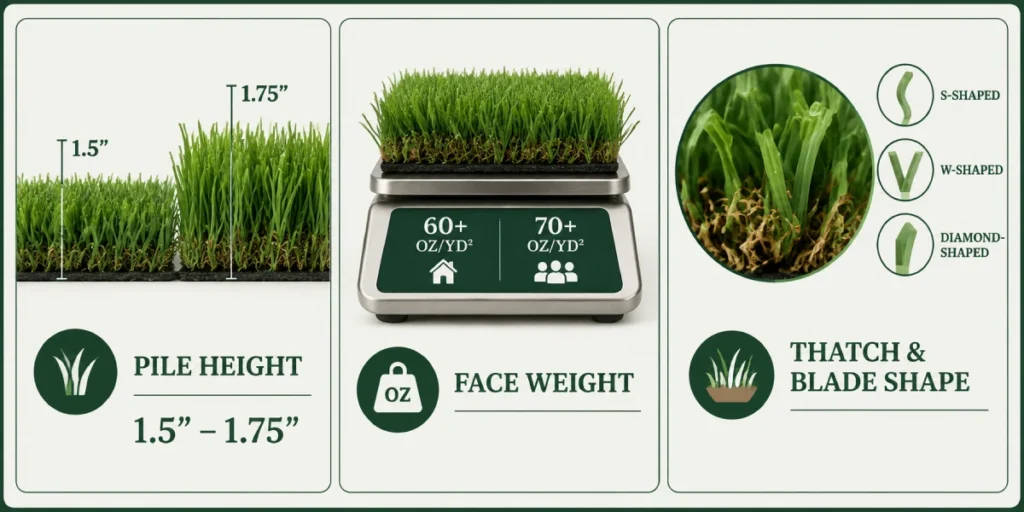
Spec sheets list a lot of numbers. Only three of them say much about how a lawn will look after a few years of use, and even those make more sense read together than one at a time. Pile height, face weight, and blade design are the ones to focus on.
Which Pile Height Fits Your Yard?
Pile height is the blade length, measured from the backing to the tip. Below about 1.5 inches, blades stay upright under pets and play. If you go taller, the lawn looks fuller, though you’ll be brushing it more often to stop it from matting.
Most backyards do well somewhere in the 1.5 to 1.75 inch range.
What Does Face Weight Tell You?
Face weight is the number of ounces of fiber in one square yard of turf, with the backing left out. More fiber means a denser lawn that wears more slowly. For a busy backyard, look for 60 ounces or more. Yards that take heavy traffic every day do better at 70 ounces and up.
Watch for one thing when comparing products. Some sheets list total weight instead, which includes the backing and always looks higher.
Thatch and Blade Shape for a Natural Look
A natural lawn has a layer of dead, brownish blades under the green. Good turf copies that with a curled tan or brown thatch, which also helps prop up the taller blades.
Blade shape is the other detail. Flat blades tend to shine in the sun and look plastic, while S-shaped, W-shaped, and diamond-shaped blades break up the light. Texas Tuff’s Rio Grande Deluxe, for example, uses a 1¾-inch pile of three-color S-shaped blades with a brown and green thatch.
Backing, Drainage, and Infill
The parts you can’t see do a lot of the work. If water can’t get through the backing, or the infill soaks up heat all afternoon, the lawn will disappoint no matter how good the blades looked in the sample. Check these details before you sign off on any product.
Perforated vs. Fully Permeable Backing
Perforated backing has small holes punched through it every few inches. For an ordinary lawn that gets rain and the occasional rinse, that’s enough.
Fully permeable backing lets water through across the whole surface. It drains faster and more evenly, which makes it the better pick for dog areas and any low spot where water tends to sit.
Infill Choices for a Cooler Surface
Infill is the sand-like material brushed down between the blades. It keeps the turf weighted down and the fibers standing, and it has a lot to do with how hot the surface feels in the afternoon. These are the options most installers offer for backyards:
- Silica sand, the budget choice
- Coated sand, which is smoother and sometimes has an antimicrobial coating
- Zeolite, for pet odor
- Cooling infill, which holds water and releases it as the turf heats up
Best Artificial Grass for Backyard With Dogs
Dogs are hard on turf in ways people aren’t. Urine has to drain fast. Odor has to stay under control. The fibers also need to survive a dog that likes to dig. Pet turf looks a lot like standard turf, but a few added features make a clear difference:
- Fully permeable backing
- A dense pile under 1.5 inches, which is easier to clean
- Face weight in the 60 to 80 ounce range
- Zeolite or antimicrobial infill
Texas Tuff’s pet guide notes that turf in the 60 to 80 ounce face weight range lasts significantly longer under regular dog traffic. Its pet installations also carry a 15-year warranty covering both the turf and the labor. The full guide to the best artificial grass for pets goes into more detail.
How to Match Artificial Grass for Backyards to Your Lifestyle
A pool deck and a shady strip under an oak tree need different turf, even when they sit in the same yard. Traffic, sun, and moisture all change from one spot to the next. The table below lines up common backyard setups with the specs that tend to work for each one.
| Backyard Use | Pile Height | Face Weight | Fiber | Infill |
|---|---|---|---|---|
| Family play yard | 1 to 1.5 in. | 60 oz. or more | Polyethylene | Coated sand |
| Dog run or pet yard | Under 1.5 in. | 60 to 80 oz. | Polyethylene or blend | Zeolite or antimicrobial |
| Pool surround or patio | 1.25 to 1.75 in. | 60 oz. or more | Heat-reflective polyethylene | Cooling infill |
| Relaxation lawn | 1.5 to 2 in. | 70 oz. or more | Polyethylene with thatch | Silica or coated sand |
| Shaded yard | 1.25 to 1.75 in. | 60 oz. or more | Polyethylene | Coated sand |
Treat these as starting points. Slope, drainage, and the amount of sun a spot gets can shift the right choice, and a good installer will check all of it on site.
Family Play Yards
Kids run the same routes over and over. Short, dense polyethylene handles that and stays comfortable on bare skin. Is there a swing set or climbing frame in the yard? Then the area under it also needs a shock pad rated for the equipment’s fall height.
Pool Surrounds and Patios
Turf beside a pool deals with splashing water, wet feet, and heat bouncing off the concrete. Fully permeable backing clears the water quickly. Add a cooling infill and a softer fiber, since people will walk on it barefoot for months.
Shaded Yards
Shade keeps turf cooler, which helps. The trade-off is slower drying and more leaves to clear, though a permeable backing and a leaf blower take care of most of that. This is also where turf makes the most sense, because Bermuda and other sun-loving grasses thin out badly in heavy shade.
Warranty, UV Protection, and Lifespan
A warranty is a fair signal of how long a manufacturer expects its turf to last. Read what it covers. Fading and fiber breakdown should be on the list, and it’s worth asking whether labor is included too.
In hot, sunny places, UV stabilizers are a must. Without them, fibers can fade and weaken after just a few summers. Installed properly and looked after, good artificial grass should last somewhere around 10 to 20 years. Texas Tuff puts a 15-year warranty on its turf products.
What Does Artificial Grass for Backyard Installation Cost?
What you pay comes down to how big the yard is, which turf you pick, and how much work the ground needs first. Angi lists turf materials at $2 to $8 per square foot and an average installed project at $5,784, though most homeowners end up spending somewhere between $1,300 and $15,000. Excavation can add $150 to $600 on its own. Curved borders, or a yard that’s hard to get equipment into, will raise labor too.
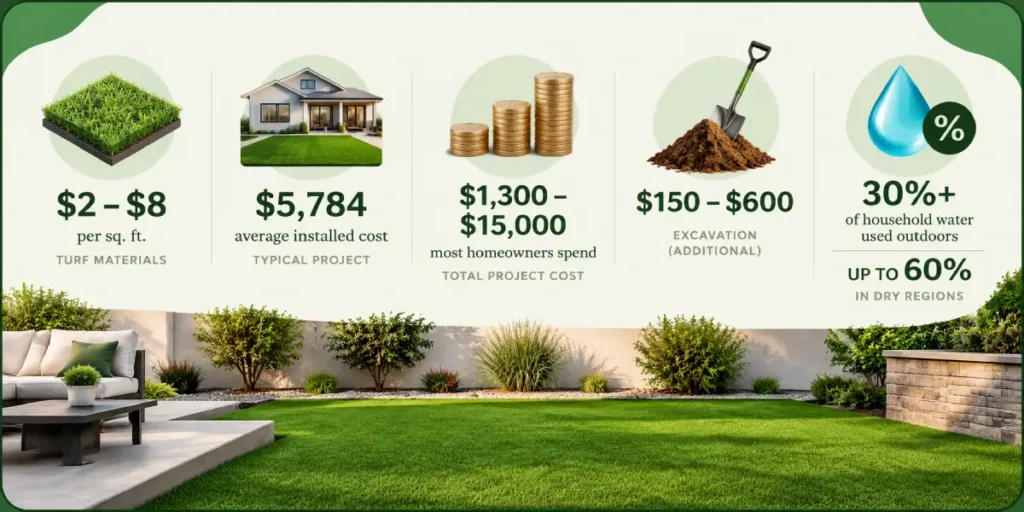
Some of that comes back on the water bill. According to the EPA’s WaterSense program, outdoor use accounts for more than 30 percent of household water on average, and up to 60 percent in dry regions. Texas Tuff’s guide to how much artificial grass costs breaks down pricing in more detail.
Final Thoughts
In most cases, the best artificial grass for backyard use ends up being a UV-protected polyethylene turf with about a 1.5-inch pile and a face weight of 60 ounces or more. From there, the backing and infill should fit the household. Dogs call for fully permeable backing and odor-control infill. A pool area does better with cooling infill and a softer blade.
Not sure which setup fits your yard? Texas Tuff can look at your sun, your soil, and how the yard gets used, then suggest turf specs to match before anything is installed.
FAQs
How Do I Choose Artificial Grass for My Backyard?
Think first about who uses the yard, and how much. With kids or dogs in the picture, go shorter and denser: polyethylene with 60 ounces of face weight or more. If it’s mostly a place to sit out in the evening, a taller, softer product will look better and hold up fine. After that, weigh up sun, drainage, and what you want to spend. And get samples. Look at them outside in your own yard, since turf can look quite different under indoor lights.
Will Turf Get Too Hot to Use in Summer?
On a sunny afternoon, it can get too hot to sit on comfortably. The best fix is shade, whether that’s a tree, a pergola, or a shade sail. Lighter greens and a cooling infill take some of the edge off too. Hosing it down cools the surface quickly, but only for about 20 minutes.
Is Nylon or Polyethylene Better for Kids and Pets?
For most homes, polyethylene. Kids and dogs find it softer, and it still stands up to everyday play. Nylon will last longer under very heavy wear, but it’s coarse, which is mainly why you see it on putting greens and not so much on family lawns.
What If Your Yard Has Clay Soil?
Turf can still go in, as long as the base is built properly. Clay soaks up water and then shrinks as it dries, and turf laid right on top of it will start to sink and hold puddles. The usual approach is to dig out 3 to 4 inches, slope the ground so water drains away, and compact a layer of aggregate before the turf is rolled out.