

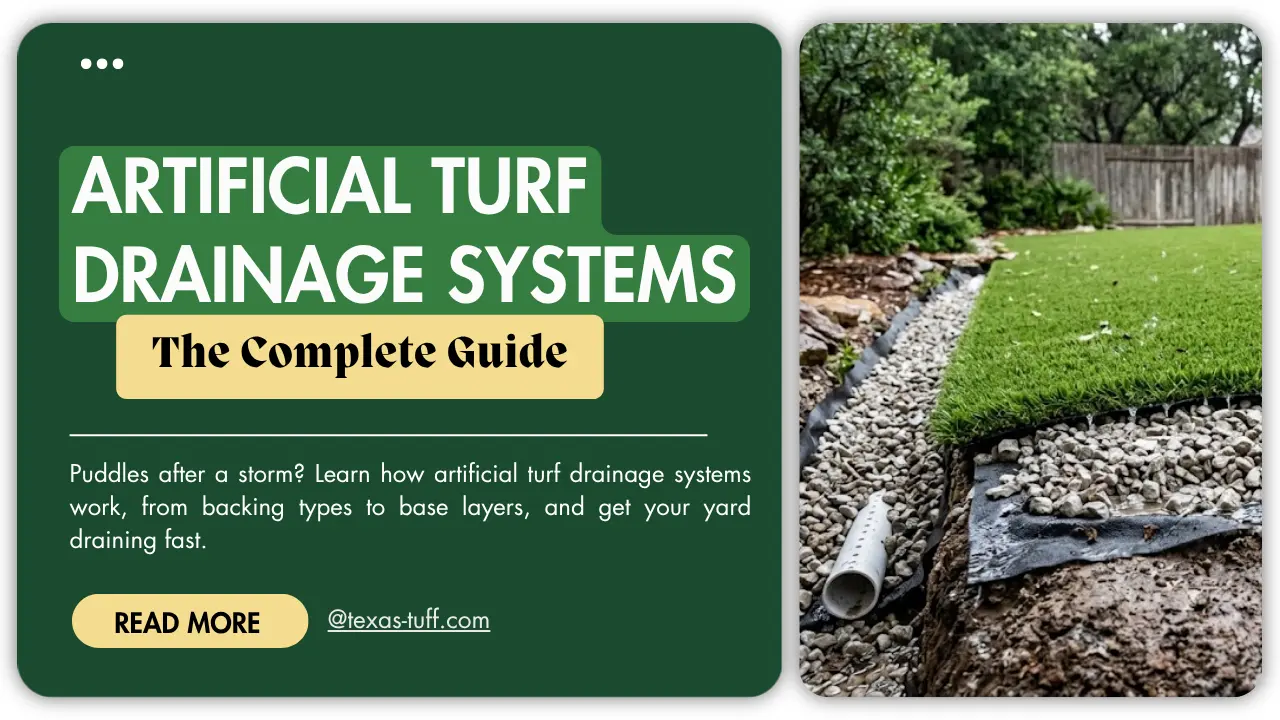
When raindrops fall on the real lawn, the dirt can drink it up. Slowly, but it drinks. Synthetic grass cannot. The water has to go somewhere, and that’s the whole point of artificial turf drainage systems. Get it right, and the yard is dry an hour after a storm. Get it wrong, and you have got a shallow pond with grass floating on top.
Clay soil makes it tougher. Clay barely drains by itself, so good artificial grass drainage has to carry the water around it. Down through the turf, into the base, and out. Before any of it gets a chance to sit.
Synthetic Turf Drainage, Layer by Layer
Three layers, top to bottom. The green blades you see. A backing they are stitched into. Then a bed of crushed rock holding it all up.
Water runs down the blades, slips through the backing, and hits that rock. Some soaks away into the ground. The rest rides the slope off to one side.
People blame the grass when a yard puddles. It is almost never the grass. It is the base. You can buy a backing that drains like a sieve and still stand ankle-deep after a storm if the layer underneath got rushed. This guide focuses on that layer.
Two Backings, Two Speeds of Drainage for Artificial Turf
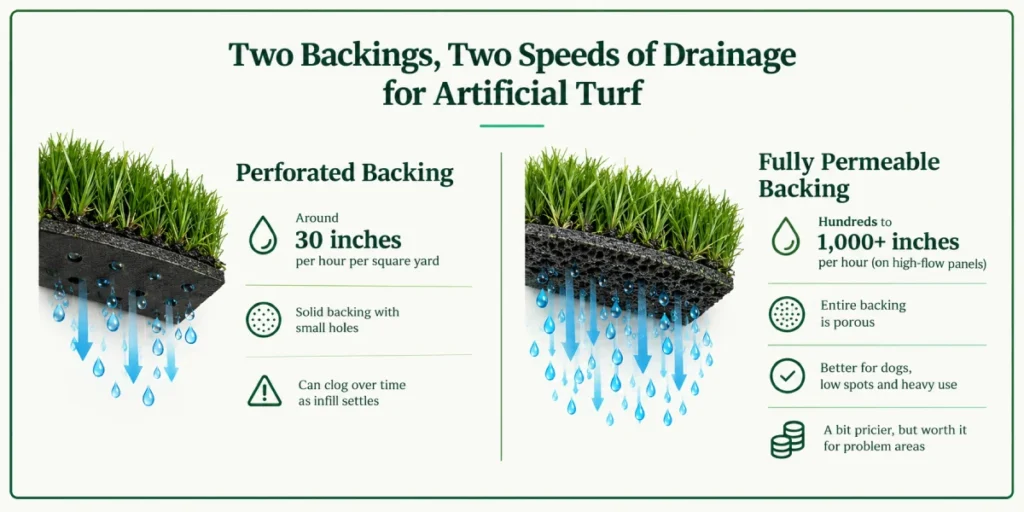
Backing comes in two ways, and the one on your roll decides how fast a storm clears. Both let water through. The difference is how much and how fast, and it is wider than most buyers expect. Worth sorting out before you order, especially for a soggy corner or a dog run. It comes down to how the backing is built.
Perforated Backing
The common one. A solid backing with small holes punched through at set spacing. Water finds the holes and drops down. Figure around 30 inches of water per hour per square yard, which is plenty for normal rain.
The weak point: those holes can clog over the years as fine infill works its way down into them.
Fully Permeable Backing
Here the whole backing is porous. Water passes through the entire sheet instead of hunting for holes, so the flow rate jumps into the hundreds, sometimes past a thousand inches an hour on high-flow panels.
Got a dog, or a low spot that always holds water? This is the safer buy. A bit pricier, and worth it on the yards that need it.
The Base Layer Does the Heavy Lifting
Ask any installer where drainage goes bad, and nobody points at the grass. They point down. This is the part of artificial turf drainage systems that decides whether your yard sheds water or holds it.
Get the base right and the turf mostly minds itself. A good turf drainage base leans on a few things at once:
- A permeable sub-base. Three to four inches of crushed or decomposed granite, giving water a clear road down.
- Firm compaction. Packed down hard. Sounds backward, but a loose base sinks into puddles later.
- A slope. One to two percent, about an eighth of an inch per foot, nudging runoff toward a drain or a low edge.
- Separation fabric. Geotextile fabric keeps soil from creeping up into the rock and clogging it.
That base does the most work on clay. Texas A&M AgriLife Extension notes that clay soils hold too much water and let almost no air through, which is why puddles linger on them. The base gives that water an exit.
Same idea the EPA describes for permeable surfaces, where stormwater sinks into layers of soil and gravel instead of sheeting off hard ground. Skip the base, roll turf straight onto graded clay, and you have built a bathtub.
When You Need an Extra Artificial Grass Drainage System
Most yards do fine on a solid base and a slope. Some do not. A low lot, water that hangs around after storms, turf going over concrete- those are the ones where an add-on pays for itself. The usual suspects:
| System | What it does | Best for |
|---|---|---|
| French drain | A gravel trench with a perforated pipe that carries water underground and away | Low spots and heavy runoff |
| Catch basin | A small grated box that collects surface water and pipes it off | Areas where water gathers at one point |
| Channel drain | A long, narrow surface drain set along the turf edge | Borders next to patios or driveways |
| Sub-base drainage grid | Panels with open voids that hold a gap under the turf so water can spread and move | Turf over concrete, rooftops, or balconies |
(Which one fits comes down to your yard, so read this as a starting point, not a prescription. Watching where water pools after a real storm tells an installer more than any table can.)
There is a health angle too. The CDC points out that mosquitoes only need standing water to breed, and one can go from egg to biting adult in seven to ten days.
Clemson’s extension office draws the line at about five days of standing water. Drainage that clears quickly never hands them the chance.
Pet Areas and Synthetic Grass Drainage
Dog owners notice drainage trouble first, and usually through their nose. Ever caught a pet lawn on a hot afternoon? That sour hit is a drainage problem, not the grass. Urine has to flush straight through the backing, not pool in the base.
For a dog run, you can go with a fully permeable backing and an infill that fights odor, usually a coated sand made for it. Add a base that clears fast and the odd rinse, and the spot stays livable instead of going foul.
Drainage Mistakes That Leave You With Puddles
Most failures come from the same short list of shortcuts, and they all end the same way. Standing water. A well-built artificial turf drainage setup dodges every one of them, and none are hard if the crew takes its time.
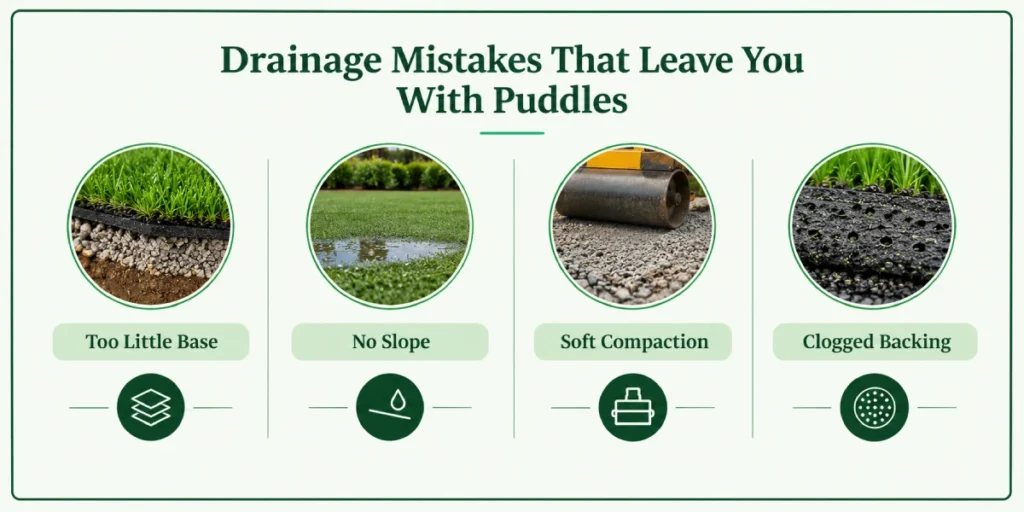
Keep an eye out for:
- Too little base. Thin or skipped aggregate leaves water nowhere to go.
- No slope. Flat installs let water sit.
- Soft compaction. A loose base settles into low pockets that collect water.
- Clogged backing. Cheap infill drifts into the holes and plugs them.
Any one of these will sink an otherwise fine synthetic turf drainage system, which is why who lays the turf counts as much as what you buy. Two identical rolls can drain nothing alike depending on the hands that put them down.
Final Thoughts
Drainage is the part of a synthetic lawn nobody looks at, and everybody feels. Do it well, and you forget it is there, even after the heaviest storm. Do it badly, and it is the first thing you notice every time the sky opens.
Solid artificial turf drainage systems come down to four things: an honest base, a true slope, the right backing, and a crew that respects all three. If you are weighing a synthetic lawn for a home or a dog run, we are glad to come walk your yard and map the drainage before a single roll goes down. See our work and reach the team at texas-tuff.com.
FAQs
Does artificial grass need a separate drain?
Usually not. A permeable backing over a sloped gravel base handles most yards on its own. The extras (French drain, catch basin, channel drain) come in when the lot is low, sits on clay, or holds water after rain.
How fast does artificial turf drain?
Depends on the backing. Perforated runs about 30 inches an hour per square yard. Fully permeable moves far more, into the hundreds. Both shrug off normal rain as long as the base under them was done right.
Why does my artificial grass still puddle?
Nine times out of ten it is the base, not the grass. Thin aggregate, no slope, loose compaction, clogged holes. The trouble sits in the layers below the turf, so patching the top seldom fixes it.
Can you put turf with good drainage over concrete?
Yes. A sub-base drainage grid or shock-pad panel opens a gap under the turf so water slides sideways to a drain. Common on patios, rooftops, and balconies where nothing can soak into the ground.