
How Much Does Synthetic Turf for Playgrounds Cost?
Playground synthetic turf typically costs about $6–$20 per square foot installed, depending on safety requirements, base preparation, and turf quality, with most school and park projects landing around $9–$14 per square foot and higher costs driven by shock pads, drainage, and heat-resistant materials.
Artificial Turf for Playground Cost
Synthetic turf for playgrounds costs between $6 and $20 per square foot installed, depending on the turf grade, infill system, base preparation, and site conditions. A small 500 square foot play area typically runs $5,000 to $8,000. A large school or park playground covering 5,000 square feet commonly falls between $35,000 and $75,000.
At Texas Tuff, we work with schools, apartment complexes, HOAs, and homeowners across the Dallas-Fort Worth area. The most common question we hear is not just the price, but what drives that price up or down. This guide answers both questions with real data, not guesswork.
Material Cost Per Square Foot by Grade
Turf material is priced by the grade of the product. Playground turf grades are defined by pile height, blade shape, face weight (ounces of fiber per square yard), and whether the product meets ASTM safety standards for fall attenuation.
Playground Turf Material Cost Per Square Foot by Grade (Materials Only, Not Installed)
What Face Weight Actually Means
| Grade Tier | Face Weight | Pile Height | Material Cost (per sq ft) | Best For |
|---|---|---|---|---|
| Entry-Level | 28 - 32 oz | 1.25" - 1.5" | $2.50 - $3.50 | Low-traffic residential, small yards |
| Standard | 35 - 40 oz | 1.5" - 1.75" | $3.75 - $5.00 | Residential with moderate use |
| Mid-Grade | 42 - 50 oz | 1.75" - 2.0" | $5.00 - $7.00 | HOA commons, small commercial |
| Premium Safety | 52 - 60 oz | 2.0" - 2.25" | $7.00 - $9.50 | School playgrounds, park play areas |
| Elite + Shock Pad | 55 - 65 oz | 2.25" - 2.5" | $9.50 - $12.00 | Certified commercial, ADA compliance |
Full Playground Turf Installation Cost Breakdown
Material is only part of what you pay. A proper synthetic turf installation for a playground involves site preparation, base construction, drainage, turf, infill, and edging. Each line item below is what a professional installer like Texas Tuff includes in a quoted project.
Per Square Foot Cost Breakdown: All Installation Components
Infill Types and Their Costs
Infill is what sits between the turf blades. On playgrounds, infill must serve two purposes: keep the blades upright and provide impact cushioning. The infill you choose has a significant effect on both safety performance and total project cost.
Texas Tuff Recommendation: For Texas playgrounds, coated antimicrobial sand or TPE infill outperforms basic crumb rubber in heat management and cleanliness. Texas summers push surface temperatures on dark-colored surfaces well past 150 degrees Fahrenheit. Infill type and turf color both affect how hot your playground gets at noon in July.
Playground Turf Cost by Project Size
Project size affects both the per-square-foot cost and the total project cost. Larger projects often see lower per-square-foot pricing because mobilization, equipment, and site prep costs spread across more area.
Here is what real budgets look like at different square footages.
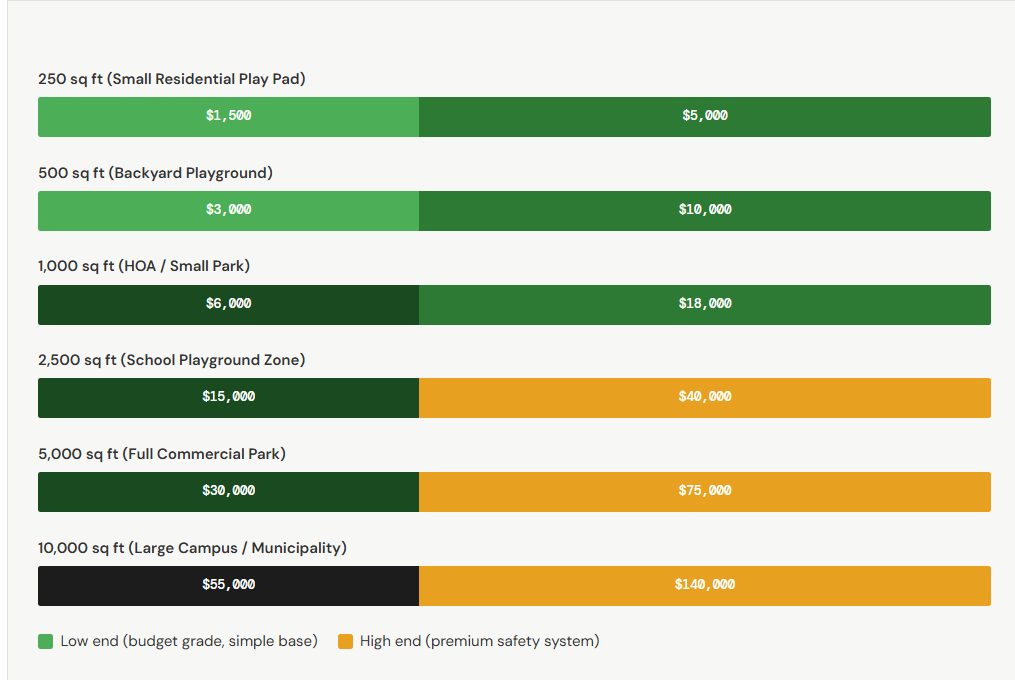
Total Installed Cost by Playground Size (Low-to-High Range)
| Project Size | Typical Setting | Cost Range (Installed) | Per Sq Ft Range |
|---|---|---|---|
| 250 sq ft | Residential backyard play area | $1,500 - $5,000 | $6 - $20 |
| 500 sq ft | Backyard playground with structure | $3,000 - $10,000 | $6 - $20 |
| 1,000 sq ft | HOA commons, apartment complex | $6,000 - $18,000 | $6 - $18 |
| 2,500 sq ft | Elementary school playground | $15,000 - $40,000 | $6 - $16 |
| 5,000 sq ft | Public park, commercial recreation | $30,000 - $75,000 | $6 - $15 |
| 10,000+ sq ft | Campus, municipality, large park | $55,000 - $140,000+ | $5.50 - $14 |
Larger playground turf projects cost more overall but less per square foot because fixed costs like labor, equipment, and site preparation get spread out over a bigger area. Smaller installations (like 250–500 sq ft) are more expensive per square foot, while large school or park projects (5,000–10,000+ sq ft) get lower rates due to scale.
Where the Money Goes
On a typical mid-grade playground turf project in Texas, the installed cost breaks down across five major components. This chart shows an average 2,000 square foot school playground installation at $12 per square foot, totaling $24,000.
Cost Distribution: Typical $24,000 Playground Turf Project (2,000 sq ft, Mid-Grade)
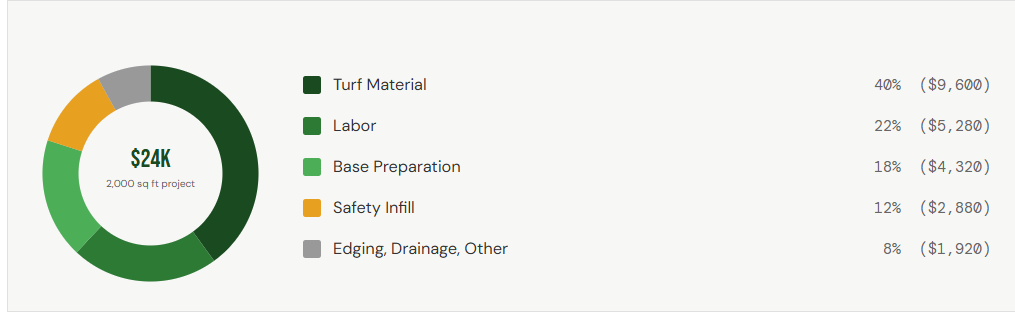
Most of the cost of a playground turf project goes to the turf material (40%) and labor (22%), followed by base preparation (18%), safety infill (12%), and smaller costs for edging and drainage (8%). In a typical 2,000 sq ft project costing about $24,000, these components together determine the final price and ensure safety, durability, and proper installation.
The Installation Process and What Each Step Costs
Understanding the installation sequence helps you evaluate quotes and know which steps cannot be skipped. Every phase below adds to the final cost, and cutting corners on base preparation is the most common reason playground turf fails early.
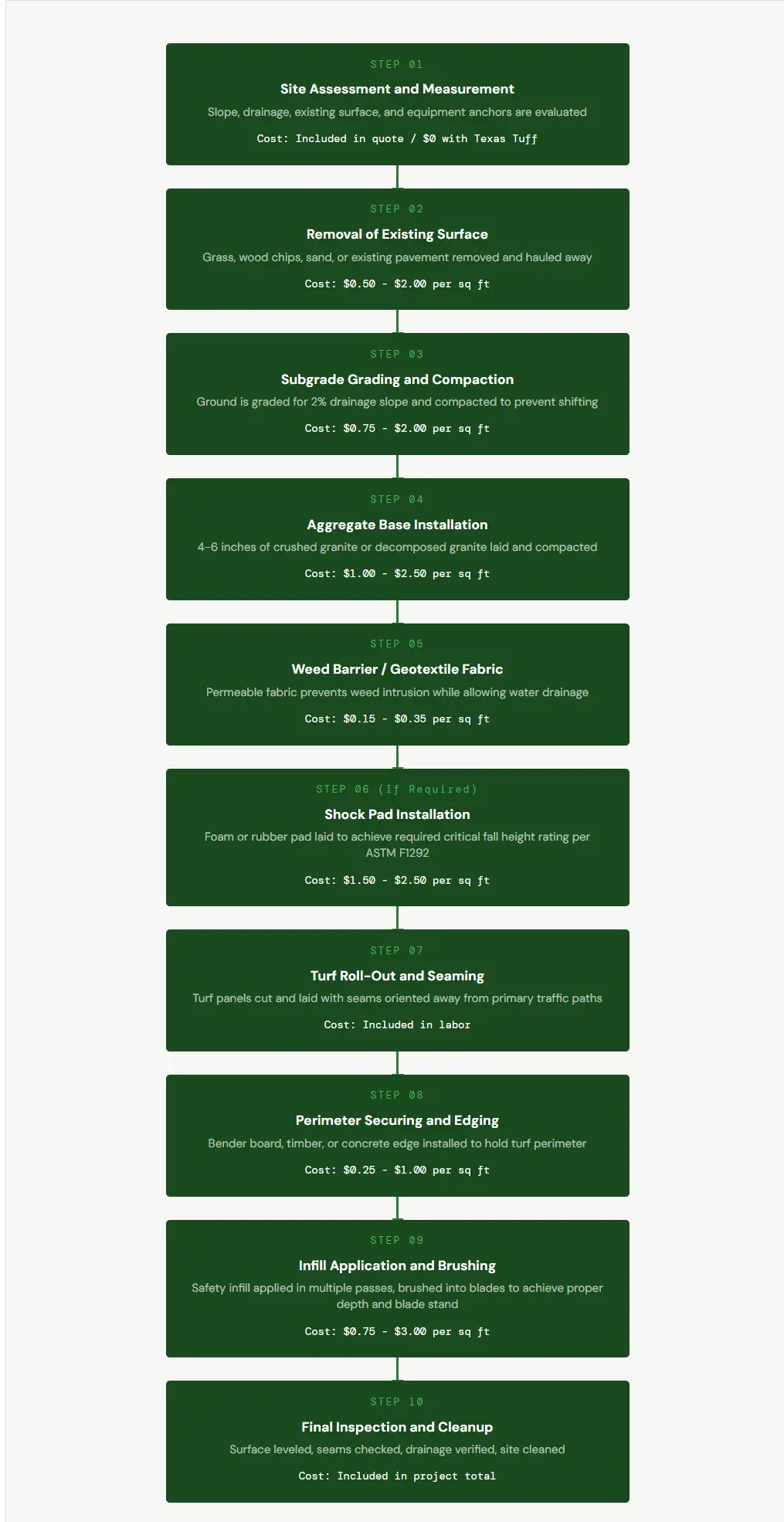
Step 1: Site Assessment and Measurement
The area is checked for size, slope, drainage, and existing ground conditions. This helps plan the correct base and materials.
Step 2: Removal of Existing Surface
Any grass, mulch, sand, or old pavement is removed and hauled away to create a clean surface for installation.
Step 3: Subgrade Grading and Compaction
The soil is leveled and compacted to create a strong foundation and ensure water flows away from the play area.
Step 4: Aggregate Base Installation
A layer of crushed stone is added and compacted. This layer supports the turf and improves drainage.
Step 5: Weed Barrier Installation
A geotextile fabric is placed over the base to stop weed growth while still allowing water to pass through.
Step 6: Shock Pad Installation (If Required)
A shock-absorbing pad is installed under the turf when needed to meet safety rules for playground fall protection.
Step 7: Turf Roll-Out and Seaming
Turf rolls are laid out, cut to fit, and joined together tightly so the surface looks smooth and even.
Step 8: Perimeter Securing and Edging
The edges are fixed using materials like timber or concrete borders to hold the turf in place and prevent movement.
Step 9: Infill Application and Brushing
Safety infill is spread across the turf and brushed in. This keeps blades upright and adds cushioning for impact.
Step 10: Final Inspection and Cleanup
The finished area is checked for safety, drainage, and surface quality before it is opened for use.
How to Choose the Right Turf Grade for Your Playground
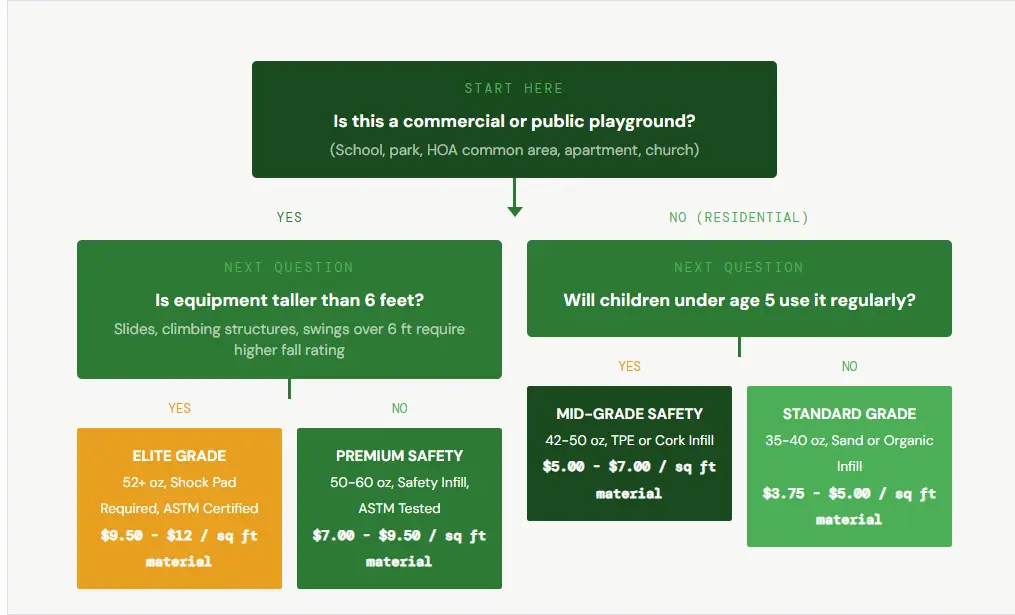
Grade selection depends on who uses the playground, what equipment is installed, and whether the project needs to meet any code or safety certification requirements.
This decision flowchart walks through the key questions.
Public or Commercial Playground (school, park, HOA, apartment, church)
First check equipment height:
→ Equipment over 6 ft: Elite Grade Turf (52+ oz, shock pad, ASTM certified)
→ Equipment 6 ft or lower: Premium Safety Grade (50–60 oz, safety-tested infill)
Residential Playground
Next check age of users:
→ Children under 5 years old: Mid-Grade Safety Turf (42–50 oz, soft infill like TPE or cork)
→ Older children / light use: Standard Grade Turf (35–40 oz, basic infill, moderate durability)
This structure helps match the turf type to safety needs, use level, and budget so the playground performs well over time.
Natural Grass vs. Synthetic for Playground
The upfront cost of synthetic turf is higher than natural grass. Over ten years, that picture reverses. Here is a side-by-side comparison for a 2,000 square foot school playground in Texas, using conservative estimates for both options.
Year 1 installation and irrigation: $4,500
Installation (mid-grade): $18,000 - $30,000
10-Year Cumulative Cost Comparison: Natural Grass vs. Artificial Turf (2,000 sq ft)
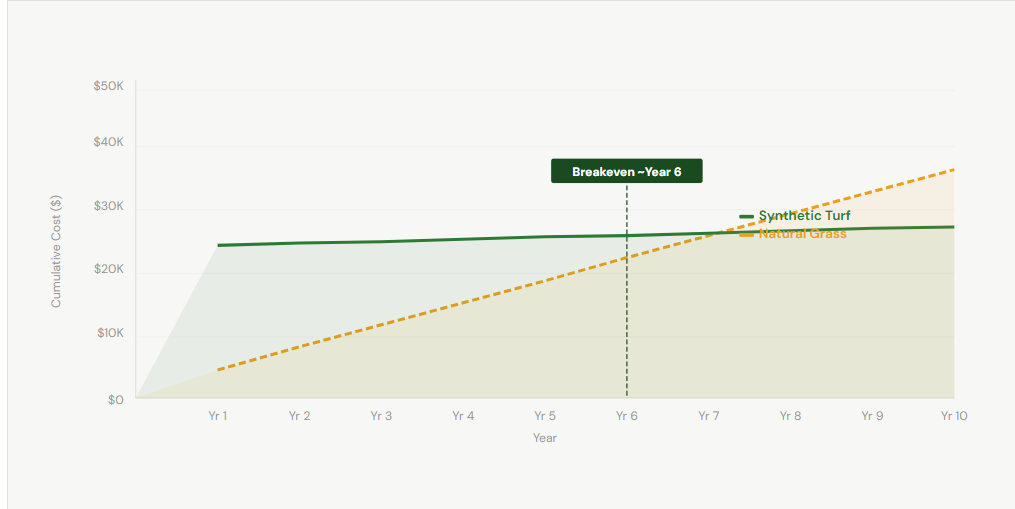
Assumptions: 2,000 sq ft Texas school playground. Synthetic turf: $24,000 installed, $400/yr maintenance. Natural grass: $4,500 install + irrigation, $3,500/yr water + mowing + repairs + seasonal reseeding.
Texas-Specific Cost Factors
Texas conditions affect both the cost of installation and the long-term performance of playground turf. If you are comparing a national cost guide to a Texas Tuff quote, these factors explain the differences.
Clay Soil and Base Preparation
North Texas clay soil, common across Dallas, Fort Worth, Plano, and Frisco, expands and contracts dramatically with moisture changes. A turf installation on clay requires deeper base preparation than sandy soil markets. That means more aggregate, more compaction passes, and more labor. Plan for base prep costs at the higher end of the range ($2.00 to $3.50 per square foot) if your site has clay.
Heat and Infill Selection
Surface temperatures on synthetic turf in direct Texas sun can reach 150 to 170 degrees Fahrenheit in July and August. This is not a reason to avoid turf, but it is a reason to select infill and turf color carefully. Light-colored turf and heat-reflective coated sand infill reduce surface temperatures by 20 to 35 degrees compared to standard dark turf with black crumb rubber infill. The cost premium is $0.50 to $1.00 per square foot more for the better infill system.
Drainage in Heavy Rain Events
Texas experiences intense rain events, particularly in spring and fall. A playground turf system must drain at least 30 inches of water per hour per square yard (industry minimum) to keep the surface usable. On impermeable base soil, a drain pipe system may be required, adding $0.50 to $1.50 per square foot to the project cost.
Frequently Asked Questions
What is the average cost to install synthetic turf on a playground?
The average installed cost for playground turf runs $6 to $20 per square foot. Most mid-grade projects in Texas, including base preparation, safety infill, and a shock pad for equipment over six feet, land between $9 and $14 per square foot. A 1,000 square foot playground budgeted at this range costs $9,000 to $14,000 installed.
Is playground turf more expensive than regular lawn turf?
Yes, by $2 to $5 per square foot on average. The difference comes from higher face weight requirements, safety-rated infill, and the shock pad layer required under playground equipment. A standard lawn turf installation might use a 35 oz product at $7 to $9 installed. A playground-grade system using a 55 oz ASTM-certified product with TPE infill and a shock pad runs $11 to $16 installed.
Does synthetic turf get too hot for children to play on in Texas?
Standard dark turf with black crumb rubber infill gets very hot in direct Texas sun, reaching 140 to 170 degrees Fahrenheit at peak hours. This is a real issue. The solution is to select lighter-colored turf, use heat-reflective or organic infill like cork or coated sand, and design the playground with shade structures where possible. Texas Tuff recommends these steps as standard practice for all DFW playground projects, not optional upgrades.
How long does playground turf last?
A properly installed and maintained playground turf system lasts 15 to 20 years. Products backed by 15-year manufacturer warranties exist in the market. The base preparation quality, infill maintenance, and the face weight of the turf are the three biggest factors in lifespan. Skimping on any one of the three shortens the life of the other two.
What is a shock pad and do I need one?
A shock pad is a layer of foam or recycled rubber installed between the turf and the aggregate base. It adds impact attenuation to the system, allowing it to meet ASTM F1292 critical fall height requirements for taller playground equipment. If your playground has any equipment taller than four feet, you almost certainly need a shock pad to meet safety standards. The cost is $1.50 to $2.50 per square foot on top of the turf system cost.
Can I install playground turf myself to save money?
DIY installation is possible for small residential play areas with no elevated equipment. The material cost savings run $2 to $4 per square foot against the professional installation cost. The risk is base preparation quality. Most DIY installations fail within three to five years due to poor compaction, inadequate drainage, or incorrect infill depth. For any commercial playground or one with structures over four feet, professional installation is required to meet ASTM standards, and those standards require documentation that DIY work cannot produce.
Final Cost Takeaway
Synthetic playground turf costs more upfront, but it delivers better safety, lower maintenance, and long-term value compared to natural grass. Most projects fall between $6 and $20 per square foot installed, with pricing driven by turf grade, safety features, and site conditions.
The key is not choosing the cheapest option, but choosing the right system for your needs. Factors like equipment height, user age, drainage, and heat all impact performance and lifespan.
At Texas Tuff, we install playground turf across the Dallas–Fort Worth area, and surrounding cities. Every project is built with proper base prep, safety layers, and materials designed for Texas conditions. When installed correctly, playground turf can last 15+ years with minimal upkeep, making it a smart long-term investment for schools, parks, and homeowners.
Texas Tuff provides free on-site assessments and detailed written quotes for playground turf projects across the Dallas-Fort Worth area.