

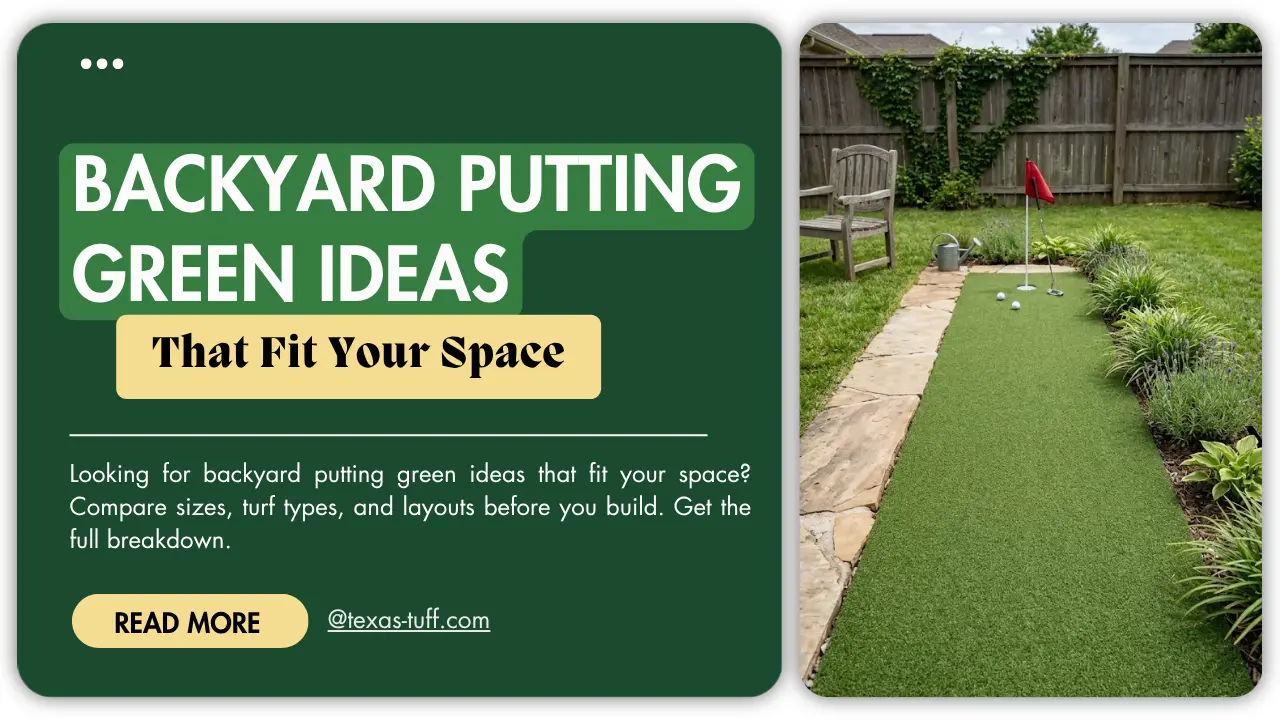
Plenty of golfers lose more strokes on the green than anywhere else. Short putts are where rounds slip away, and most people practice them for ten minutes before a tee time, if at all. A green at home changes that. Practice happens in the evening, a few putts at a time, with no drive to the course.
The hard part is fitting one into the yard you have. The backyard putting green ideas below range from a one-cup strip beside the patio to full designs with chipping areas and lights, so there’s something here whether you have 80 square feet or 800.
Where to Start With Putting Green Ideas for Backyard Spaces
Start by walking the yard with a tape measure. How much room there is sets the first limit, of course. After that, look at how much sun the spot gets, which way the ground slopes, and where rainwater sits after a storm. Those details rule out some layouts before you ever look at turf samples.
Measuring the Space
For a small home green, plan on roughly 100 to 200 square feet. If you want room for several cups and some break, you’re looking at something closer to 300 to 500 square feet. Measure the spot, then watch it for a day. A green that bakes in full sun all afternoon won’t see much use in July.
Slope counts too. A gentle grade can be shaped into a useful break, while a steep one needs grading work before anything else goes down.
Green Speed and Turf Choice
Green speed is measured with a Stimpmeter, a grooved ramp that releases a ball at the same speed every time. How far the ball rolls, in feet, is the reading. The USGA puts most American courses somewhere in the 7 to 12 range, so a reading of 10 means the ball traveled about 10 feet.
The turf on a putting green is shorter and packed tighter than lawn turf, and it’s normally made from nylon or texturized polyethylene. That’s what lets a ball roll straight instead of wobbling. One example is Texas Tuff’s St. Andrews, a texturized nylon with a 3/8-inch pile and built-in UV protection.
Small Backyard Putting Green Ideas That Work in Tight Spaces
A small yard can still hold a useful green. The trick is to choose one thing to get better at, whether that’s holing short putts or judging distance on long ones. Both need surprisingly little room. A smaller green is also cheaper to put in, and there’s less of it to brush and clean.
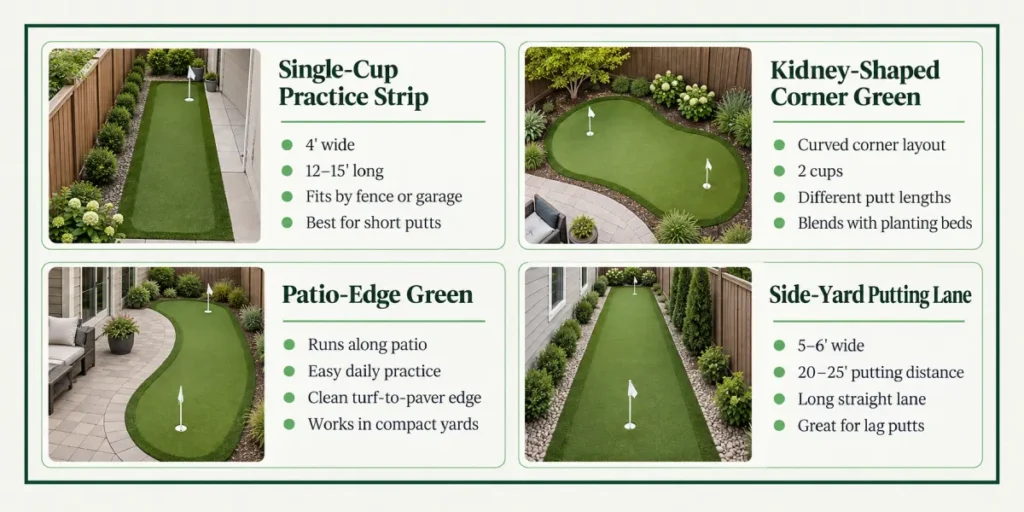
1. Single-Cup Practice Strip
A strip about 4 feet wide and 12 to 15 feet long, with one cup at the far end, is as simple as it gets. It fits along a fence or behind a garage. It won’t teach much about reading break. For building a steady stroke on short putts, though, it’s hard to beat.
2. Kidney-Shaped Corner Green
Curved edges make a small green look planned instead of squeezed in. A kidney or bean shape tucked into a back corner, with a cup at each end, gives you putts of different lengths in very little space. The curves also sit more naturally next to planting beds than a hard rectangle does.
3. Patio-Edge Green
Running a green right up to the patio makes it easy to use. You can step out with a coffee and roll a few putts before work. Put a thin metal or composite edge between the turf and the pavers, so the seam stays clean and the turf doesn’t creep.
4. Side-Yard Putting Lane
That narrow strip between the house and the fence usually holds trash cans and not much else. At 5 or 6 feet wide, it can take a long, straight putting lane. Lag putts from 20 or 25 feet are hard to practice anywhere else at home, and a side yard may be the only spot with that much length.
Backyard Putting Green Design Ideas for Serious Practice
More space opens up more options. You can add slopes, a second or third cup, even a fringe of longer turf around the edge, and the green starts to play more like one at a course. Not every idea here is cheap to build, so it makes sense to choose based on what you practice most and how much maintenance sounds reasonable.
5. Multiple Cups at Set Distances
Try three or four cups spaced at 6, 12, and 20 feet from the same starting point. That covers short, medium, and lag putts in a single session. Regulation holes are 4¼ inches across, a size the USGA has chosen to keep, so use full-size cups and skip the oversized ones that make practice too easy.
6. Built-In Contours and Break
A perfectly flat green gets boring fast. If the base is shaped with a few gentle rolls before the turf is laid, the ball will break as it heads toward the cup. Don’t overdo it. Mild slopes help you learn to read a green, but steep ones mostly send the ball rolling off the side.
7. Fringe and Collar Zones
A band of slightly longer turf around the putting surface works like the fringe on a golf course. It slows balls that roll past, frames the green, and gives you a place to practice those awkward putts from just off the edge. Installers usually use a taller landscape turf for this ring.
8. Chipping Area and Approach
If there’s space, add a chipping zone off one side. Hitting soft chips onto the green from 10 to 30 feet out works the part of the short game that putting alone misses. The green should be firm enough to hold a chip without letting the ball bounce straight over the back.
9. Sand Bunker Accent
A small bunker beside the green adds one more shot to practice and makes the area look more like a golf hole. It does bring upkeep. The sand has to be raked, and without its own drain, a bunker turns into a puddle every time it rains. Of all fifteen ideas, this is the one to think hardest about before building.
Backyard Putting Green Landscape Ideas to Frame the Green
The nicest greens don’t look like they were dropped onto the lawn from above. They connect to the patio, the planting beds, and the paths around them. A stone edge here, some grasses there, a few lights along the border, and the green looks like it always belonged. Good edges are also easier to keep neat.
10. Stone and Paver Borders
A flagstone or paver edge, or even a line of smooth river rock, makes the green look finished. If there’s natural grass next to it, the border keeps the mower and string trimmer from chewing into the turf. It helps to use the same stone as the patio or walkway nearby, so everything looks like one project.
11. Low Plantings Around the Green
Ornamental grasses and low shrubs soften the edges of a green. Keep them short and a few feet back. Anything that drops leaves, berries, or petals onto the putting surface means more cleanup, and it can knock a putt off line.
12. Poolside Putting Green
Pool areas already get used for relaxing and entertaining, so a green nearby fits right in. People at a pool party usually wander over and try a few putts. Just keep the green far enough from the pool that a missed putt doesn’t roll in, and slope the ground so water splashed out of the pool runs away from the turf.
13. Night Lighting
Low-voltage landscape lights let you practice after dark. That counts for a lot in summer, since Penn State research shows synthetic turf can run 35 to 55°F hotter than natural grass on hot days. Set fixtures low and off to the sides to avoid long shadows across the line of a putt.
DIY Backyard Putting Green Ideas
Some homeowners would rather build a green themselves. A simple one is manageable with rented tools and a weekend or two. Larger greens with contours and chipping areas are harder to get right, because an uneven base shows up in every putt. Keep a first project small and flat.
14. Budget Starter Green
A flat rectangle of about 100 square feet, with one or two cups, is the cheapest place to start. The base is where most of the effort goes. You’ll dig out a few inches of soil, spread crushed rock, compact it well, and finish with a layer of fine aggregate raked and leveled smooth. Call 811 a few days before any digging so buried utility lines get marked.
15. Removable Cups for New Pin Positions
Cups with removable liners and plugs let you move the hole around. Install three or four sockets across the green and swap the flag between them. It makes a small green feel less repetitive, and it costs very little to add during installation.
Blending the Green Into the Rest of the Yard
Some of the most practical backyard ideas with putting green space put the green right next to where the family already spends time. That might be beside the kids’ play lawn, near the fire pit, or next to an outdoor kitchen on the patio.
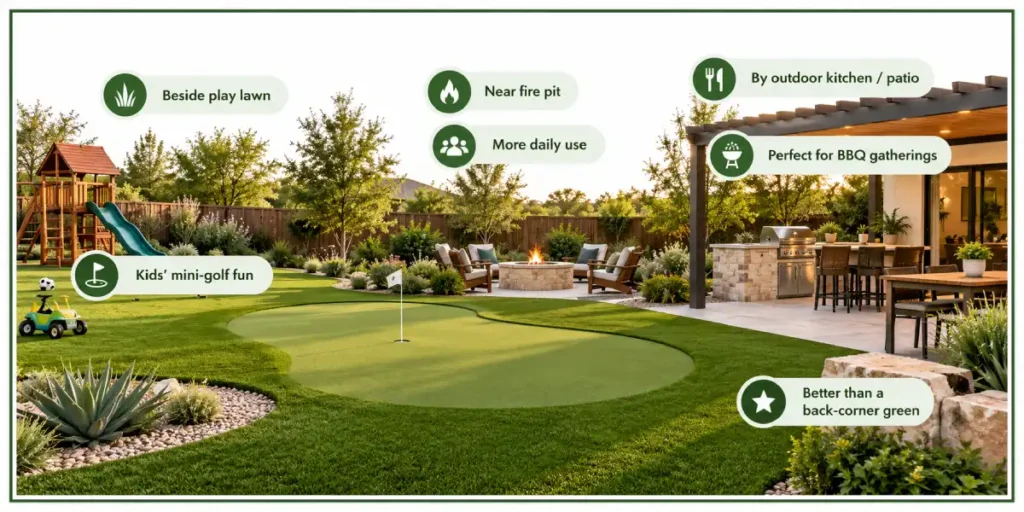
Children will turn it into a mini-golf course, and at a barbecue, someone always picks up a putter sooner or later. Laid out this way, the green gets used far more than it would tucked into a back corner.
Turf and Base Specs for a Backyard Putting Green
Most putting green backyard ideas are built the same way underneath, even if the designs on top look completely different. Short, tightly packed turf goes over a firm, level base. The table below lists the typical specs installers work with on a home green.
| Component | Typical Spec | Purpose |
|---|---|---|
| Fiber | Nylon or texturized polyethylene | True, consistent ball roll |
| Pile height | About 3/8 to 5/8 inch | Shorter pile rolls faster |
| Infill | Fine silica sand | Adjusts firmness and speed |
| Base | Compacted crushed rock topped with fine aggregate | Smooth, level surface that won’t shift |
| Drainage | Slight grade plus perforated backing | Keeps water from pooling on the green |
| Cups | 4¼-inch diameter | Matches regulation hole size |
Treat these numbers as a general guide. Your ideal setup will depend on how fast you want the green to roll, what kind of soil you have, and which turf you choose, so go over the details with your installer.
No matter which design you go with, the backyard putting green ideas that last are the ones sitting on a well-built base.
Final Thoughts
The best backyard putting green ideas are the ones sized to your yard. Even a one-cup strip will tighten up a short game. Go bigger, with contours, a chipping area, and lights, and the green can become the place friends and family end up on summer evenings. Whatever the size, a level base and quality putting turf decide how well it plays.
Texas Tuff builds custom putting greens using turf like its St. Andrews nylon, which carries a 15-year warranty. During a consultation, the team can help work out the size, where the cups should go, and how water will drain, all before any digging begins.
FAQs
What Size Putting Green Fits a Typical Backyard?
It comes down to what you want to work on. For short putts alone, 60 to 100 square feet is plenty. For several cups and some break, plan on 300 square feet or more. If lag putting is the goal, length counts more than width, so a long, narrow shape can work well.
What Are Some DIY Small Backyard Putting Green Ideas on a Budget?
Start with a plain rectangle or strip, one or two cups, and no contours. Leave the bunker and lights for later. Most of the money should go into a well-compacted base and decent putting turf, since those two things decide how the ball rolls. Borders and extras can be added over time.
What Green Speed Works Best for Home Practice?
Aim for something close to the courses you play most. Courses in the U.S. mostly run from 7 to 12 on the Stimpmeter, and for home practice, a green rolling at around 9 to 11 feels right to most golfers. You can speed it up or slow it down through pile height, the amount of infill, and how hard the base is packed.
What About Drainage in Clay Soil?
Clay stays wet for days, and a damp base develops soft spots that throw putts off line. To help the green dry faster after rain, grade the area so water runs off, use a compacted rock base, and choose turf with a perforated backing.