

If you own a dog, you already know what happens to natural grass. Brown patches appear, mud shows up after rain, and suddenly, your dog is tracking dirt inside the house. Artificial turf solves that problem. It stays green all year, drains quickly, and it’s much easier to clean.
However, the benefits of artificial turf can only be fully realized with proper installation. A poor installation can trap odors, cause drainage issues, and make the turf feel uneven. So in this guide, I’ll walk you through the process step by step.
Why Do Dog Owners Install Artificial Turf?
Dogs are tough on natural grass. Urine contains nitrogen, which can burn the lawn and leave yellow spots. Heavy play also destroys the soil over time.
Artificial turf removes those problems.
There’s also a hygiene factor many people don’t think about. Environmental research by the US Environmental Protection Agency shows concerning facts. They found out that one gram of dog waste can contain around 23 million fecal coliform bacteria. And, they can wash into waterways through rain runoff.
Not just them, the U.S. Department of Agriculture also warns about pet waste. According to their research, pet waste contributes nutrients like nitrogen and phosphorus that pollute water systems.
Even landscape researcher Pieter De Frenne from Ghent University agreed and noted:
“Dog urine adds extremely high nitrogen levels to soil compared with natural nutrient cycles.”
Well, artificial turf doesn’t eliminate waste, but it makes cleanup easier and prevents lawn damage. That’s one of the reasons pet-friendly turf systems are becoming popular in residential landscapes.
What Tools and Materials Do You Need Before Starting?
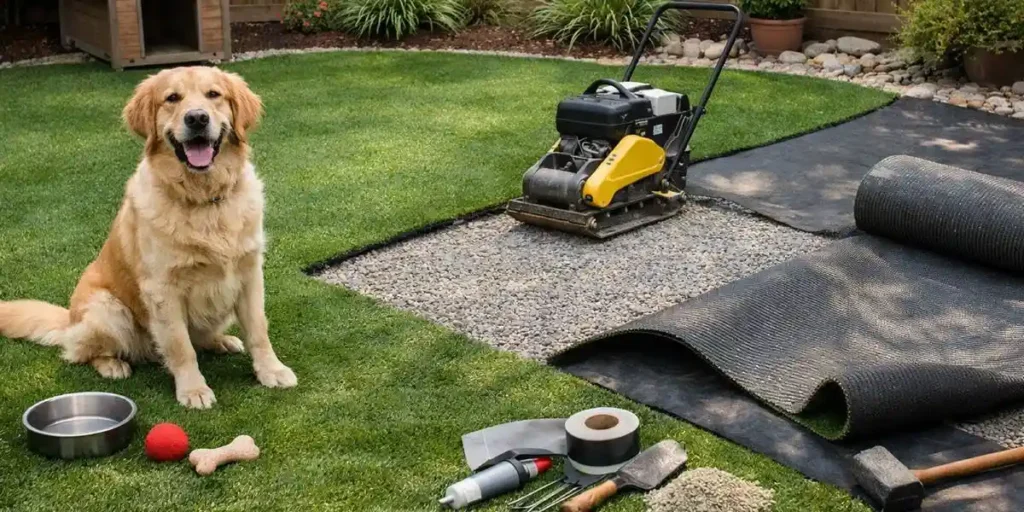
Before digging up your yard, gather the right tools and materials. This saves time and keeps the installation smooth. You’ll need a few basic things.
Materials
- Artificial turf designed for pets
- Crushed stone or decomposed granite
- Weed barrier fabric
- Turf adhesive and seam tape
- Landscape nails
- Pet-friendly infill
Tools
- Shovel
- Rake
- Plate compactor
- Utility knife
- Tape measure
- Wheelbarrow
You can collect artificial turf for pets from any reliable turf provider around you.
How Do You Prepare the Ground for Artificial Turf?
Ground preparation is the most essential step. Skip it and deal with future drainage problems and ongoing issues with your installation.
- Start by removing the natural grass and digging down approximately 3–4 inches. This gives your base the necessary room to speak.
- Once the soil is exposed, remove the rocks, roots, and all debris. Smooth out the surface.
- Now, install the weed barrier fabric. This will help protect your base from weed infestations growing through your turf.
- Then, spread the crushed stone or decomposed granite. This serves as a solid and lightweight drainage layer to help your base.
- Using the plate compactor, pack the base down firmly. When done correctly, the soil should feel solid and level.
How Do You Install Artificial Turf for Dogs?
Now the fun part. This is where your yard will begin to look like a nice, clean, and green lawn again.
- Roll the turf out across the aisle and let it sit in the sun for around 30 minutes to allow the backing to relax and remove the wrinkles.
- Trimming the edges with a sharp utility knife will require a little more patience. Be careful to provide clean edges a sharp and professional look.
- When using several pieces of turf, connect them using seam tape and glue. Ensure all grass fibers are aligned in the same direction for a more natural appearance.
- For edges, use landscape nails to secure them a few inches apart.
- Then, use a stiff broom to brush the fibers of the turf upright.
If all of this seems a little too daunting, you have a great option available. You could hire a professional turf installer to take care of the installation for you!
What Type of Infill Is Best for Dog Turf?
Infill sits between the turf blades. It helps support the grass fibers and improves drainage.
Different infill materials behave differently with pets.
| Infill Type | Key Benefit | Pet Suitability |
| Silica Sand | Affordable and stable | Good |
| Rubber Infill | Soft under paws | Moderate |
| Zeolite | Absorbs urine odor | Excellent |
| Antimicrobial infill | Controls bacterial growth | Excellent |
Zeolite infill is especially useful for dog areas. It naturally traps ammonia molecules that cause urine odor.
That means fewer smells in your yard.
How Do You Make Artificial Turf More Dog-Friendly?
Artificial turf works best for pets when a few extra steps are taken during installation.
Here are some smart adjustments that experienced installers use.
- Choose a perforated turf backing that drains quickly
- Install a deep gravel base for urine drainage
- Use odor-neutralizing infill like zeolite
- Rinse the turf occasionally with water
These small choices make a big difference in long-term cleanliness.
How Do You Maintain Artificial Turf for Dogs?
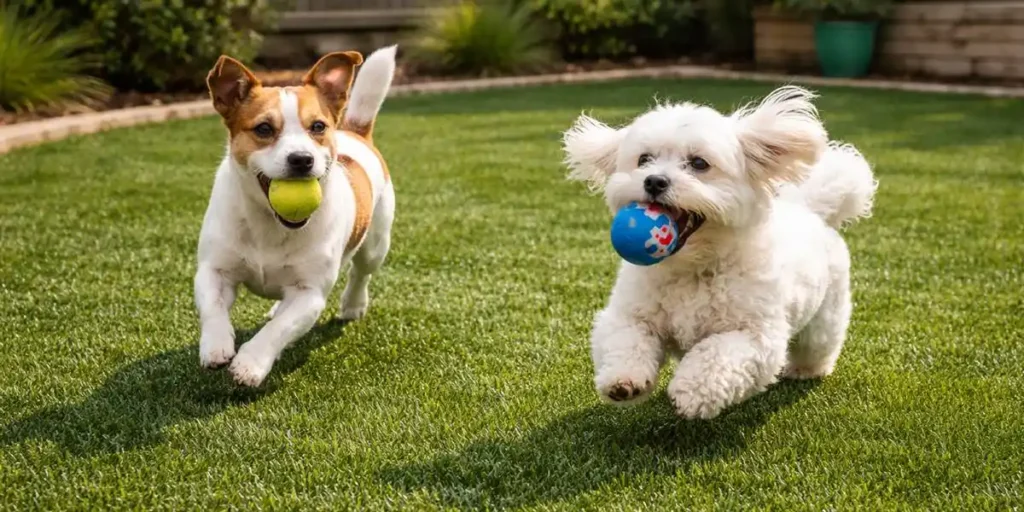
One reason homeowners love turf is the easy maintenance. You don’t have to mow or fertilize it. Besides, there are no dead patches.
Maintenance is simple.
- Remove solid waste regularly
- Rinse the turf with a hose once or twice a week
- Use enzyme cleaners if odors appear
- Brush the turf occasionally to keep fibers upright
Don’t want to go through the maintenance process every once in a while? You can hire professionals for your artificial turf maintenance to get it done without any stress. With proper installation and maintenance, artificial turf typically lasts 10 to 15 years.
Final Thoughts
Artificial turf for dogs helps many pet owners solve the problem of pet traffic on their grass, and keeps their yard clean of dirt and mud from pets.
It can if you install the artificial turf correctly.
If you focus on pet-friendly infill, drainage, and a good base, you can keep artificial turf for pets clean, green, and usable for a long time. If you have a whole yard upgrade planned, you can use our products or services to buy turf and turf installation assistance.
FAQs
Is artificial turf safe for dogs?
Of course, artificial turf for dogs is made of non-toxic polyethylene fibers, and pet turf contains infill that is antimicrobial to fight against bacteria and smells.
Does dog urine damage artificial turf?
Dog urine will not damage any artificial turf, but it will smell if you do not clean it periodically, and it also needs to have good drainage.
What is the best base for artificial turf for dogs?
Good drainage and no smell is 3 to 4 inches of compacted crushed stone or decomposed granite.
How do you clean artificial turf used by dogs?
Waste needs to be removed immediately, and then the turf has to be rinsed. Enzyme cleaners made for that purpose are good for turf that has a smell.
What is the lifespan of artificial turf when dogs are involved?
With the right installation and maintenance, quality artificial turf lasts about 10-15 years.