
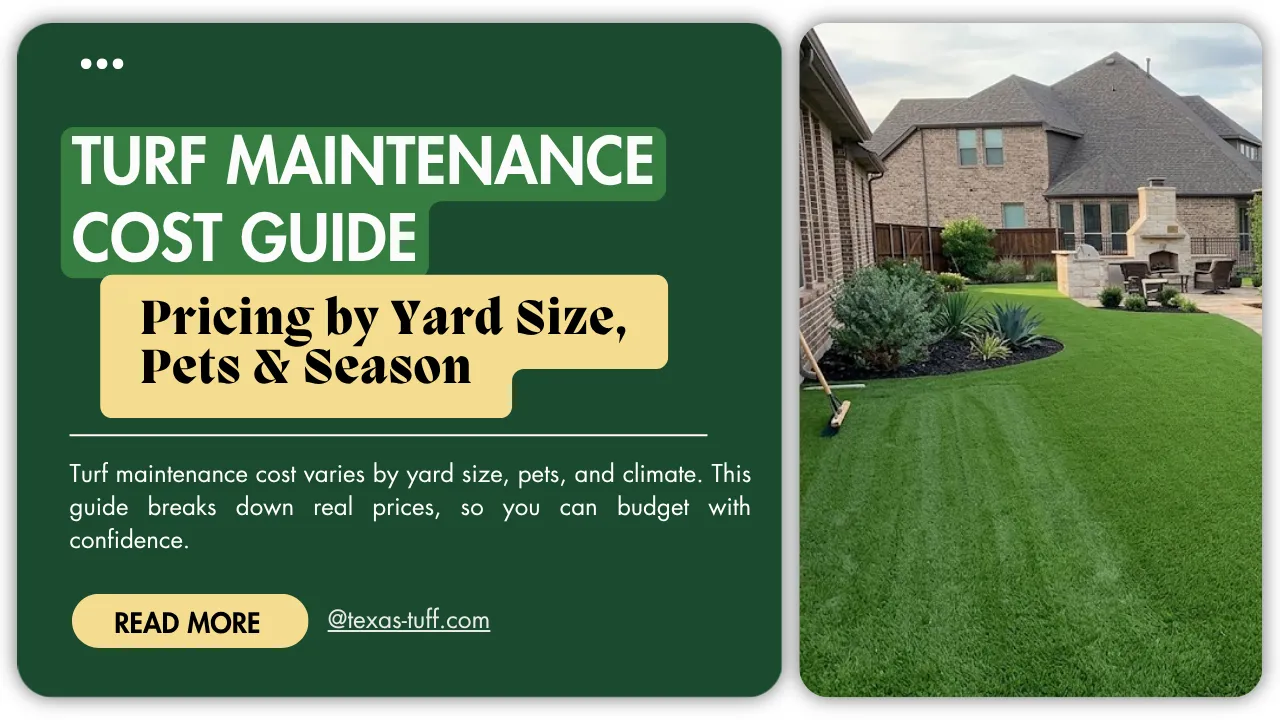
Artificial turf maintenance costs are between $350 and $900 per year for professional services. The total cost depends on the size of the lawn and the number of pets you have. Although synthetic grass needs less time, regular maintenance is essential. It prevents odors and fiber matting.
How Much Does Artificial Turf Maintenance Cost?
In 2026, the average professional turf maintenance costs $0.35 to $0.65 per square foot. You’ll get tiered packages from basic grooming to intensive pet-focused deep cleans.
Quick Cost Summary Table:
| Restoration & Brushing | $0.10–$0.30 / sq. ft. or $100–$250 per visit | Brushing helps maintain a neat, upright appearance. Average annual brushing costs around $165, while larger yards or heavier restoration work may cost more. |
| Repairs | $100–$600 per visit | Professional turf repairs typically range from $100 to $600, depending on the damage, such as seams, small tears, or burns. |
| Drainage Checks | $75–$200 per visit | Costs depend on lawn size and whether drainage problems are identified. Basic inspections are less expensive, while corrective work costs more. |
| Infill Replacement | $0.30–$1.80 per lb. of infill | Roughly 1 lb. of infill may be needed per sq. ft. Sand filler typically costs $0.30–$1.80 per pound. Full replenishment may average around $85 per service. |
Disclaimer: Prices above are general industry estimates for 2026 and may vary by lawn size, turf condition, and location. Contact Texas Tuff for a personalized assessment and exact quote.
Synthetic Turf Maintenance Cost by Yard Size
The most direct measurement a contractor uses to determine the cost of a service quote is the total area of your installation. The larger the yard, the more infill material and man-hours are required to brush and sanitize. But the per sq ft cost sometimes decreases as the project size increases.
- 500 sq. ft.: Maintenance for a small townhome yard or dog run usually costs between $200 and $350 per visit.
- 1,000 sq. ft.: A suburban lawn typically costs $400 to $550 for a full professional service.
- 1,500 sq. ft.: For larger residential lawns, the price ranges from $600 to $800 per visit. This is due to the increased time required for debris removal and brushing.
- 2,000+ sq. ft.: Estate-sized installations often receive bulk pricing. Even at a low rate like $0.25 per square foot, the total bill may exceed $900.
Turf Field Maintenance Cost Per Square Foot
The average price for professional maintenance of turf is $0.45 per square foot. This price usually covers debris removal, power brushing, and a sprayed sanitation. When major repairs are needed in the turf, or a considerable amount of new infill is required, the cost can climb to $0.80 per square foot.
Why Pricing Doesn’t Scale Perfectly
Maintenance pricing does not scale linearly because every job has fixed costs, such as travel time, equipment setup, and fuel. A company must charge a service fee (often $175–$250) regardless of how small the yard is.
How Texas Climate Affects Turf Maintenance Costs
North Texas has a unique climate that impacts the frequency and cost of artificial grass upkeep. The Dallas-Fort Worth Metroplex has extreme temperature fluctuations and shifting soil conditions compared with other climates.
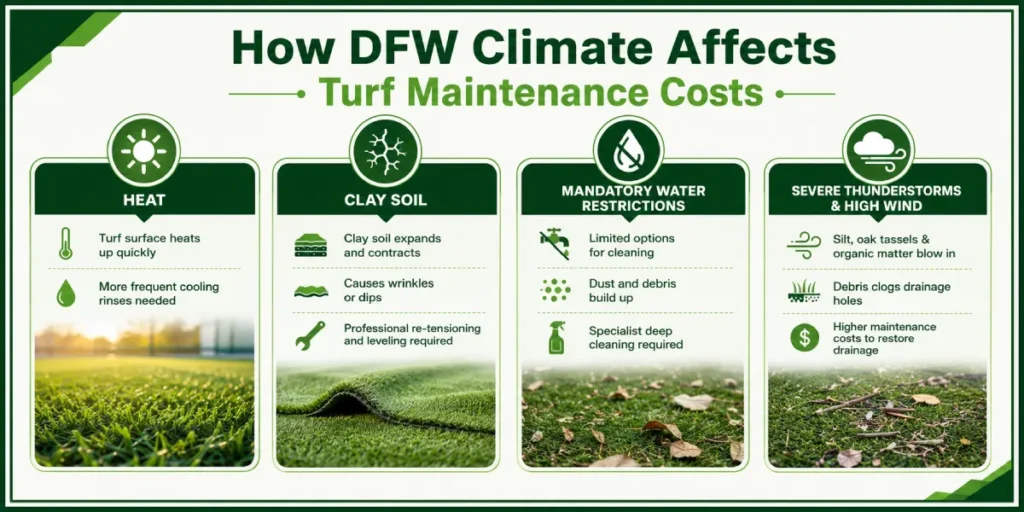
You need maintenance strategies that will help you protect your turf.
- Heat: Synthetic turf can get hotter than the air temperature. When temperatures are high, as they are in the summer in Texas, the surface needs to be comfortable. Also, pet odors need to be “removed” from the infill to prevent them from “baking” in. The cost of the more frequent cooling rinses must be taken into account by homeowners here.
- Clay Soil: DFW’s typical clay soil expands and contracts in reaction to moisture changes. This can make the crushed stone base on which your sod is lying unstable. This results in wrinkles or dips that have to be professionally re-tensioned and leveled.
- Mandatory Water Restrictions: In cities such as Dallas and Fort Worth, there are mandatory drought restrictions. There are few options to clean your lawn. This causes accumulation of dust and dust particles, which need specialist deep cleaners to remove.
- Severe Thunderstorms and High Winds: North Texas has a higher risk for high winds and severe thunderstorms. These storms stir up a lot of silt, oak tassels, and organic matter to come onto lawns. This debris has the potential to fill in the drainage holes of the turf backing. So, water clogs, and there are higher maintenance costs to restore the drainage.
Annual Turf Maintenance Tasks and Their Costs
If you’re budgeting for annual maintenance, break down individual tasks. In this way, you get a clear idea where the money is going.
| Restoration & Brushing | 1–2 times | $0.10–$0.30 / sq. ft. or $100–$250 | $100–$500 |
| Repairs | As needed | $100–$600 | $0–$600 |
| Drainage Checks | As needed | $75–$200 | $0–$200 |
| Infill Replacement | As needed | $0.30–$1.80 / lb. of infill or $75–$200 | $75–$200 |
| Total Annual Estimate | — | — | $175–$1,500 |
Disclaimer: Prices above are general industry estimates for 2026 and may vary based on lawn size, turf condition, and service provider. “As needed” tasks may not apply every year, so actual annual totals can fall below the estimated range. Contact a professional for a personalized assessment and exact quote.
What’s Included in Professional Maintenance?
A standard maintenance package usually includes restoration and power brushing. “Extras” include repairs (seam, edge, or wildlife/burn damage), drainage checks, and infill replacement (beyond routine top-off). Always ask for a detailed checklist of what the quoted price covers before booking a service.
Pet Turf Maintenance Costs: What You’ll Actually Spend
Are you a cute little puppy owner? Or the energetic golden retriever? If the answer is yes, get ready: turf maintenance costs are higher than others. Proper pet turf care is not optional. The buildup of bacteria can become a health hazard for your beloved pet and yourself too.
Pet owners should expect to spend $80 to $150 per year on high-quality enzyme treatments for DIY use, at least twice a week for rinsing and once every three months for professional deep cleaning. This brings the total annual cost for pet-specific maintenance to between $900 and $1,600. Professional pet cleaning is more expensive because it involves a “flood” method. Here, the turf and the crushed stone base are flooded with enzymes to kill odors at the source.
Disclaimer: Texas Tuff does not offer enzyme treatments, rinsing, or pet odor cleaning services. Figures above are general industry estimates for informational purposes only.
DIY vs. Professional Artificial Turf Maintenance
Deciding whether to maintain your turf yourself or hire a pro depends on your budget and how much free time you have. Most homeowners choose a hybrid approach: DIY weekly upkeep and hiring a pro for the annual “heavy lifting.”
If you’re choosing the DIY method, you’ll need basic equipment, like a turf rake and leaf blower, which are one-time purchases. However, professional power brushes cost upwards of $500 to buy, making professional service more attractive. DIY upkeep takes about 45 minutes a week, whereas a professional visit takes 3 hours but achieves a deeper level of restoration. While you can rent power brooms for around $80 a day, the cost of the rental plus materials often equals the price of a professional service visit.
Is a Maintenance Plan Cheaper Than One-Time Service?
Yes, most turf companies offer maintenance plans that reduce the cost per visit by 15% to 20%. A one-time “emergency” deep clean is always more expensive than a scheduled bi-annual visit. Plans also ensure that your turf warranty remains valid, as many manufacturers require proof of professional care.
What Affects Your Maintenance Quote?
When a contractor provides a quote, they look at these-
- access to the yard
- the proximity to trees,
- the number of pets
- and the current condition of the turf.
For year-long neglected turf, the first “restoration” visit will cost more than maintenance visits.
How Turf Maintenance Costs Change Over 20 Years
As the turf ages, the type of care it requires changes. It shifts from simple cleaning to more technical preservation and repair.
- Years 1–3: Costs are low. As the turf is relatively new, focus on basic cleaning and light brushing.
- Years 4–8: You may need to add more infill. Also, perform minor seam repairs as the lawn settles.
- Years 9–15: Now the turf is officially old. The fibers show signs of wear. This turf needs frequent professional grooming to maintain appearance.
- Years 16–20: In the final stage, your turf needs deep restoration. This step is the final maintenance before replacing the turf. Maintenance costs rise the most here.
Common Maintenance Mistakes That Increase Costs
- Never skip regular brushing. It can flatten fibers and make restoration more difficult.
- We think the more water we use, the clearer our turf will be. But in reality, using excessive water pressure can displace infill. It also damages turf seams.
- Ignoring low infill can leave turf fibers unsupported and uneven.
- Delaying small seam repairs can turn into expensive repairs. So it’s better to repair even if the damage seems minor.
- Never ever leave pet waste untreated. It can cause stubborn odors that won’t go away with regular cleaning.
- Letting leaves and debris build up can make routine cleaning harder.
- Using harsh cleaners can damage turf fibers, backing, or infill.
- Skipping routine inspections can allow small issues to become costly problems.
Artificial Turf Maintenance Costs vs. Natural Grass Maintenance
To understand the true value of turf maintenance, you must compare it to the ongoing costs of a natural lawn.
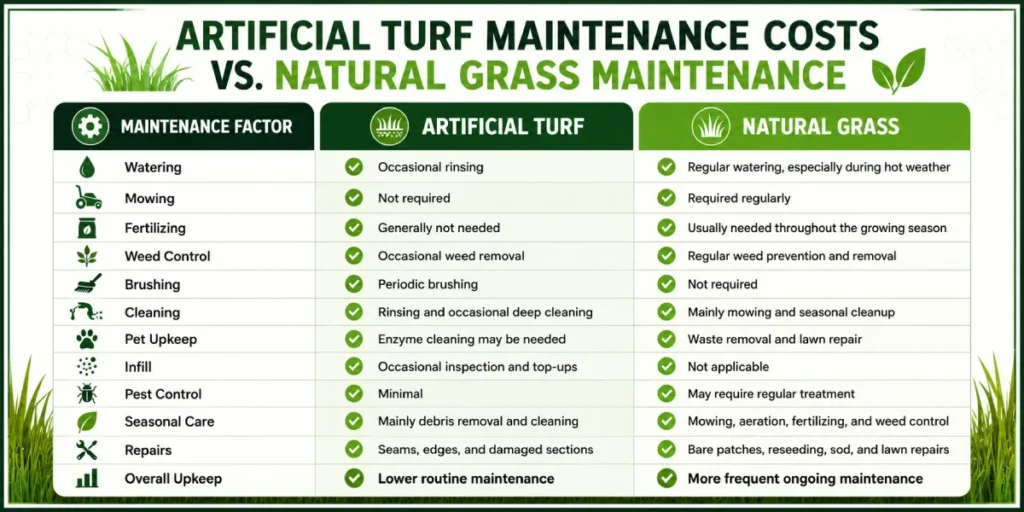
While turf has a higher upfront maintenance service fee, the cumulative costs of natural grass are much higher.
| Maintenance Factor | Artificial Turf | Natural Grass |
| Watering | Occasional rinsing | Regular watering, especially during hot weather |
| Mowing | Not required | Required regularly |
| Fertilizing | Generally not needed | Usually needed throughout the growing season |
| Weed Control | Occasional weed removal | Regular weed prevention and removal |
| Brushing | Periodic brushing | Not required |
| Cleaning | Rinsing and occasional deep cleaning | Mainly mowing and seasonal cleanup |
| Pet Upkeep | Enzyme cleaning may be needed | Waste removal and lawn repair |
| Infill | Occasional inspection and top-ups | Not applicable |
| Pest Control | Minimal | May require regular treatment |
| Seasonal Care | Mainly debris removal and cleaning | Mowing, aeration, fertilizing, and weed control |
| Repairs | Seams, edges, and damaged sections | Bare patches, reseeding, sod, and lawn repairs |
| Overall Upkeep | Lower routine maintenance | More frequent ongoing maintenance |
FAQ about Turf Maintenance Cost
How much does it cost to maintain a turf field?
Maintaining a professional or municipal sports turf field typically costs between $5,000 and $10,000 per year.
What does lawn care cost on average?
For a standard natural grass lawn, homeowners spend an average of $2,000 to $3,000 annually. This includes professional mowing, seasonal fertilization, weed control, and irrigation. But professional artificial turf maintenance for a similar-sized yard averages $500 to $900 per year.
Is turf cheaper to maintain than grass?
Yes, artificial turf is cheaper to maintain than natural grass over the long term. Synthetic grass needs a higher upfront installation cost. But you don’t need monthly water bills, fuel for mowing, and expensive chemical treatments here.
How often should I have my turf professionally cleaned?
Professional maintenance every six to twelve months is recommended. If you have multiple dogs/pets, quarterly cleaning can manage odors.
Can I use a regular vacuum on my artificial grass?
No, you should never use a household vacuum on artificial turf. It will suck up the infill material. This infill is necessary for turf’s stability and blade support.nt larger repair expenses in the future. The majority of basic artificial grass maintenance can be done by yourself. Professional cleaning may be beneficial in situations such as heavy use, pet mess, and larger yards.
Does artificial turf get too hot for pets in the Texas summer?
Yes, synthetic grass can get very hot. On 100-degree days, you should rinse the turf with a hose to cool the surface temperature. Then let your dogs play on it.
How do I get rid of the smell of dog urine in my turf?
Use an antimicrobial enzyme cleaner designed for turf. Saturate the area so the cleaner reaches the base layer, let it sit, and then rinse it thoroughly.
Will weeds grow through my artificial turf?
While turf has a weed barrier, seeds can occasionally grow in the infill. These are usually easy to pull by hand or treat with a standard water-based weed killer.
Final Thoughts
Artificial turf is not completely maintenance-free. The amount of turf maintenance cost depends on the size of your yard, pets, weather, turf age, and yard cleanliness. Ongoing checks for infill, removal of debris, rinsing, and brushing can prevent larger repair expenses in the future. The majority of basic artificial grass maintenance can be done by yourself. Professional cleaning may be beneficial in situations such as heavy use, pet mess, and larger yards.
“Disclaimer and Cost Transparency: The figures provided in this guide are estimates based on regional averages for the Dallas-Fort Worth market in 2026, sourced from local industry data and historical maintenance trends. Please note that these costs are for informational purposes and do not represent the exact pricing or service packages of Texas Tuff.”