
If you install, specify, or sell artificial grass in a hot climate, surface temperature is no longer a side note. It is one of the top three reasons clients reject a project after the first summer.
This guide is built from real install data, manufacturer spec sheets, and peer-reviewed field measurements so you can choose heat resistant artificial turf that actually performs when the asphalt next to it is hitting 150°F.
Why surface heat is the #1 turf complaint in hot climates
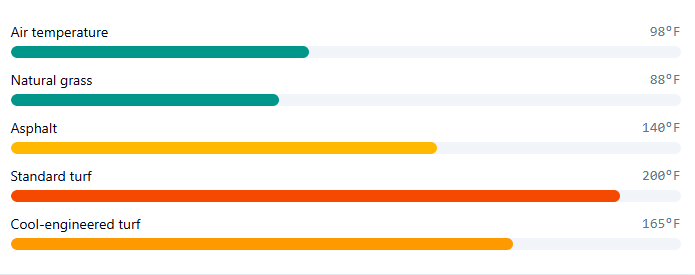
Standard polyethylene artificial turf can reach surface temperatures of 160°F to 200°F on a sunny day with an air temperature of just 98°F. A landmark Brigham Young University study measured synthetic turf at 200°F when air temperature was 98°F, while adjacent natural grass measured 88°F. Penn State’s Center for Sports Surface Research has reproduced similar numbers, recording synthetic turf 35–60°F hotter than natural grass.
For context, the American Society for Testing and Materials (ASTM) and the CDC both flag 140°F as the threshold where bare skin can sustain a second-degree burn in under five seconds. That means a turf lawn in Phoenix, Las Vegas, Dallas, or Riyadh is not just uncomfortable. It is a documented liability. Choosing the right product is no longer about pile height and color. It is about thermal engineering.
Does artificial turf get hot? The cause-and-effect chain
Yes. All artificial turf gets hotter than the air around it because the polymer fibers absorb shortwave solar radiation and re-emit it as heat. The real question is how much hotter, and that is controlled by a predictable physical chain:
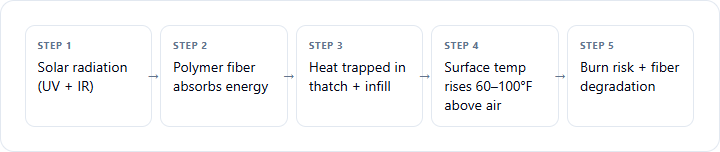
Break any link in that chain and temperature drops. A well engineered “cool” turf system can run 15–30°F cooler than a standard product in the same conditions. That is the difference between a yard your client uses every weekend and a yard they call you back to rip out.
For more information on performance in hot climates and cooling technology, see our guide on cooler artificial grass for hot climates.
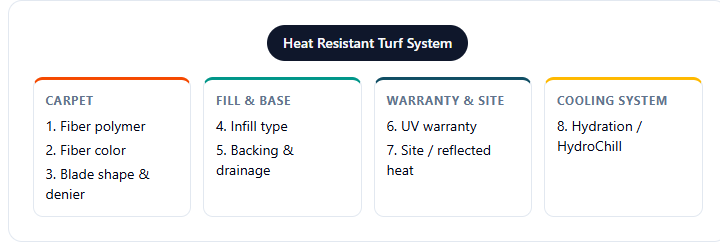
The buyer's checklist: 8 things that actually move the temperature needle
Work through each point before finalizing a product spec. These are not preferences, they are threshold requirements for any install in a hot-climate or high-sun-exposure environment.
01. Fiber polymer
02. Fiber color
03. Fiber shape and denier
04. Infill — the single biggest lever you control
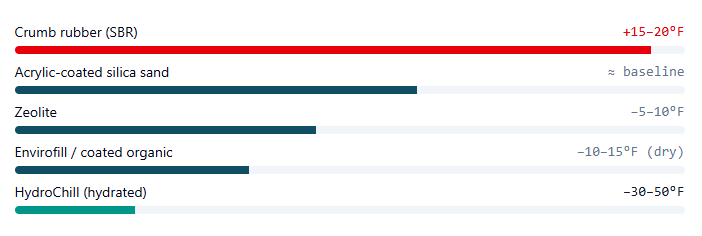
If the manufacturer cannot tell you the infill spec on the line item, walk away. Infill is not an upcharge. It is the product.
05. Backing and drainage rate
06. UV warranty — read the fine print
07. Site conditions and reflected heat
07. Cooling systems and post-install options
What 'cool turf' actually means in product terms
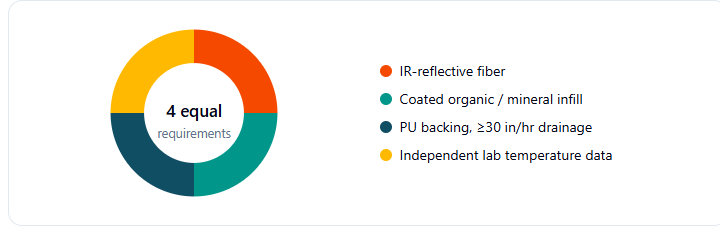
When a vendor says “cool artificial grass” or “artificial turf that doesn’t get hot,” they should be able to give you all four of the following on a single spec sheet. Miss one and the claim is marketing.
Field-tested combinations that work
Based on installs across Phoenix, Austin, and inland Southern California, the following stacks consistently measure 20–35°F cooler than a standard 80 oz polyethylene + crumb rubber baseline at 2 PM in July. These are the configurations I specify by default for any project above the 32nd parallel.
| System | Fiber | Infill | Backing | Δ vs baseline |
|---|---|---|---|---|
| Standard 80 oz PE + crumb rubber | Standard PE | SBR rubber | Latex | Baseline |
| IR-reflective C-shape + Envirofill 16/30 | IR-reflective PE | Envirofill 2 lb/sf | Polyurethane | −20°F |
| S-shape dual-tone + zeolite + coated sand | Stem-stiff PE | Zeolite + AC sand | Polyurethane | −25°F |
| Nylon-PE blend + HydroChill (irrigated 2x/wk) | Nylon blend | HydroChill sand | Polyurethane | −35°F |
Setting client expectations the right way
Heat resistant artificial turf is cooler, not cool. Even the best system on the market will be warmer than natural grass because grass transpires and turf does not. Most callbacks come from a mismatch between sales promise and physical reality, not the product itself.
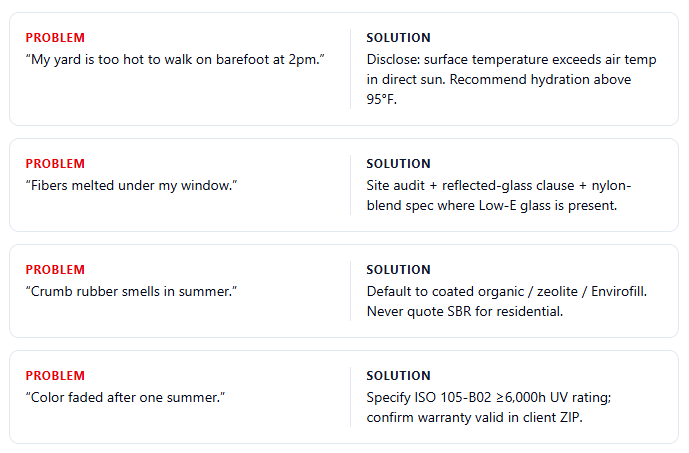
Put this paragraph in your contract — it eliminates roughly 80% of post-install heat complaints in my experience:
Synthetic turf surface temperatures will exceed ambient air temperature in direct sun. Selected product is engineered to reduce surface temperature by approximately X°F vs. standard polyethylene turf under matched conditions. Hydration before barefoot use is recommended on days exceeding 95°F.
Quick-reference buyer's checklist
Print this. Take it to your supplier meeting. If they cannot answer “yes” with documentation to every line, you do not have a heat resistant turf, you have a brochure.
Stop guessing. Specify turf that survives a Texas summer.
The best artificial grass for hot climates is not the one with the highest face weight or the longest warranty banner. It is the one whose spec sheet survives this checklist. Specify it correctly the first time and your phone stops ringing in August for the right reason: referrals, not complaints.
If your project sits anywhere between Dallas, Fort Worth, Austin, San Antonio, or Houston, you are not designing for a mild coastal climate. You are designing for 100°F+ air, brutal UV load, and clients who will walk barefoot on day one and call you on day two. That is exactly the environment Texas Tuff builds for, with IR-reflective, cool-yarn turf systems engineered and installed across Texas.
FAQ About Heat Resistant Artificial Turf
Does artificial turf get hot even with heat resistant fiber?
How much does heat resistant turf cost compared to standard turf?
Expect a 15 to 30% premium on the product cost for properly specified heat resistant artificial turf with coated infill. On a typical 500 sq ft residential install, that translates to roughly $400 to $900 more in material cost. For pool surrounds, pet areas, and play zones in hot climates, that premium is easily justified by the client experience and reduced risk of heat-related complaints.
Is turf that doesn't get hot actually possible?
No product delivers turf that doesn’t get hot at all in direct summer sun. What is achievable is turf that doesn’t get dangerously hot, surfaces in the 100°F to 115°F range rather than 170°F to 185°F. That difference is the gap between a surface that can be used with caution and one that causes immediate pain on contact. Shade, cooling infill, and IR-reflective fiber together close most of that gap.
Does artificial turf get hot in moderate climates too?
Yes, though less severely. Even in the Pacific Northwest or northern states, artificial turf in direct afternoon sun on a 85°F day can reach 130°F to 145°F surface temperature. The duration of uncomfortable heat is shorter, but the risk is still real for barefoot users. Zeolite infill and a lighter blade color are cost-effective heat mitigation steps for installs outside the extreme heat zones.
Send your site conditions (sun exposure, reflected glare, pets, kids, pool deck, pet runs) and the Texas Tuff team will recommend the exact yarn, infill, and cooling stack that holds up under Texas sun, with a written surface-temperature expectation in your proposal.