

Most artificial grass installations fail not because of the turf itself, but because of weak design decisions made before the first roll is laid. These 12 artificial grass backyard ideas cut through the noise and focus on what actually holds up in real projects. No filler. Just what works.
Why Design Intent Matters More Than Product Specs
Texas Tuff works with homeowners to design and install artificial grass systems that fit the space, the budget, and the lifestyle. A premium pile height doesn’t save a poorly planned layout.
The designs that fail are the ones where the product choice was made based on price or aesthetics alone, without accounting for the actual use conditions. A difference in turf grade rarely matters as much as a poorly prepared base or an inadequately rated drainage system.
Every one of the artificial grass backyard ideas below follows the same underlying logic: specify the product to match the application, prepare the substrate properly, and plan the drainage before anything goes in the ground.
The clients who end up dissatisfied with artificial grass almost always received an install where the design phase was rushed. Use the 12 concepts below as a structured briefing checklist — the more context you collect upfront, the fewer surprises on install day.
12 Artificial Grass Backyard Ideas Worth Considering
Artificial grass is a popular low-maintenance choice, but the best backyard designs use it as more than just a lawn replacement. When combined with hardscape, planting beds, and functional zones, turf can create a more structured, durable, and visually balanced outdoor space instead of a flat, uniform yard.
Below are expanded ideas to help you build out a more structured, usable, and visually interesting artificial grass backyard layout.
01. Zoned Lawn + Hardscape Blend
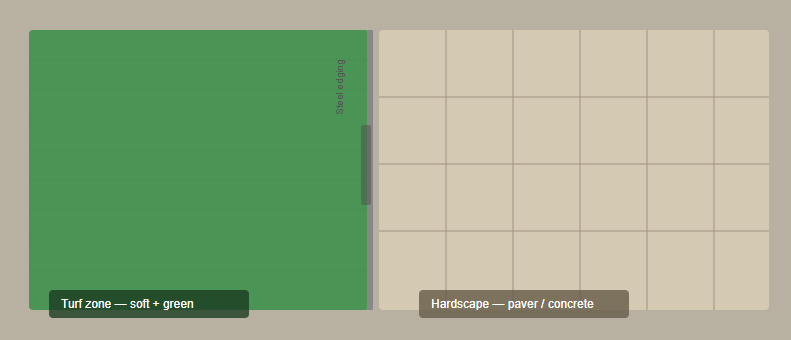
One of the most versatile artificial grass backyard ideas is combining turf panels with hardscape elements such as concrete strips, stepping stones, or porcelain pavers. Instead of wall-to-wall grass, you create defined zones that serve different functions. The result looks intentional, not like a compromise.
The key is to plan the junction lines before installation. Invisible edging profiles, aluminium or bender board, keep the turf edge clean and prevent lifting over time. Aim for straight or gently curved transitions. Complex shapes increase waste and labor cost.
Use a minimum 40mm base depth (crushed aggregate + sand) under the turf zone, even if the hardscape sections are thinner. Differential settling creates visible height mismatches within 12–18 months on poorly prepared sites.
Natural stone borders used as edging around turf areas frame the green surface and prevent edges from lifting or fraying. Irregular flagstone gives a garden-style look; cut concrete or porcelain gives a cleaner, more contemporary result.
02. Pet-Dedicated Turf Zone
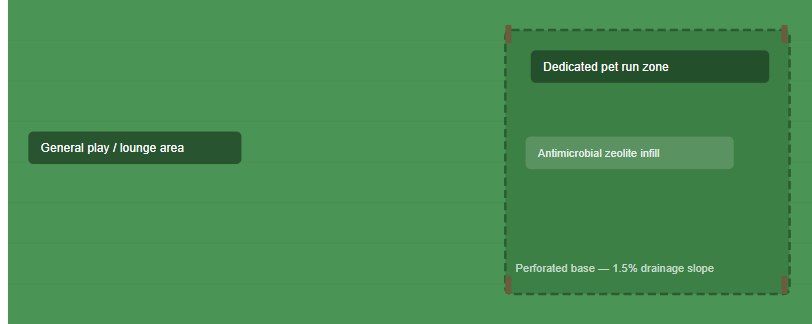
Pet use is one of the top reasons clients choose artificial grass, and one of the top reasons it fails when done wrong. A dedicated pet turf zone needs more than just a random section of grass. It needs a drainage gradient (minimum 1.5% slope), an antimicrobial infill such as zeolite or silica-coated sand, and perimeter access for hosing down.
Separate the pet zone from the primary aesthetic lawn with a hard edge and a subtle grade drop. This directs liquids away from entertaining areas and makes the maintenance zone obvious during cleanup.
The main backyard area can use a softer, more aesthetically focused turf product while the pet zone uses a more durable, easy-to-clean variety with higher drainage capacity.
Solid waste should be removed promptly and the area rinsed with water regularly. A pet-specific enzymatic cleaner applied occasionally controls odors. Most quality pet turf products are designed to handle this with minimal effort.
03. Low-Maintenance Kid Play Area
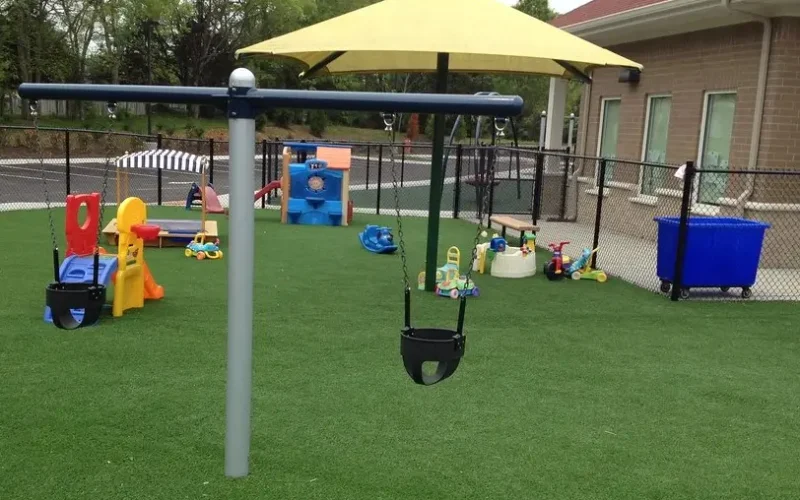
Artificial grass backyard ideas for families often focus on aesthetics but overlook impact attenuation. If the play area includes any structure, such as a swing set, slide, or climbing frame, you need to specify a shock pad underlay with a Critical Fall Height (CFH) rating appropriate to the structure’s height.
Turf alone does not meet fall protection standards for equipment above 600mm. A 20mm foam shock pad beneath a 35–40mm pile turf is a common combination. Always verify against EN1177 or ASTM F1292 standards depending on your market.
Children’s play areas benefit from clearly defined borders, soft edging materials that prevent tripping, and good drainage underneath so the surface dries quickly after rain. Colorful inlaid game lines or decorative elements can be added to the turf during installation using non-toxic materials.
People often mix up these terms, but in fire safety they mean different things.
According to the National Fire Protection Association (NFPA), the difference depends on the flashpoint (the temperature needed for ignition).
Artificial turf is combustible, not flammable. This means it does not catch fire easily from normal outdoor heat, but it can burn if exposed to strong heat or flames.
04. Rooftop or Balcony Turf
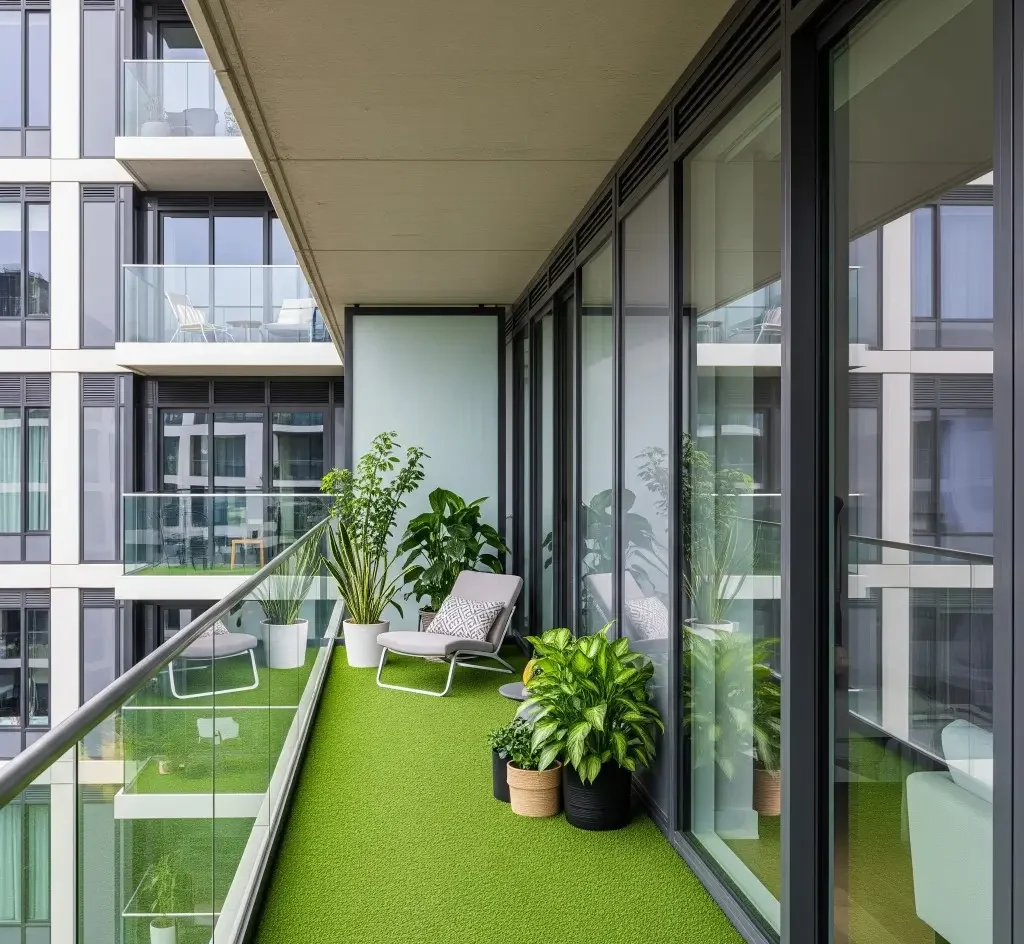
Installing turf on elevated surfaces is a growing trend in urban residential and commercial design. The constraints are different from ground-level installs: waterproofing must be confirmed intact, weight loading must be calculated (wet base weight can reach 80–120kg/m²), and modular turf tiles are often preferable to rolled turf to allow drainage access and panel replacement.
On balconies and rooftop decks, artificial grass is typically installed directly over the existing hard surface. A drainage layer or rubber underlayment is sometimes added to improve comfort underfoot and protect the roofing membrane below. The turf is cut to the exact dimensions of the space and secured at the edges to prevent lifting in wind.
Be explicit with clients about what is required before installation: waterproof membrane inspection, structural sign-off if required, and drainage outlet clearance. These steps protect the installer from liability and the client from a failed installation within the first wet season.
05. Pool Surround Grass Strip
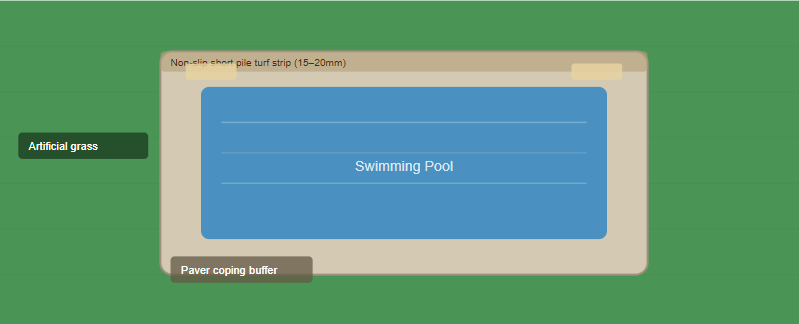
Turf around a pool replaces high-maintenance decking and eliminates the muddy footfall that tracks into the water. The product specification here is critical: use a non-directional short pile (15–20mm) that dries rapidly, resists chlorine splash, and doesn’t retain heat to uncomfortable levels in direct sun.
Pool surround installations are typically designed with a paver or concrete buffer zone immediately adjacent to the pool coping. This provides a non-slip, easy-to-hose-down surface right at the water’s edge. Artificial turf then fills the larger surrounding area, creating a soft, comfortable, visually appealing surround that stays green without any water input from the homeowner.
06. Backyard Putting Green Layout
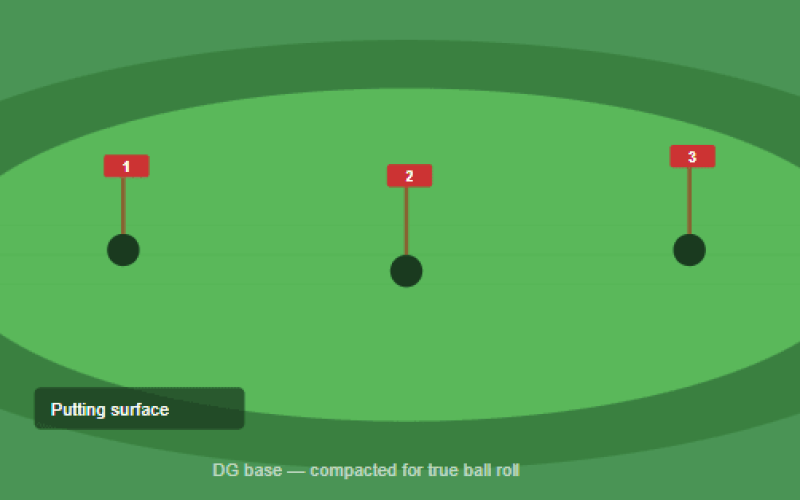
Backyard putting greens represent a premium segment of artificial grass backyard ideas. The turf spec is entirely different from lawn turf; shorter pile (10–15mm), denser blade count, and a specific infill weight to achieve realistic ball roll and break.
The subbase is also more demanding. A compacted decomposed granite base with a smooth sand layer creates the firmness needed for true ball response. A standard crushed aggregate base produces a soft feel and poor ball performance. Don’t attempt a putting green on the same base spec you would use for a lawn installation.
07. Narrow Side Yard Strip
Side passages are often neglected spaces that collect gravel, weeds, and debris. Replacing a narrow side yard with artificial grass is one of the fastest ROI artificial grass backyard ideas for homeowners; low material cost, quick installation, and immediate visual improvement.
Most side yards have limited airflow and light. Specify a turf with UV-stabilized yarns and good drainage properties. Avoid dense infill applications in enclosed spaces where humidity can cause odor retention. A lighter infill application, or a no-infill system with a sufficiently weighted turf, performs better in confined runs.
Steel bender board edging containing the turf on both sides gives a clean, professional finish and prevents the turf from shifting or lifting in a zone where foot traffic and furniture don’t hold it in place naturally.
08. Raised Lawn Platform
Elevating the turf level creates defined outdoor rooms without needing walls. A timber or composite-edged raised platform at 150–300mm above the surrounding patio level makes the lawn feel like a deliberate design feature rather than a ground covering.
This works particularly well in small courtyards where you want to create the perception of more space through level variation. The platform edge becomes a seating ledge or planting border by default — a functional detail that requires no additional furniture or built elements.
Structurally, the platform frame needs to be engineered with adequate drainage and ventilation beneath the turf surface. A solid timber box without airflow will trap moisture and degrade the backing faster than expected. Specify a slatted or perforated sub-frame with a geotextile membrane above it.
09. Slope Stabilization Turf
On inclines, natural grass is difficult to mow safely and prone to erosion in heavy rainfall. Artificial grass on slopes solves both problems, but requires mechanical fixings at the top edge and periodic ground anchors down the face.
For slopes above 20 degrees, use adhesive bonding at all seams rather than just at edges. A geotextile membrane beneath the aggregate base adds erosion protection during installation until the surface is secured. Standard stapling patterns used on flat installs are not sufficient on steeper gradients.
09. Slope Stabilization Turf
On inclines, natural grass is difficult to mow safely and prone to erosion in heavy rainfall. Artificial grass on slopes solves both problems, but requires mechanical fixings at the top edge and periodic ground anchors down the face.
For slopes above 20 degrees, use adhesive bonding at all seams rather than just at edges. A geotextile membrane beneath the aggregate base adds erosion protection during installation until the surface is secured. Standard stapling patterns used on flat installs are not sufficient on steeper gradients.
10. Mixed Planting + Turf Borders
Some of the most attractive artificial grass backyard ideas pair turf with real planting; raised beds, border shrubs, structural trees. The contrast between a curated turf surface and organic planting creates a naturalistic result that reads better than wall-to-wall synthetic grass.
In this application, turf with a slightly longer pile height (1.5 to 2 inches) tends to look more natural alongside real plants and flowers, and is soft enough for casual seating in the spaces between garden areas.
Stone or brick borders are typically used to separate turf from soil in planting beds. This edge treatment serves two functions: it keeps roots from growing into the turf base, and it creates a clean visual line that makes the landscape look intentional and well-maintained throughout the year.
11. Minimalist Courtyard Design
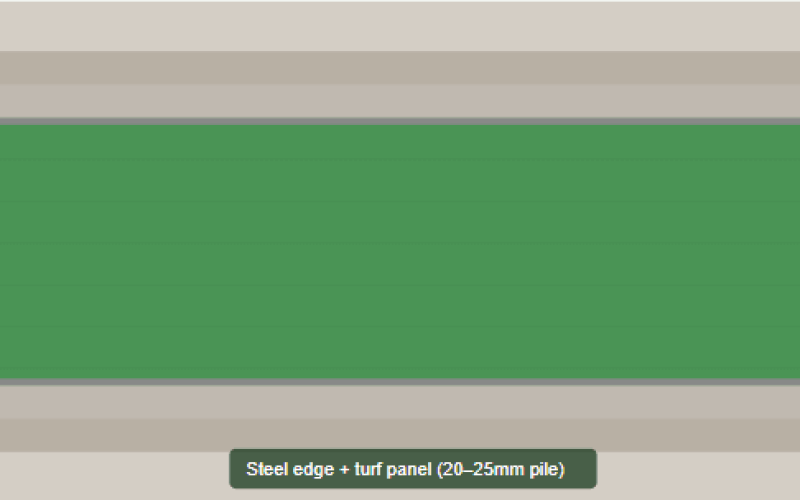
In enclosed courtyards, urban terraces, internal garden rooms, and contemporary townhouse gardens, geometric turf panels set within stone or concrete create a clean, architectural result. This style scales well on small footprints where a traditional lawn would feel disproportionate.
Keep pile height short (20–25mm) and specify a product with natural green color variation rather than a single-tone blade. Monocolor turf reads as obviously artificial in tight, well-observed spaces where people are close to the surface at standing and seated eye levels.
Vertical elements, wall-mounted planters, trellises, or green wall panels, pair well with ground-level turf panels in small spaces, creating the impression of a more layered landscape without requiring additional ground space.
12. Multi-Zone Backyard Design
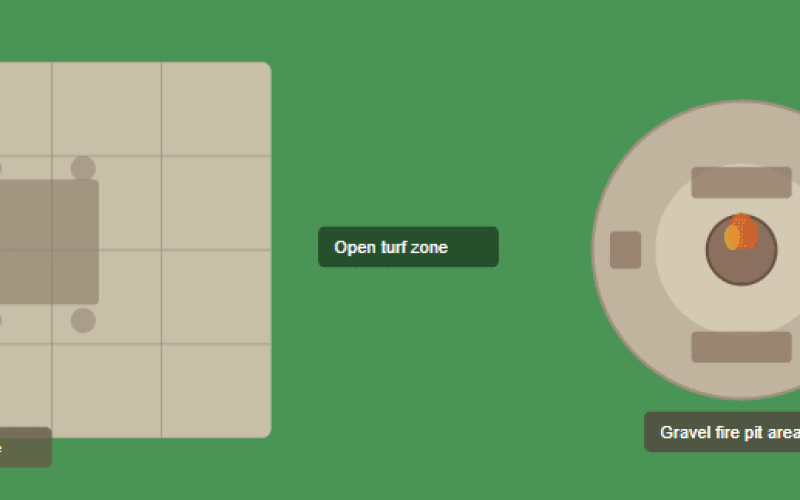
For homeowners with larger backyards and multiple competing needs, a multi-zone design allows the yard to serve different purposes simultaneously. A typical multi-zone layout includes a structured entertainment area near the house, a dedicated pet zone with its own perimeter, a children’s play section, and a quieter garden or lounge area in the furthest corner from the main activity zones.
Artificial grass serves as the primary surface material across all or most of these zones while transitions between zones are defined by changes in edging, hardscape elements, level changes, or planted borders. This makes turf selection more nuanced, different zones may benefit from different product specifications. Play areas may want more padding. Pet zones may want better drainage. Lounge areas may want a softer pile height for comfort.
| Advantages of Artificial Grass | Considerations |
|---|---|
| No mowing, watering, or fertilizing required | Higher upfront installation cost than natural grass |
| Stays green in shade, heat, and drought | Surface can become warm in direct afternoon sun |
| Durable under heavy foot traffic and pet use | Not biodegradable at end of life |
| No mud or bare patches | Requires professional installation for best results |
| Reduces outdoor water use by approximately 70% | Infill needs occasional replenishment over time |
| Lasts 15 to 20 years with basic care | Pet odor management requires routine rinsing |
| Can increase home resale value by an average of 7% |
Choosing the Right Turf Product for Your Design
Not all artificial grass products are the same, and the right choice depends on the specific application. These categories represent the main specification decision points most homeowners and contractors face when selecting a product.
Pile Height
Shorter piles (10–15mm) for putting greens and high-traffic sport zones. Medium piles (30–45mm) for general backyard use. Longer piles (50–65mm) for lush aesthetic areas with lower foot traffic.
Blade Shape
Flat blades wear faster but cost less. C-curved and W-shaped blades stand upright better and resist matting under foot traffic. Thatch layers between blades add realism and improve the overall look.
Infill Type
Silica sand is the standard general-use infill. Antimicrobial zeolite or coated sand for pet areas. Organic infills (cork, coconut fiber) preferred in children’s play zones by many installers and parents.
Drainage Rate
Pet areas and pool surrounds need the highest drainage rates. Look for products rated above 30 inches per hour for high-rainfall climates or sealed pet zones. Verify drainage rate as a specification, not a marketing claim.
UV Stability
All quality products carry UV stabilization. In intense summer sun, confirm the product carries a warranty that specifically covers color stability over the expected lifespan, not just structural warranty.
Face Weight
Measured in ounces per square yard. Higher face weight means more fiber and a denser, more realistic product. For most residential applications, 50 to 90 oz products cover the practical range of applications.
Always specify pile height relative to use, confirm drainage capacity in litres per m² per hour (25–30 l/m²/h minimum for residential use in wet climates), and run seams parallel to the main viewing angle, never perpendicular. These three decisions alone account for most of the difference between installs that hold up and ones that don’t.
Common Questions About Artificial Grass Backyards
How long does artificial grass last in hot climates like Texas?
Quality artificial grass products are typically warranted for 8 to 15 years, and many installations remain in good condition for 15 to 20 years with basic maintenance. In regions with intense sun exposure, selecting a product with a specific UV stabilization warranty matters more than pile height alone. Nylon tends to outperform polyethylene and polypropylene in extremely hot or high-traffic conditions. Texas Tuff products are tested and rated for the heat conditions common across Texas and the Southwest.
How much does artificial turf cost for a backyard?
Does artificial grass get too hot to use in summer?
Can artificial grass be installed over concrete?
Yes. Artificial turf can be installed directly over concrete in most cases. A thin foam or rubber underlayment is typically added between the concrete and the turf to improve cushioning and drainage. If the concrete has drainage slope built in, this works well. If the concrete is level with no drainage slope, additional drainage provisions may be needed to prevent water from pooling under the turf over time.
What maintenance does artificial grass actually require?
Maintenance is minimal. Leaves and debris should be removed periodically with a leaf blower or stiff brush. The surface should be rinsed occasionally to remove dust, and in pet areas, to manage odor. Brushing the turf fibers with a stiff-bristle broom every few months keeps blades upright and prevents matting. Infill may need occasional top-up over the years as it settles in high-traffic areas. Beyond these tasks, the surface essentially manages itself.
Will my HOA approve artificial grass?
This varies by location and HOA guidelines. Many homeowner associations now explicitly permit quality artificial turf, and some municipalities are required by law to allow it given water conservation mandates. Before installation, review HOA guidelines in writing and, if unclear, request written confirmation from your HOA board. Providing product samples and installed reference photos can often move an approval forward when there is initial resistance.
How is artificial grass installed and how long does it take?
Professional installation begins with removing the existing surface, excavating 3 to 4 inches of soil, compacting and grading a crushed aggregate base, then laying and securing the turf with staples or adhesive at seams and edges. Infill is spread and worked into the turf fibers as a final step. A typical residential backyard installation takes one to three days depending on size, site complexity, and crew size. More technical installs; slopes, elevated platforms, putting greens, add time accordingly.
Texas Tuff works with homeowners to design and install artificial grass systems that fit the space, the budget, and the lifestyle.