
Quick answer
Is turf bad for the environment? Not categorically. Synthetic turf wins on water, fertilizer, pesticide, and mowing emissions. It loses on surface heat, microplastic shedding, and end-of-life recycling. The honest answer is that an eco friendly turf grass system, installed correctly, is a meaningful net positive in hot and drought-stressed regions like Texas. A cheap turf with crumb rubber infill and a mixed backing is not.
Who this guide is for
This is written for homeowners who actually have to make the call. We get the same questions on most estimates: am I doing something bad by putting turf in? What does eco friendly artificial grass really mean once you strip the marketing? Is recycled synthetic grass a real thing or a sticker on a box?
We answer those the way we would on a site walk, with numbers, not slogans. If you want a single sentence: the environmental answer depends on your climate, your current lawn habits, and the specific product you choose, in that order.
Throughout this article we use the same checklist we run for paying clients in Dallas Fort-Worth Metroplex. The climate framing is Texan, but the spec rules apply anywhere with hot summers, water restrictions, or a serious sustainability goal.
Is Artificial Turf Bad for the Environment?
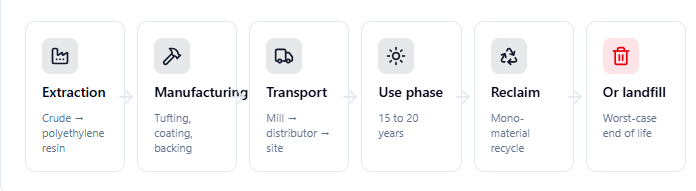
Most arguments about whether turf is bad for the environment collapse because they only look at one stage. A fair answer looks at the full lifecycle: raw material extraction, manufacturing, transport, installation, the 15 to 20 year use phase, and disposal.
Natural lawns dominate the use-phase burden through water, fuel, and chemicals. Synthetic turf dominates the manufacturing and end-of-life burden. Whichever phase is largest in your specific situation usually decides the answer.
For a Texas yard watered three to four months a year, the use phase is enormous. For a Pacific Northwest yard that gets rain ten months a year and a manual mower, the use phase is tiny and the embedded plastic of synthetic turf looms larger. Same product, different verdict, because the inputs avoided are different.
Why Artificial Grass Has Strong Environmental Upsides
The strongest environmental case for artificial grass eco systems is the inputs you stop pouring on the ground. The EPA estimates that outdoor watering accounts for roughly 30% of residential water use nationwide and up to 60% in arid regions.
A typical Texas lawn during a hot July is on the high end of that range. Replace it with sustainable synthetic turf and that line on the water bill effectively goes to zero.
The chemical story is similar. A natural lawn that looks magazine green almost always relies on synthetic fertilizer, pre-emergent herbicide, and seasonal pesticide. None of that runs off a turf yard, because none of it is applied.
Add the gasoline, two-stroke emissions, and noise of weekly mowing and edging, and the operational footprint of an eco friendly synthetic grass install is dramatically lower than a maintained lawn over a 15 to 20 year horizon.
Heat: the legitimate downside (And How It Can Be Reduced)
The strongest environmental case for artificial grass eco systems is the inputs you stop pouring on the ground. The EPA estimates that outdoor watering accounts for roughly 30% of residential water use nationwide and up to 60% in arid regions.
A typical Texas lawn during a hot July is on the high end of that range. Replace it with sustainable synthetic turf and that line on the water bill effectively goes to zero.
The chemical story is similar. A natural lawn that looks magazine green almost always relies on synthetic fertilizer, pre-emergent herbicide, and seasonal pesticide. None of that runs off a turf yard, because none of it is applied.
Add the gasoline, two-stroke emissions, and noise of weekly mowing and edging, and the operational footprint of an eco friendly synthetic grass install is dramatically lower than a maintained lawn over a 15 to 20 year horizon.
Microplastics and Infill in Artificial Turf
Synthetic turf is plastic. Over years of UV exposure and foot traffic, fibers shed micro and nanoparticles, and infill can migrate. The biggest historical concern was crumb rubber from recycled tires used as infill on athletic fields.
EPA and CDC ran a multi-year federal research program on tire crumb and published findings showing limited but not zero exposure pathways.
The practical answer for residential yards is to avoid the controversy entirely. Specify organic infill, cork, walnut shell, coconut blend, or coated silica. Pair it with a permeable backing over a clean crushed-stone base and a slope away from the house. Done that way, an environmentally friendly artificial turf system keeps storm water moving into soil and keeps the questionable chemistry off the spec sheet.
Can Artificial Turf Actually Be Recycled?
The honest weak point of the industry is end of life. Older turf systems mixed nylon fiber, polyethylene thatch, and polyurethane backing. That sandwich is hard to separate, and most of it has historically gone to landfill.
The newer answer is mono-material polyethylene turf, where every layer is the same polymer family and a polymer recycler can grind, melt, and reuse it.
Recycled synthetic grass is real but still small. A handful of European and US recyclers process old fields back into raw polyethylene pellets used in piping, pallets, and other plastic goods.
The credible signal for a homeowner is a written takeback program from the manufacturer or installer, not a generic green label. Ask for it in writing before signing.
The eco friendly turf checklist we use
When a client asks us to specify the most eco friendly artificial grass we will install, this is the short list we run through. Anything missing knocks the product off the shortlist.
01. 100% polyethylene mono-material
A turf system whose fiber, thatch, and backing are all polyethylene can be reground and reprocessed by polymer recyclers. Mixed nylon plus polyurethane backing is much harder to recycle.
02. Written takeback or recycling plan
03. Permeable backing and clean base
04. Organic or coated infill
05. IR-reflective fibers, lighter color blend
Reflective pigment and lighter olive blends drop peak surface temperature, which reduces the heat-island contribution of a turf yard.
06. Documented UV warranty (8+ years)
Side by side: natural lawn vs. eco friendly artificial turf
Here’s a direct comparison of how natural grass and eco friendly artificial turf perform across key environmental factors. This helps show where each system wins and where the tradeoffs actually matter in real-world use.
| Factor | Natural Lawn | Eco-Friendly Artificial Turf | Lower Impact |
|---|---|---|---|
| Water use | Heavy, recurring irrigation needed | Near zero after installation | Synthetic |
| Fertilizer & pesticide | Regular chemical applications | None required | Synthetic |
| Mower & blower emissions | Weekly fuel or electricity use | None | Synthetic |
| Surface temperature | Close to ambient | Significantly hotter in direct sun | Natural |
| Carbon sequestration | Ongoing soil absorption | None | Natural |
| Habitat / pollinators | Limited (monoculture lawn) | None | Natural |
| End-of-life waste | Biodegradable | Landfill unless recycled | Natural |
| Storm water runoff | Depends on soil quality | Depends on base & backing design | Tie |
Red Flags That a Turf Product Is Not Actually Eco-Friendly
Not all “eco” or “sustainable” turf claims are legitimate. In practice, the environmental quality of a system comes down to materials, transparency, and end-of-life handling. If these details are missing or vague, it usually signals a low-quality or misleading product.
The honest verdict
Is turf bad for the environment? On a per-yard, full-lifetime basis in a hot, drought-prone climate, a thoughtfully specified eco friendly artificial turf install is usually a net win against a chemically maintained, irrigated lawn. The water saved, the fertilizer not applied, and the gasoline not burned add up fast over 15 to 20 years.
In a cool, rainy region with a lawn that survives on rainfall alone and a homeowner who pushes a manual reel mower, the math tilts the other way. And in every region, a cheap turf with crumb rubber, mixed backing, and no recycling story is the worst of both worlds.
The right framing is not turf versus grass in the abstract. It is this turf, on this site, against this lawn, over this many years. Specify a recycled synthetic grass system with organic infill, IR-reflective fiber, a permeable backing, and a written takeback plan, and the environmental case for sustainable synthetic turf gets very strong.
How we apply this at Texas Tuff
We work in a climate where outdoor irrigation can dominate the water bill for half the year. For Texas yards we default to polyethylene mono-material turf, organic or coated cool-sand infill, IR-reflective fibers, and a drainage-first base. It is the version of artificial turf we are willing to defend on environmental grounds.
FAQ About Heat Resistant Artificial Turf
Is turf bad for the environment compared to a natural lawn?
What makes artificial turf eco friendly?
Recyclable monofilament backing, organic infill (cork, walnut, coconut), no crumb rubber, IR-reflective fibers, a takeback or recycling plan from the manufacturer, and proper drainage that protects soil and storm water.
Is recycled synthetic grass actually recycled?
Some manufacturers now offer 100% polyethylene mono-material systems that can be processed by polymer recyclers, and a small number of fields per year are reclaimed in the US. Most older turf still ends up landfilled, so the credible signal is a written takeback program.
Does artificial turf leach chemicals into soil?
EPA and CDC research on tire crumb infill found exposures to be limited but not zero. Choosing organic infill (cork, walnut, sand) avoids the question entirely and is what we install for residential yards.
Is sustainable synthetic turf worth the premium?
For homeowners staying 7+ years in a hot or drought-prone climate, yes. The water and lawn-care savings typically offset the upgrade within the first half of its 15 to 20 year lifespan.
Get expert guidance on selecting a truly sustainable artificial turf solution built for durability, drainage, and long-term environmental performance across the DFW area. Contact us today for artificial turf installation services to discuss your project and get a custom recommendation.